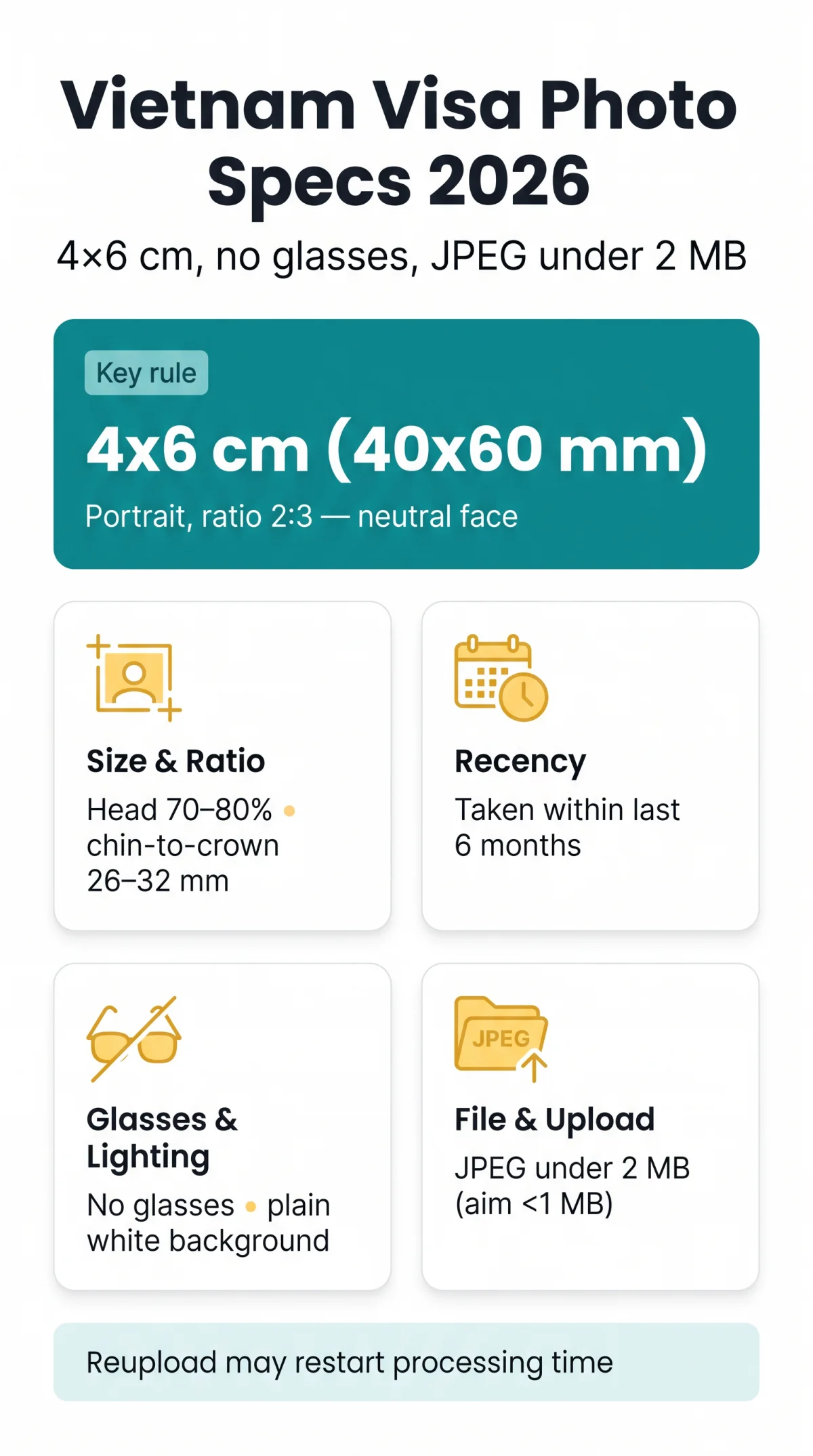
Vietnam visa photo specifications 2026 are short and firm: your portrait must be 4×6 cm (40×60 mm) in a 2:3 ratio, taken within the last six months against a plain white background, with glasses removed and no glare. Digital uploads must be JPEG under 2 MB, ideally below 1 MB. This guide walks you through the full rules and shows you how to fix a rejected photo, step by step, on the evisa.gov.vn instruction page.
This is an independent guide for UK travellers, not a government page – it doesn’t take fees or file applications on your behalf. Before you travel, double-check your dates and photo requirements on the portals linked below.
Core Photo Rules: Size, Face and Recency
The photo must measure 4×6 cm in portrait orientation – 40 mm wide, 60 mm tall, a 2:3 ratio, from the last six months.
| Requirement | Rule |
|---|---|
| Photo size | 4×6 cm (40×60 mm), ratio 2:3 |
| Recency | Taken within last 6 months |
| Expression | Neutral, mouth closed, eyes open |
| Gaze and ears | Straight at camera, both ears visible |
| Head coverage | 70 – 80% of photo height |
Stick to the 4×6 cm portrait format. Some services also list 2×2 inches, but a square crop can cut off the top of the head or the chin, so the 2:3 shape is the safer choice.
Head size and framing
Your chin-to-crown distance should measure 26 – 32 mm on the printed photo. Leave 3 – 6 mm of space between the top of your head and the edge of the frame, and keep your shoulders visible at the bottom.
White Background, Lighting and the No-Glasses Rule
The background must be plain white and evenly lit, with no shadows behind your head or shoulders. Patterned walls, visible objects or shadows get rejected. Lighting should be even across your face, with no flash glare, no red-eye and no harsh shadows under your nose or chin.
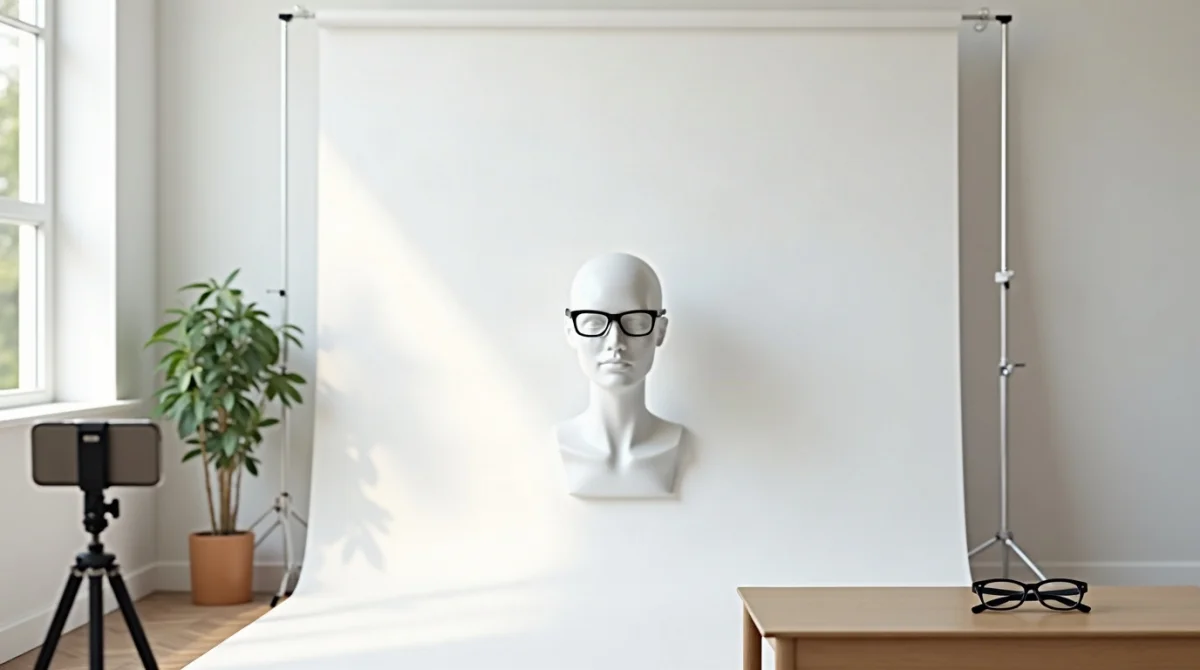
Glasses are the big one. The portal’s rules require a portrait with no glasses, so take them off before the shutter clicks. Sunglasses and tinted lenses are out as well.
Against a white wall, a dark-toned face can end up underexposed. Shoot facing a window with soft daylight and check that the facial features stay clearly visible while the background stays white.
Why anti-reflective coatings trigger rejection
The safe move: remove the glasses. Your visa photo doesn’t have to match your passport photo, so a photo without glasses is fine even if you wear them in your passport.
Applying from the UK: 35×45 mm vs 4×6 cm
A standard UK passport photo has the wrong proportions for Vietnam – 35×45 mm (a 7:9 ratio) against 40×60 mm (a 2:3 ratio) – so recrop it before uploading.
| UK passport photo | Vietnam visa photo | |
|---|---|---|
| Size | 35×45 mm | 40×60 mm |
| Aspect ratio | 7:9 | 2:3 |
| Background | Plain light | Plain white |
| Use for Vietnam | Embassy counter only | Online and prints |
Got a digital code from a UK photo booth? Recrop the image to 2:3 first, keeping the head at 70 – 80% of the frame height. One exception: the Embassy of Vietnam in London accepts 35×45 mm prints for physical counter submissions – but not for the online e-visa.
Digital Uploads and Phone Photos
Upload JPEG only – no PNG, no HEIC from an iPhone, no PDF. Convert the file first. Keep it under 1 MB (up to 1024 KB) where you can; the portal’s limit is 2 MB. Resolution should be at least 350×350 px, ideally 472×709 px at 300 DPI or 945×1417 px at 600 DPI.
Skip beauty filters, portrait-mode blur and arm’s-length selfies. The system also checks your passport bio-data page scan separately: it must show the full MRZ lines (the row of <<<< characters), be a JPG under 2 MB, with no glare or cropped corners.
How to take the photo at home with your phone
Use the rear camera, not the front one. The front lens is wider and exaggerates whatever is closest to it, so the rear camera gives truer facial proportions. Stand 1 – 2 metres away, with the phone at eye level on a tripod or held by someone else. Frame yourself from the chest up with space on the sides, so you can crop to 2:3 later.
Common Rejection Causes and Their Fixes
Rejections usually come down to a few recurring problems, and each has a quick fix:
- Background not white – retake against a plain white wall or paper.
- Glare or reflections – remove glasses, switch off the flash, dab oily skin.
- Face too small – recrop so the head fills 70 – 80% of the height.
- Photo too blurry – retake at 300 DPI with steady light.
Watch the upload fields, too. Putting your portrait in the passport slot (or the reverse) means the files have to be replaced, which drags out approval, and heavy editing gets flagged.
The “captured from another source” error explained
The portal runs facial recognition and OCR on both uploads, comparing your portrait with your passport scan. Crop your portrait straight out of your passport bio page and you’ll get a message like “Match: 74.68% Portrait photo was captured from another source”. The fix is a fresh smartphone photo against a white wall – no studio needed.
Step-by-step: re-uploading a rejected photo
Open the search page
Go to the application search page at evisa.gov.vn/e-visa/search.
Enter your details
Registration Code, date of birth and contact email.
Upload your new JPEG
Place it in the portrait section.
Check and save
Verify the format and size, then save the form.
One timing caveat: resubmitting may restart the processing clock. There’s no official confirmation of this, so if you’re flying in the next few days, get the photo right the first time.
Prints, Headwear, Children and Other Requirements
Online applications need one digital portrait plus the passport scan. Visa on Arrival and embassy filings are different: an embassy submission needs at least one printed colour photo, and Visa on Arrival two identical ones, 4×6 cm on photographic paper. Forgot your prints? Photo counters in Vietnamese airport arrival halls charge around 2 USD per set, though you may have to queue.
For clothing, wear dark solid colours that contrast with the white background. Avoid white clothing, which blends into the background; uniforms, camouflage or military wear and tank tops are not accepted. Religious head coverings like a hijab or turban are allowed as long as your full facial oval stays visible, with no shadows.
Travelling with a baby? Photograph them alone, lying on a white sheet or in a covered seat – no hands, toys, bottles or pacifiers in frame. A baby’s eyes should be open if at all possible, and children under ten can have a head ratio of 50 – 80% (22 – 36 mm). Piercings and tattoos pass if they don’t glare or hide facial landmarks.
Around the photo, remember the rest of the file: check the passport-validity rule for your route – the Embassy of Vietnam in London requires a passport valid for at least one month beyond your planned exit from Viet Nam. Current e-visa fees are listed on evisa.gov.vn, and children with their own passports need separate applications.
Where to Apply and How to Spot Fake Sites
File through the genuine immigration portal at evisa.gov.vn – the real domain ends in gov.vn, and the current fee is shown on the portal before payment. Private agencies charge markups for verification packages you may not need. If a site copies the state layout, adds a different domain ending, or promises guaranteed approval, close the tab and go to the gov.vn address directly.
Frequently Asked Questions (FAQ)
What are the exact Vietnam visa photo specifications 2026?
The photo must be 4×6 cm (40×60 mm) in a 2:3 portrait ratio, taken within the last six months against pure white. Your face covers 70 – 80% of the frame, chin-to-crown 26 – 32 mm, with a neutral expression. Digital uploads must be JPEG under 2 MB.
Can I wear prescription glasses in my Vietnam visa photo?
No – the portal’s rules require a portrait with no glasses. Your visa photo doesn’t need to match your passport photo, so a glasses-free shot is fine even if you wear them in your passport.
Can I use a standard UK passport photo for my Vietnam visa?
Only for a physical counter filing at the Embassy of Vietnam in London, which accepts 35×45 mm. For the online portal, no: the 7:9 proportions don’t fit the 2:3 frame, so recrop to 2:3 first, keeping your head at 70 – 80% of the frame height.
Why was my photo rejected with “portrait photo was captured from another source”?
The system compares your portrait with your passport scan using facial recognition. If you cropped the portrait from the bio-data page, it flags the match – often with a percentage like 74.68%. Take a fresh photo against a white wall instead.
What file format and size does the Vietnam e-visa portal accept?
JPG or JPEG only, under 2 MB (2048 KB) – the recommended target is below 1 MB. Minimum resolution is 350×350 px; 472×709 px at 300 DPI works best. Convert HEIC, PNG or PDF files to JPEG first.
How do I fix a rejected Vietnam visa photo and re-upload it?
Open the application search page at evisa.gov.vn/e-visa/search and enter your Registration Code (electronic profile ID), date of birth and contact email, then upload a compliant JPEG in the portrait field and save.
Can I take my Vietnam visa photo at home with a smartphone?
Yes. Use the rear camera from 1 – 2 metres away at eye level – the front lens distorts your face. Face a window for soft daylight, skip portrait mode and filters, and frame yourself from the chest up so you can crop to 2:3 later.
Does re-uploading a photo reset the visa processing time?
It may. The portal doesn’t confirm whether an amendment restarts processing, so treat the timeline as starting again from the new upload. If you’re flying in the next few days, get the photo right on the first upload.
Sources and Further Reading
- evisa.gov.vn/instruction – the e-visa portal’s own photo, file and upload instructions.
- vietnamembassy.org.uk visa rules – general visa rules from the Embassy of Vietnam in London, including 35×45 mm acceptance for counter filings.
Rules can change, so confirm current requirements on the portal before you travel.