
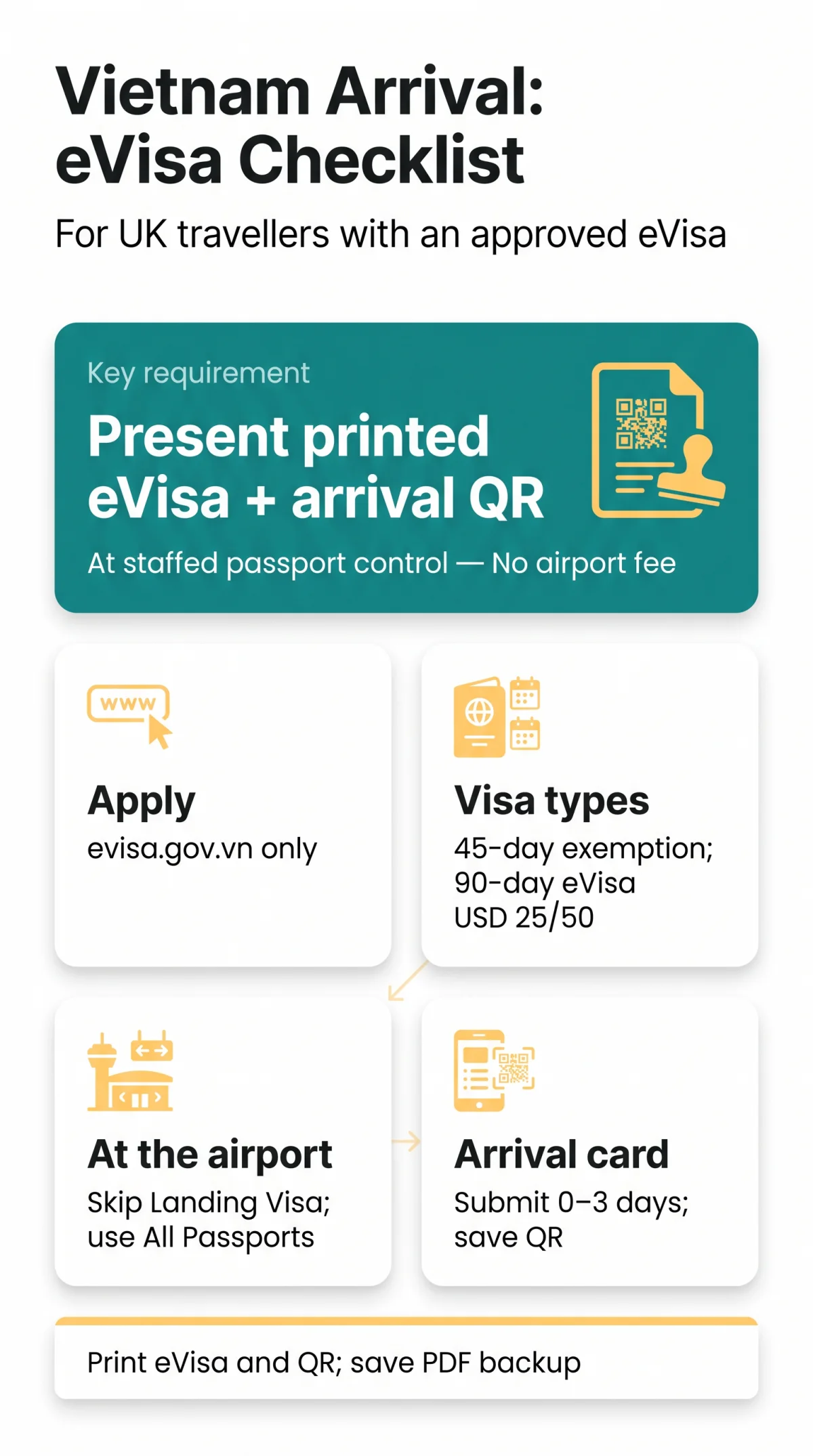
To complete the immigration procedure on arrival in Vietnam, skip the landing visa desk and go straight to the staffed passport control lanes. Present your British passport with a printed copy of your approved Vietnam Electronic Visa (eVisa) plus your digital arrival card QR code. Officers stamp your passport directly, so there is no fee to pay at the airport.
This guide is for UK travellers who already hold an eVisa and want to get from the check-in desk at Heathrow to the arrivals hall in Hanoi or Ho Chi Minh City without a hitch. It’s an independent travel-information guide, not a government site, and it doesn’t take fees or submit applications on your behalf. You can check every rule and apply directly at evisa.gov.vn before you fly.
Entry Pathways for UK Travellers: 45-Day Exemption or 90-Day eVisa
British Citizen passport holders can enter Vietnam visa-free for up to 45 consecutive days under a unilateral exemption. Check the stamp gives you 45 days from your arrival date, because immigration will not change it once you leave the border. If you’re staying longer, or you want to come and go, you need an eVisa valid for up to 90 days, single or multiple entry.
- 45-day exemption: free, no application; the stamped leave-by date is not changed once you leave the border.
- 90-day eVisa: USD 25 single entry or USD 50 multiple entry, paid online when you apply.
- Where to apply: only the national portal, evisa.gov.vn.
Some commercial sites charge a service fee on top for filing on your behalf, and some imitate the look of the national portal; the fees above are what the national system charges.
eVisa vs Visa on Arrival: The Counter Difference
These two products lead to different queues, and mixing them up costs you time. A Visa on Arrival (VOA) is based on a pre-approval letter; at the airport you queue at the Landing Visa counter with that letter, a completed NA1 form, two passport photos (4×6 cm, white background), and the stamping fee in cash: USD 25 single or USD 50 multiple entry.
eVisa holders do none of that. You don’t fill in an NA1 form, you don’t queue at the VOA counter, and you don’t pay anything at the airport, because the fee was settled online when you applied.
Documents Inspected During the Immigration Procedure on Arrival in Vietnam
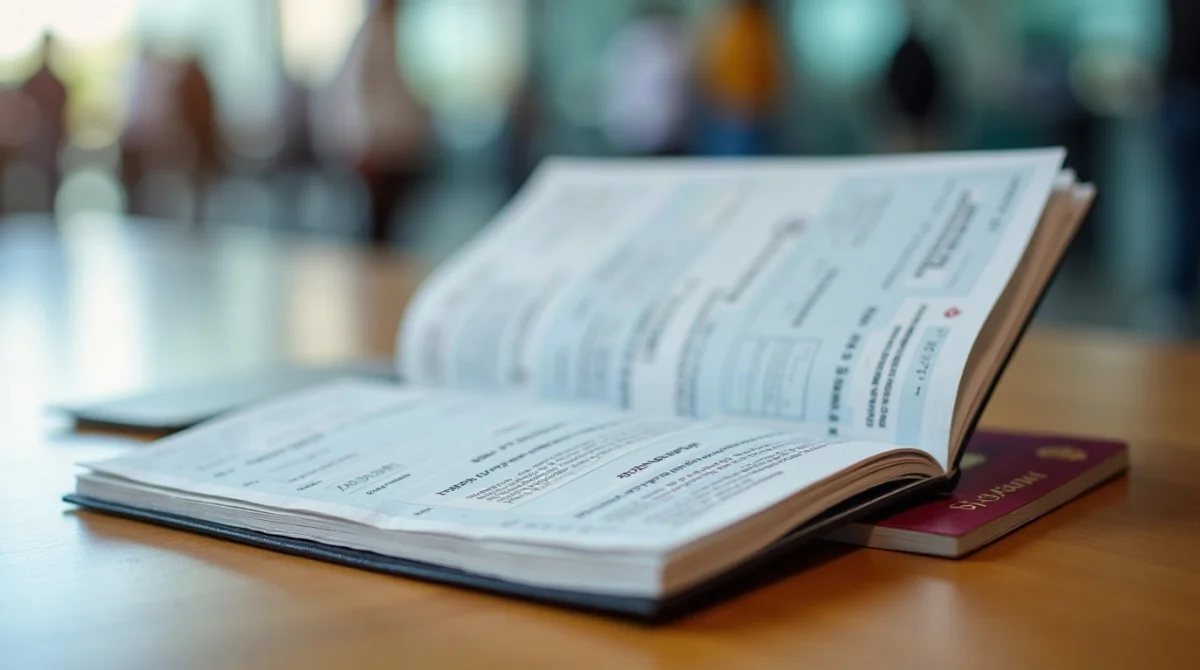
Border officers check your passport and your printed eVisa; proof of onward travel may also be requested. Check with your travel provider that your documents meet the requirements before you leave home.
| What they check | Minimum requirement | If it fails |
|---|---|---|
| Passport validity | Six months beyond your arrival date | Entry may be refused; check with your airline before departure |
| Blank visa pages | Two blank pages | Entry may be refused; check with your airline before departure |
| Passport condition | No tears, water damage, or peeling laminate | Entry refused at the border |
| Onward ticket | Proof of return or onward travel | Entry may be refused; check with your airline before departure |
| eVisa format | Printed hard copy | A printed copy is often required at check-in and at the border |
Passport damage is the silent one: British nationals have been denied entry to and exit from Vietnam because of damaged passports.
Why You Should Carry the eVisa on Paper
Airlines and Vietnamese border officers often still want the eVisa on paper, so a PDF on your phone may not be accepted. Print the eVisa before you fly and keep the digital file as backup.
Your name on the eVisa must match your passport exactly, middle names included; otherwise the airline may refuse to carry you.
The Digital Pre-Arrival Declaration: Online Arrival Card
Before you land, you complete the digital arrival card at prearrival.immigration.gov.vn. The filing window is short: you may submit it upon arrival or not more than three days before arrival.
Gather your documents
Passport, flight number, and eVisa number
Enter your accommodation
Your first hotel address in Vietnam
Submit the form
Wait for the confirmation QR code by email
Save your QR code
Screenshot on your phone and a printed backup copy
The QR code is what immigration officers scan. Terminal Wi-Fi after landing can be patchy and batteries die, so don’t rely on loading the email at the desk. The card is in use at Hanoi (HAN), Ho Chi Minh City (SGN), Da Nang (DAD), Cam Ranh (CXR), and Phu Quoc (PQC). If you land without it, you can still complete it on arrival via the QR code or a paper form at the airport, but that costs you time in the queue.
Immigration Procedure on Arrival in Vietnam: Airport Walkthrough
From the aerobridge to the arrivals hall, here’s the path. The step that trips people up is the queue choice, so read step two twice.
Follow the signs
Head for “Immigration / Passport Control” signs from the gate.
Walk past the Landing Visa zone
Go by the “Visa on Arrival / Landing Visa” area without stopping.
Join the manual desks
Queue at the “All Passports / Foreign Passengers” staffed desks.
Present your documents
Hand over your passport and boarding pass with the eVisa printout, QR code ready.
Answer routine questions
The officer may ask about your stay length or return ticket.
Show your face and collect your passport
Remove any hat, mask or sunglasses so the officer can verify your face, then collect your stamped passport.
Do not queue here: the Landing Visa counter is for VOA holders only. If you join it with an eVisa, you’ll queue for nothing and be sent back to the passport control lanes.
The same goes for the automated gates. Automated arrival gates are currently open only to Vietnamese passport holders, so as a foreign eVisa holder you must use a staffed manual desk.
Inspecting Your Entry Stamp Before You Leave the Desk
Before you step away, spend 30 seconds on the stamp. Check the arrival date, then check the permitted leave-by date against your eVisa validity.
If the date is wrong, raise it politely before you leave the border control area, because immigration will not change the date afterwards. A wrong date can mean an overstay fine, questioning, or problems at departure. See gov.uk for the full entry requirements for Vietnam.
Port Mismatch and Data Errors: Fixing Problems Before You Fly
Your eVisa is tied to the border checkpoints you selected when applying, and you must enter and exit through those exact ports. If you arrive at a checkpoint that is not on your eVisa, you will not be allowed to enter.
| Error | What happens | How to fix it before departure |
|---|---|---|
| Wrong port of entry | Entry refused on arrival | Apply for a new eVisa with the correct port |
| First and last name reversed | Airline may refuse to carry you | Apply for a new eVisa with correct name order |
| Middle name missing | Airline may refuse to carry you | Apply for a new eVisa matching the passport |
| Passport number typo | Airline may refuse to carry you | Apply for a new eVisa with the correct passport number |
Because the details are checked character by character, a single wrong letter is enough. If you spot an error days before flying, applying for a new eVisa with the correct details is usually the only route.
One caveat on help from home: British consular staff can advise you, but they cannot change a Vietnamese immigration decision, and the British Embassy will not assist with visa extensions. Fix the document, not the argument.
Baggage, Customs and Domestic Connections After Border Control
Once you’re through passport control, collect your bags and pick a customs channel. Green means “nothing to declare”; Red means you have something to declare. Here’s what triggers the Red Channel:
- Cash over USD 5,000 or 15,000,000 VND.
- Prescription medication with a total import value over USD 100; keep it in hand luggage with the prescription.
- Alcohol beyond the allowance: 1.5 L of spirits over 22% ABV, 2.0 L under 22%, or 3.0 L of beer (18+).
- Tobacco beyond 200 cigarettes, 250 g of shredded tobacco, or 20 cigars (18+).
After customs, your hotel handles one formality for you: the accommodation provider registers your temporary residence with the local police; you just hand over your passport at check-in.
Transfers at Hanoi and Ho Chi Minh City Airports
Flying London to Hanoi or Saigon and onwards to Da Nang or Phu Quoc? You clear immigration at your first port of entry, not at the final destination. Collect all checked luggage from the international carousel, clear customs, then transfer to the domestic terminal and check your bags in again.
Allow plenty of time between flights, as immigration queues eat into tight connections.
Frequently Asked Questions (FAQ)
Can I show my Vietnam eVisa on my smartphone at airline check-in?
Carry a printed copy. Airlines and Vietnamese border officers often ask for the eVisa on paper, and a version shown only on a phone screen may not be accepted, so print it before you fly and keep the PDF as backup.
Which queue should I join at the airport if I already have an eVisa?
Walk past the Visa on Arrival / Landing Visa counter, which serves only travellers holding a pre-approval letter, and join the staffed passport control desks for foreign passengers. There you present your passport, boarding pass, printed eVisa and arrival card QR code.
What is the difference between the 45-day visa exemption and the 90-day eVisa for British citizens?
The 45-day exemption is free and needs no application, but the stamped leave-by date cannot be changed after you leave border control. The paid eVisa, USD 25 single entry or USD 50 multiple entry, grants up to 90 days and requires approval before departure via the national portal.
What happens if the immigration officer stamps the wrong exit date in my passport?
Point out the error immediately while still at the booth. Dates are not corrected after you leave the border control hall, and an incorrect stamp may lead to overstay fines.
Can I enter Vietnam at a different airport than the one on my eVisa?
No. An eVisa is valid only at the border checkpoints you selected when applying, so arriving at a different airport means entry will be refused. If your plans change, apply for a new eVisa with the correct port of entry before you fly.
Do I need to pay any stamping fee at the airport with an eVisa?
No. The eVisa fee of USD 25 for single entry or USD 50 for multiple entry is paid online through the national portal’s payment gateway when you apply, and it is not refunded if the visa is refused. The cash stamping fee of USD 25 or USD 50 applies only to Visa on Arrival holders at the Landing Visa counter.
How far in advance must I complete the digital arrival card for the immigration procedure on arrival in Vietnam?
Complete it at prearrival.immigration.gov.vn upon arrival or not more than three days before arrival. The system then generates a confirmation QR code, which you should save on your phone or print, because immigration officers scan it at the desk.
What should I do if my middle name is missing on my printed Vietnam eVisa?
A name that does not match your passport can stop you at check-in, and the data on an issued eVisa cannot be edited. Apply for a new eVisa showing your full passport name, middle names included, before you travel.
Sources and Further Reading
- gov.uk: Vietnam entry requirements – passport validity, stamp verification, customs and medication rules for British travellers.
- evisa.gov.vn – the national eVisa application portal, with fees and port-of-entry rules.
- prearrival.immigration.gov.vn – the digital arrival card and confirmation QR code.
- Embassy of the Republic of Singapore in Hanoi – the three-day filing window for the pre-arrival declaration.
- US Embassy Hanoi notice – pre-arrival declaration implementation at Vietnamese airports.
Rules can change, so confirm current requirements on the portals above before you travel.