
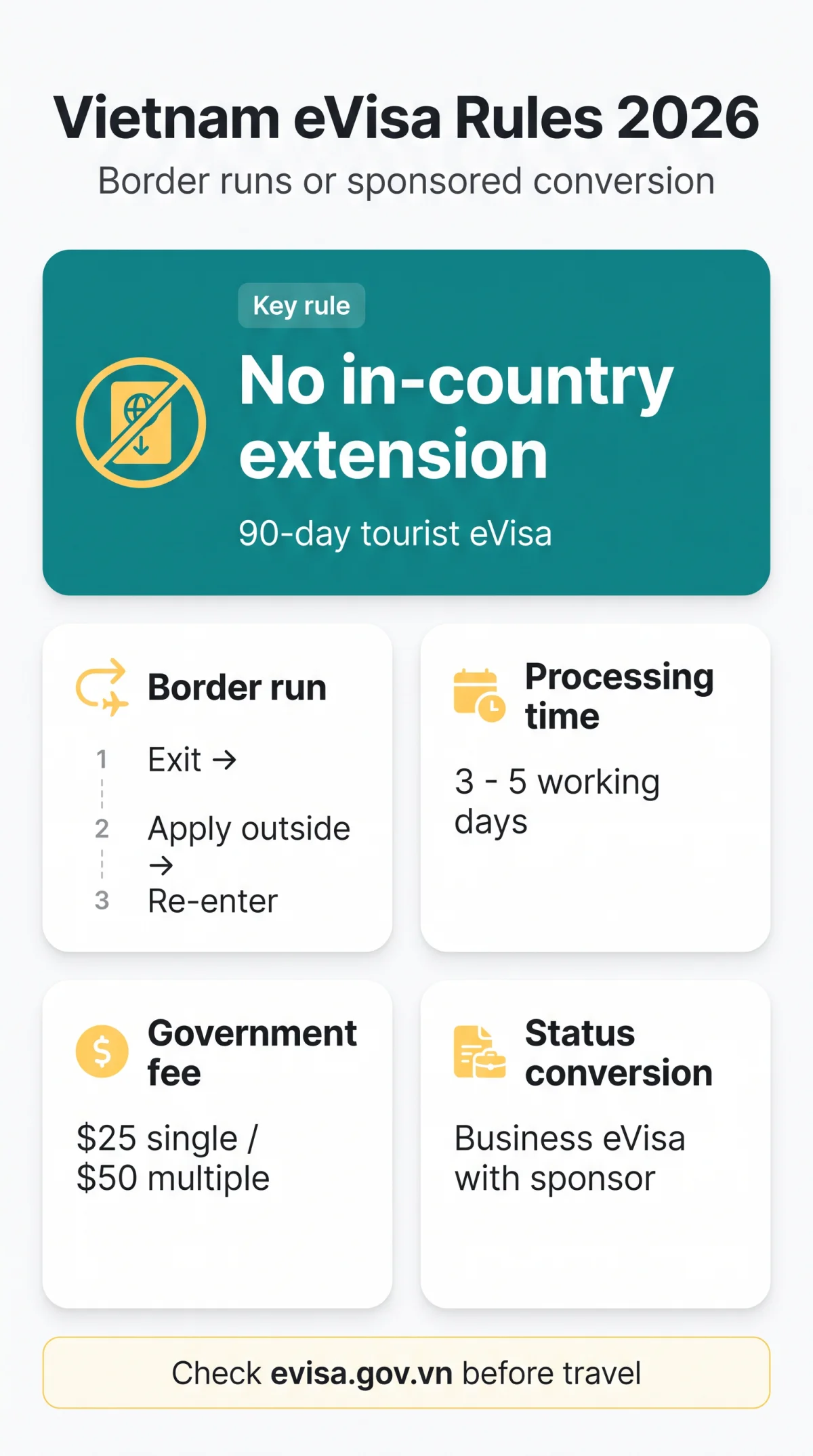
No, you cannot extend a standard 90-day Vietnam tourist eVisa from inside the country in 2026. Continuing your stay legally requires a border run on a newly approved eVisa, or a formal status conversion if you hold a business eVisa with a Vietnamese sponsor. Retirees and repeat visitors should plan around these Vietnam eVisa extension options before arrival.
This independent, informational guide is written for UK travellers planning a longer stay, whether you’re a retiree wintering in Da Nang or a repeat visitor hopping between HCMC and Bangkok. We don’t process applications or charge fees; before you travel, check the details on the official portal at https://evisa.gov.vn/, as rules can change.
Can You Extend a 90-Day eVisa In-Country?
The short answer is no. A standard 90-day tourist eVisa, single or multiple entry, can’t be extended at a local immigration office, so check the temporary residence certificate stamped in your passport on arrival and treat that date as the end of your legal stay.
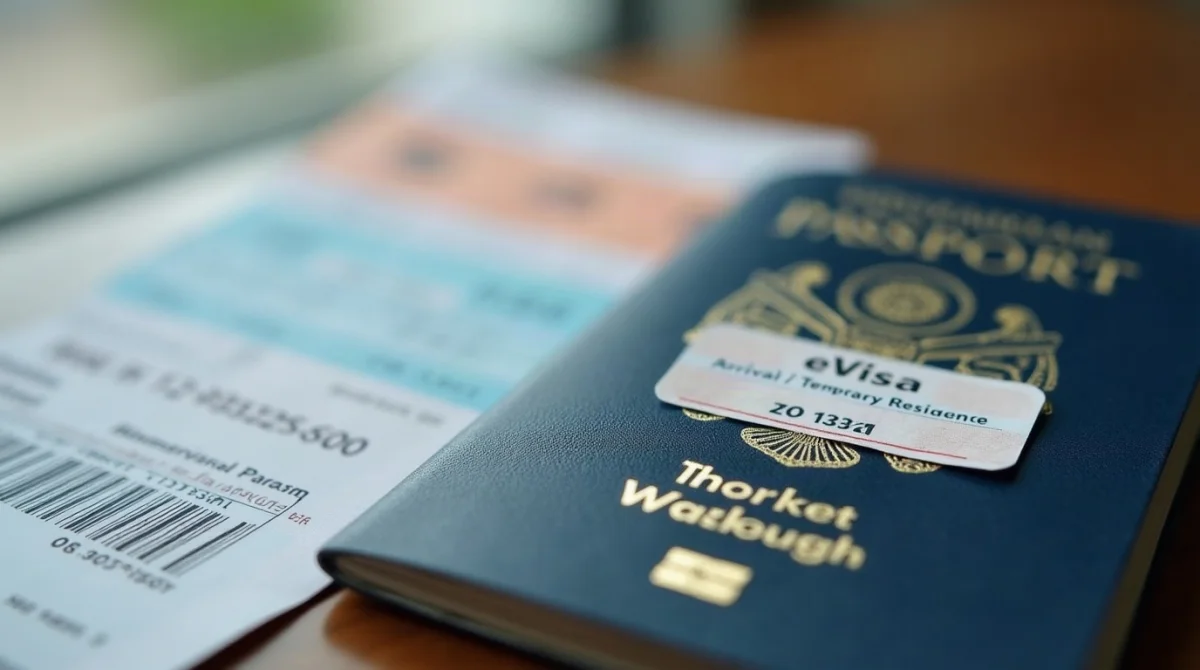
There’s a second catch: you also can’t apply for a new eVisa while still inside Vietnam, so the exit-and-re-entry route is the only option for most tourists. Your passport must also be valid for at least 6 months beyond your planned entry date, and at least 30 days longer than the eVisa itself.
- Tourist eVisas are non-extendable, full stop.
- You can’t apply for a new eVisa from inside Vietnam.
- The only legal in-country route is a sponsored conversion, covered below.
- Extension in Vietnam is available only for categories such as a business visa or a valid 5-year visa exemption certificate; renewal services at the Immigration Office are not available, so paid offers of a tourist “extension stamp” cover either a visa run or a sponsored conversion.
The Border Run Blueprint: Step by Step
Resetting your stay means leaving Vietnam and applying for a new eVisa once you are outside the country, so budget for the 3 – 5 working days of standard processing while you wait abroad.
Exit Vietnam
Get your exit stamp at the checkpoint.
Enter Cambodia or Laos
On the entry document required there.
Apply online for a new 90-day eVisa
Do it from outside the country and wait for it to be granted.
Print the approved eVisa
Make at least one copy and keep it with your passport.
Re-enter Vietnam
Enter on the new eVisa and check the entry stamp date.
One detail decides everything: you must enter through the exact border gate selected on the eVisa, though you may exit through any of the approved gates. Popular land gates include Moc Bai and Ha Tien (Cambodia) and Lao Bao (Laos).
Land vs Air Border Run
| Factor | Land run (Moc Bai) | Air run (via Bangkok) |
|---|---|---|
| Government eVisa fee | $25 single / $50 multiple | $25 single / $50 multiple |
| Where you apply and wait | Outside Vietnam, 3 – 5 working days | Outside Vietnam, 3 – 5 working days |
| Entry point | The land gate named on your eVisa | The airport named on your eVisa |
Back-to-Back eVisa Re-Entry Risks
The rules set no limit on consecutive eVisas, but entry and the stay granted are always decided by the immigration officer at the border, within the entry conditions and refusal grounds set out in the law.
What a Border Run Actually Costs
The only fixed cost of a border run is the government eVisa fee, $25 for a single entry and $50 for multiple entries, plus transport and any entry document required by the neighbouring country. The fee is non-refundable even if your application is refused.
| Cost item | Land run (Moc Bai) | Air run (Bangkok) | Agency package |
|---|---|---|---|
| Government eVisa fee | $25 single / $50 multiple | $25 single / $50 multiple | $25 single / $50 multiple |
| Transport and entry documents | Vary by route and season | Vary by route and season | Not applicable |
| Service fee on top | None | None | Charged by the agency |
Long-Stay Alternatives for Retirees and Repeat Visitors
Here’s the gap most guides skip: Vietnam has no dedicated retirement visa category, which leaves three realistic strategies.
- Rotate 90-day multiple-entry eVisas ($50 each) with regional trips. Flexible, but your right to re-enter stays at the officer’s discretion.
- Investor Visas (DT1 – DT4) based on documented investment status, which can lead to a Temporary Residence Card (TRC).
- 5-Year Visa Exemption Certificate for family members of Vietnamese citizens and people of Vietnamese origin; the permitted stay under it can be extended in-country while the certificate is still valid.
The legal framework is the Law on Entry, Exit, Transit, and Residence of Foreigners (Law No. 47/2014/QH13, amended in 2019 by Law No. 51/2019/QH14 and in 2023 by Law No. 23/2023/QH15). Status conversion in-country is limited to business eVisa holders with a sponsoring entity in Vietnam, such as an employer, business partner or Vietnamese relative, who can move to a work visa (LD), an investor visa (DT) or a Temporary Residence Card, with the paperwork completed before the current eVisa expires.
Who Can Convert Without Leaving
| Your situation | What you can do |
|---|---|
| Business eVisa holder with a Vietnamese sponsor | Convert to an LD visa, a DT visa or a TRC before the eVisa expires |
| Individual tourist on an eVisa | Must exit and re-enter |
| Traveller on a visa-free stay | Must exit and re-enter |
UK 45-Day Exemption vs 90-Day eVisa
Vietnam grants citizens of the countries on its unilateral exemption list a 45-day temporary residence certificate on arrival; check the current list on evisa.gov.vn before you rely on it. The certificate can’t be swapped for an eVisa inside Vietnam; you’d need to exit first. So plan by length of stay: up to 45 days, enter on the exemption if your country is on the list; 46 – 90 days, apply for a single-entry eVisa ($25); over 90 days with regional trips, get a multiple-entry eVisa ($50) and budget for border runs. For a longer-term base, look at the DT visa or Temporary Residence Card route.
If you need to deal with the Immigration Department in person, its addresses are 69 Mac Thai To, Yen Hoa Ward, Hanoi and 333-335-337 Nguyen Trai, Cau Ong Lanh Ward, Ho Chi Minh City.
Overstaying: Fines, Exit Visas and Entry Bans
Don’t let your stay run past the stamped date, as overstaying brings escalating administrative fines and beyond a few days it gets serious.
1 – 3 days over
A warning or a small fine
4 – 10 days over
A higher administrative fine
More than 10 days
Heavy fines, dealing with the Immigration Department before you can leave, and possible deportation, after which entry is barred for 3 years from the date the deportation decision takes effect
Overstaying also leaves a negative record with the Immigration Department and, in the more serious cases, a blacklist entry that blocks future entry.
Common Mistakes to Avoid
- Applying for a new eVisa from inside Vietnam. eVisas are only issued to applicants who are outside the country, so file the application after you exit and allow the 3 – 5 working days of standard processing.
- Typing a wrong passport number or entry date. You can’t edit the application yourself after paying; either the Immigration Department asks you to supply corrected details, or you start over with a new application and a second fee.
- Using a site other than the government portals. Applications are made only at evisa.gov.vn or thithucdientu.gov.vn. Paid agencies charge a service fee on top of the government fee for a form you can complete yourself; sites that imitate the government portal simply collect unauthorised fees and your passport data.
- Choosing a border crossing that doesn’t match your eVisa. The eVisa covers entry only at the border gate you selected, though you may leave through any of the approved gates.
Frequently Asked Questions (FAQ)
Can I extend my Vietnam eVisa online without leaving the country?
No. A tourist eVisa can’t be extended or renewed from inside Vietnam. You must exit and re-enter on a newly approved eVisa; the only in-country alternative is a status conversion open to business eVisa holders with a sponsoring entity in Vietnam.
How much does a Vietnam eVisa border run cost on average?
The fixed cost is the government eVisa fee, $25 for a single entry or $50 for multiple entries. Transport and any entry document the neighbouring country requires come on top of that, and both vary by route and season.
Does Vietnam offer a retirement visa for UK citizens?
No. Retirees typically rotate 90-day multiple-entry eVisas, qualify for an investor visa (DT1 – DT4) on the basis of documented investment, or apply for the 5-year visa exemption certificate through family ties or Vietnamese origin.
What happens if I overstay my 90-day eVisa by a few days?
Expect an administrative fine. One to three days usually means a warning or a small fine. Longer overstays bring higher fines and the need to settle the case with the Immigration Department before you leave. Beyond ten days, deportation is possible, and the law then bars entry for 3 years from the date the deportation decision takes effect.
Can I amend mistakes on my eVisa after paying the fee?
No. Once the fee is paid, you can’t correct passport details, dates or entry ports yourself. Either the Immigration Department requests amended details, or you submit a fresh application and pay the fee again.
Can I switch from a 45-day visa-free stamp to a 90-day eVisa inside Vietnam?
No. The 45-day unilateral exemption can’t be converted to an eVisa at an immigration office. You have to leave Vietnam and re-enter, presenting your newly approved eVisa at the border.
How far in advance should I apply for a new eVisa before a visa run?
You can only apply once you are outside Vietnam, so plan the trip around the standard 3 – 5 working days of processing; public holidays or a request for extra information can add more time.
What are the Vietnam eVisa extension options 2026 for repeat visitors?
Repeat visitors have three routes: exit and re-enter on consecutive eVisas, convert status in-country if they hold a business eVisa and have a Vietnamese sponsor, or qualify for the 5-year exemption certificate through family ties or Vietnamese origin.
Is there a limit on how many consecutive 90-day eVisas I can use?
No fixed legal limit exists, but the officer at the border always decides on entry and the stay granted, under the refusal grounds set out in the law.
Sources and Further Reading
- evisa.gov.vn – the Vietnamese government’s official eVisa application portal.
- evisa.gov.vn/faq – answers on applying from abroad, the 90-day limit and passport validity.
Rules can change, so confirm current requirements on evisa.gov.vn before you travel.