
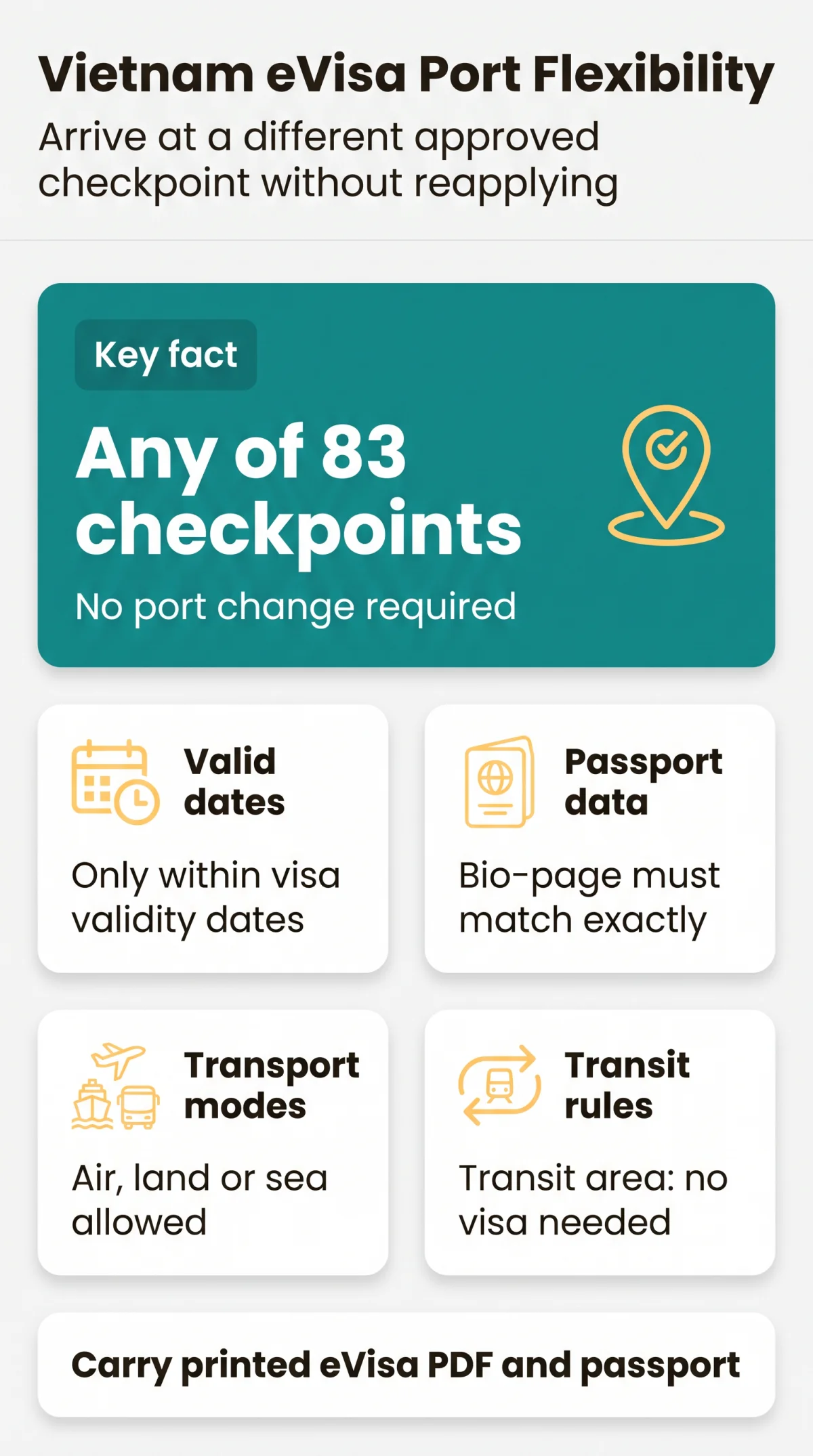
Yes, you can arrive at a different port than stated on your Vietnam electronic visa (eVisa). Under current regulations following Government Resolution No. 389/NQ-CP of 2 December 2025, entry is permitted through any of the 83 eligible international checkpoints without a new visa. Switching between approved ports does not invalidate your eVisa.
This guide is for British travellers whose flights have changed, who’s arriving by land or sea, or who’s worried about a blank port field on their visa PDF. We’re an independent travel guide, not a government service: confirm your details on the official portal at evisa.gov.vn before you fly.
What the Rules Permit
Since Resolution No. 389/NQ-CP took effect at the end of 2025, the Port of Entry field has been removed from the eVisa PDF, so a blank port field is expected – it’s not an error. Older guidance that told travellers to reapply after a flight change no longer applies.
You can switch ports freely as long as you meet three conditions:
- Your new port is on the list of 83 eligible international checkpoints (airports, land borders, seaports).
- You arrive within your approved visa validity dates – not before the start date.
- Your passport bio-page data matches: full name, date of birth, passport number, nationality, passport expiry date, and the visa validity dates.
In short: the port and transport mode are flexible data. Your passport details are not. You can also leave through a different gate than the one you entered.
Air, Land, and Sea Scenarios
Switching between airports, land borders, and seaports is permitted, provided the new gate is on the 83-checkpoint list; what gets travellers refused is an unapproved local crossing.
Air. If your flight is rebooked or diverted from Noi Bai (HAN) to Tan Son Nhat (SGN) or Da Nang (DAD), immigration processes your entry normally.
Land. You can arrive by bus through Moc Bai (from Cambodia) or Lao Bao (from Laos) even if you declared an airport. Carry a printed copy of the eVisa PDF for land crossings.
Sea. Cruise arrivals at designated seaports are accepted on the same basis. An approved eVisa cannot be changed – errors mean a new application. Common application mistakes include picking a city name instead of the actual border gate, or relying on outdated checkpoint lists. Keep a printed copy of your eVisa with you.
Transit and Domestic Connections
Staying in the international transit area without entering Vietnam does not require an eVisa; a domestic connection or a self-transfer on separate tickets does, because you must clear immigration. Confirm transit conditions for your route on evisa.gov.vn.
If you remain in the international transit area and do not pass immigration, you don’t need a visa. The moment you leave that area, you do.
| Your layover situation | Visa needed? |
|---|---|
| Single ticket, staying in the international transit area | No |
| Separate tickets (self-transfer) with VietJet, AirAsia, or Scoot | Yes |
| Domestic connection to another Vietnamese airport | Yes, at your first airport |
Immigration and customs are always cleared at your first international point of entry. Landing in Hanoi on the way to Da Nang? You enter Vietnam at Noi Bai, not at your destination.
Land at the international terminal
Clear immigration with your eVisa and passport
Collect your checked baggage and pass customs
Cross to the domestic terminal
Re-check your baggage and board the domestic flight
Separate tickets mean no interline baggage agreement, so you’ll pass border control to collect bags – a valid visa is mandatory regardless of how short the layover is.
Boarding in the UK, Fixing Errors, and Avoiding Scams
UK check-in agents check your passport details and the validity dates of your visa, not the port you declared in the application. Only critical errors require a new application.
At Heathrow, Gatwick, or Manchester, ground agents check that your passport bio-data matches and that your visa validity window covers your trip. If someone questions the blank port field on your 2026-format visa, explain the change introduced by Resolution No. 389/NQ-CP. Have ready: a printed eVisa PDF and a passport valid at least six months from arrival.
Know which mistakes actually matter:
| Error type | Result at the border | What you do |
|---|---|---|
| Different eligible port, or switched transport mode | Entry permitted | Nothing – travel as planned |
| Entry date shifted within your validity window | Entry permitted | Nothing – travel as planned |
| Passport number typo or wrong birthdate | Visa data doesn’t match your passport | Submit a new application before flying |
| Name order mismatch on the visa | Visa data doesn’t match your passport | Submit a new application before flying |
| Arrival before your visa start date | Entry only within the validity window | Apply again with corrected dates |
You may not need a new application at all. No paid “port change” service is required, because the port field no longer exists on the document. Agencies charge a service fee on top of the government fee; a scam is something different – a site posing as the government portal. Verify the current 83-checkpoint roster on evisa.gov.vn.
Frequently Asked Questions (FAQ)
Can I enter Vietnam at a different airport than the one listed on my eVisa application?
Yes. You can enter through any of the 83 approved international checkpoints, even if they differ from your application. The port field was removed from the eVisa PDF under Resolution No. 389/NQ-CP, so switching airports doesn’t invalidate your visa.
Why doesn’t my Vietnam eVisa show a port of entry?
It’s deliberate. The field was removed under Resolution No. 389/NQ-CP, effective from late 2025 into 2026, letting you enter through any of the 83 designated checkpoints without document amendments.
Do I need a new visa if my flight is diverted to another Vietnamese airport?
No. A diversion – say, landing at Tan Son Nhat instead of Noi Bai – doesn’t invalidate your eVisa. As long as the arrival airport is among the 83 eligible checkpoints and your dates are valid, immigration processes your entry without issue.
Can I exit Vietnam from a different port than the one I entered through?
Yes. Vietnamese rules allow you to exit through a different eligible checkpoint, for example entering at Noi Bai airport and leaving through the Moc Bai land border into Cambodia.
What happens if I arrive at a different port than stated on eVisa but before my visa start date?
Your eVisa is valid only within its approved dates, so you cannot use it before the start date, whichever checkpoint you arrive at. To travel earlier you would need to submit a new eVisa application with the correct dates.
Do I need a transit visa for a layover in Hanoi or Ho Chi Minh City?
Not if you stay in the international transit area and do not pass immigration. On separate tickets with carriers like VietJet or AirAsia you must clear immigration to collect baggage, and then a valid visa is required.
Can I switch from an airport arrival to a land border crossing like Moc Bai on the same eVisa?
Yes. Entering via Moc Bai from Cambodia instead of flying into Tan Son Nhat requires no new visa. Bring a printed copy of your eVisa PDF for the border check.
Will UK airline staff stop me at Heathrow if my ticket doesn’t match the port on my visa application?
No. Check-in staff verify your passport details and the validity dates of your visa; the arrival gate you entered on the application form is not part of that check. If asked, explain that the current eVisa format no longer shows a port of entry.
Sources and Further Reading
- evisa.gov.vn – the government portal where you apply, check the 83-checkpoint roster, and read the official FAQ on port flexibility.
- gov.uk – eVisas: access and use your online immigration status – unrelated to the Vietnam eVisa; covers UK online immigration status for travel to and from the UK.
- gov.uk – Entering the UK: border control overview – what to expect when returning through UK border control.
Rules can change, so confirm details on evisa.gov.vn before you travel.