
To get a Vietnam e-visa approved first time, you need a passport valid for at least six months beyond arrival, a compliant 4×6 cm digital photo, your first accommodation address, and a 25 USD or 50 USD fee. This guide lists the documents required for Vietnam evisa application step by step, so you don’t waste the non-refundable fee on a rejected file.
This is an independent travel guide, not a government site – you apply and pay only through the official portal at evisa.gov.vn.
What Documents Are Required for Vietnam Evisa Application?
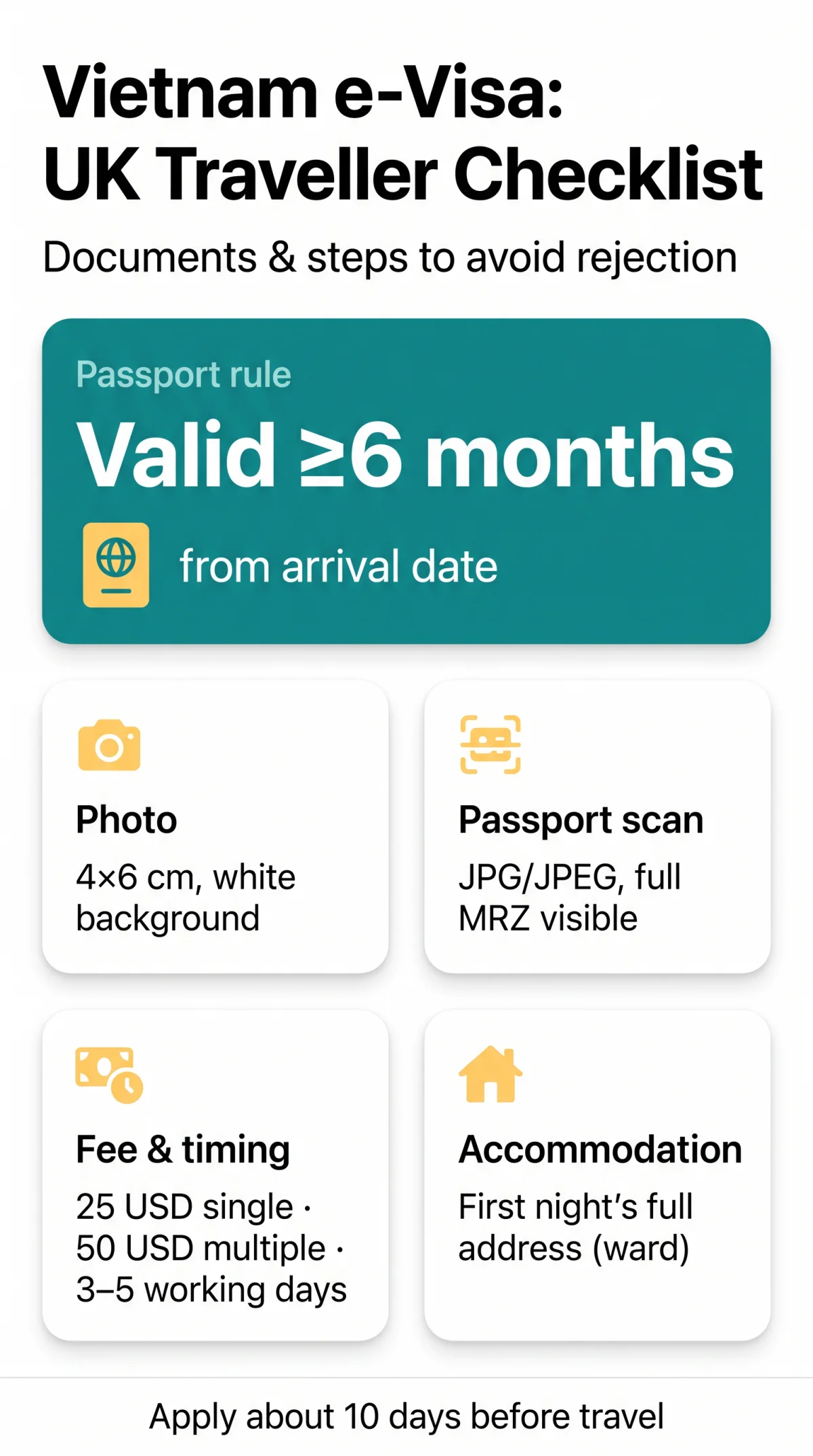
UK travellers need a valid passport scan, a portrait photo, accommodation details, travel dates, and a card for the fee. The e-visa is valid for up to 90 days, single or multiple entry, and processing takes 3 working days at the statutory minimum – realistically 3 – 5 working days, so apply about 10 days ahead.
| Item | Specification |
|---|---|
| Passport bio-data page scan | JPG/JPEG, clear and uncropped, full MRZ visible |
| Digital portrait photo | 4×6 cm, white background, taken within 6 months |
| Accommodation address | First night’s stay: name, street, ward, district, city |
| Travel details | Entry and exit dates, chosen border gates |
| Payment card | Visa, MasterCard or JCB for the USD fee |
| Active email | Receives your registration code and e-visa PDF |
The fee is 25 USD single entry or 50 USD multiple entry, non-refundable even if your application is rejected.
Passport Standards and Bio-Data Page Scan Rules
Your British passport must be valid for at least six months beyond your arrival date, undamaged, and have two blank pages for entry and exit stamps, per UK FCDO guidance. A torn page, heavy wear or a detached cover can get you denied boarding or entry.
Bio-Data Page Scan: Capturing the MRZ Without OCR Errors
Scan the bio-data page – the one with your photo and personal details. The scan must show the Machine Readable Zone (MRZ) – the two lines of characters at the bottom of the page – in full, with no glare, reflections or shadows.
Keep the borders uncropped and save the file as JPG or JPEG.
Minimum Passport Validity Before You Apply
If your passport has less than six months left from your arrival date, you don’t meet the e-visa conditions – renew it first. Check the expiry date against your planned entry before you do anything else.
Digital Portrait Photo Specifications
Upload a 4×6 cm colour portrait taken within the last six months, on a plain white background, without eyeglasses or headwear. Non-compliant photos are the most common reason applications come back, so a picture that looks fine to you can still fail.

| Parameter | Passes | Fails |
|---|---|---|
| Size | 4×6 cm framing | Cropped too tight or too wide |
| Background | Plain white | Coloured or patterned wall |
| Glasses | Removed entirely | Even anti-reflective prescription glasses |
| Headwear | Religious headwear | Hats and caps |
| Expression | Neutral, mouth closed, facing camera | Smiling, shadows, tilted head |
| Age of photo | Taken within 6 months | Older holiday snaps |
Technical Framing: Dimensions, Background and Lighting
The photo must meet ICAO standards: white background, front-facing, no glasses or hat. Watch for pixelation and compression artefacts – resize the image, don’t screenshot it. Skip social-media filters and retouching.
Strict Appearance Rules: Eyeglasses, Headwear and Expressions
Take the glasses off, even prescription ones with anti-reflective coating. No hats or headwear except religious headwear, and keep your expression neutral with your face fully visible to the camera.
Accommodation Address Requirements for Vietnam Evisa
Declare only your first night’s address in full Vietnamese administrative format – no booking PDFs are uploaded. The form asks for the property name plus the street, ward, district and city, and an incomplete entry usually leads to an email asking you to complete the address.
Use this template:
- Property name (hotel, hostel, homestay or residential address)
- Street and house number
- Ward (Phường/Xã)
- District (Quận/Huyện)
- City or province (Tỉnh/Thành phố)
Administrative Formatting: Hotels vs Airbnb and Homestays
An entry such as “Airbnb, Hanoi” is not a full address, so the application is likely to come back with a request for the complete one. Open your booking confirmation and find the ward and district in the address, then enter them in the right fields. A Hanoi example: hotel name, street and number, Phường, Quận, Hà Nội. For Ho Chi Minh City, the same structure applies with its own ward and district names.
You only need the first accommodation – booking every night in advance isn’t mandatory. Staying with friends? Ask them for their full address including the ward.
Night-One Transit: Sleeper Trains and Late Arrivals
Landing late and boarding an overnight sleeper train to Sapa or a night bus to Da Nang? Declare the address of where you’ll spend the first registered night – for example, your hotel in Hanoi – and note the transit in your plans. Keep your train ticket handy in case the portal asks for clarification by email.
One legal duty to know about: your hotel or landlord must file the temporary residence declaration (khai báo tạm trú) with the local commune, ward or town police. You hand over your passport at check-in and the accommodation files it.
Onward Ticket Rules for Evisa Holders
Onward tickets aren’t uploaded with your e-visa application, but UK airline check-in desks may demand proof of exit before they hand you a boarding pass. When the check happens depends on how you’re entering Vietnam.
| Entry route | Onward ticket checked? | Who checks it |
|---|---|---|
| 45-day UK visa exemption | Yes, exit ticket within 45 days | Airline check-in desk |
| 90-day e-visa | Not uploaded; may be requested later | Portal by email, occasionally airlines |
| Immigration on arrival | Sometimes verified | Border officers |
45-Day Exemption vs 90-Day E-Visa at Airline Check-In
If you travel visa-free under the UK’s 45-day unilateral exemption, a return or onward ticket within 45 days is required and airlines check it at the UK check-in desk. With a 90-day e-visa you have more flexibility, but if your itinerary looks incomplete during background checks, the portal may email a request for additional information asking for exit proof.
Land and River Border Crossings: Acceptable Proof of Departure
Leaving by land or river? Keep your onward bus or ferry booking to hand – airlines and border officers may ask for proof that you will leave Vietnam. Keep it as a PDF on your phone and a printout in your bag.
Step-by-Step Portal Submission and Pre-Payment Checks
Verify every field before you pay – the form locks after payment, and any typo means a brand-new application and a duplicate fee. Here’s the order to work in.
Go to evisa.gov.vn and start a new application
Type the address yourself to avoid lookalike agency sites.
Enter your personal data exactly as printed in the MRZ
Middle names included, not truncated.
Select your entry and exit border gates to match your tickets
Pick the gate you’ll actually use, not the biggest airport.
Upload the passport scan and the portrait photo
Clear, uncropped, with the full MRZ visible.
Type your accommodation address in full administrative format
Property name, street, ward, district and city.
Run the pre-payment checklist
MRZ data, ports, address and full name all verified.
Pay 25 USD single entry or 50 USD multiple entry
The form locks after payment, so check every field first.
Save your registration code and watch for the e-visa PDF by email
It arrives within 3 – 5 working days.
Your e-visa is valid only at designated international border gates – air, land and sea. Pick the gate you’ll actually use, not the biggest airport.
Port Selection and Data Matching: Avoiding the Form Lock
As noted above, paid applications can’t be edited – so before paying, check: MRZ data matches your passport, ports match your tickets, the address includes the ward, and your full name is in passport format – middle names included, not truncated.
Payment Gateway: USD Fees, FX Surcharges and Fake Portal Checks
The fee is billed in USD only, so UK cards may add foreign transaction and FX charges on top. Since the fee is non-refundable, those card charges are lost too if the application fails. And type the portal address yourself – paid agencies charge a service fee on top of the government fee, and some lookalike sites imitate the government portal altogether.
Common Document Mistakes and Border Arrival Myths
If your dossier gets flagged, fix it with your registration code – and ignore outdated advice about airport passport photos. Here’s what goes wrong and how to solve it.
- Cropped scan borders: the MRZ can’t be read – re-shoot with all four page edges visible.
- Glare on the passport page: move away from direct light and retake the scan.
- Missing ward details: the portal emails a request for additional information – reply with the full address.
- Mismatched ports: your entry gate doesn’t match your flight – file a new application.
- Oversized or unclear files: re-upload a sharp, uncropped scan; keep the portrait photo file under 2 MB.
A4 Printout and the Digital Pre-Arrival Card
Print your e-visa PDF on A4 – two copies are recommended. A PDF on your phone is often not enough at the counter. Separately, submit the Digital Pre-Arrival Card in the three days before arrival via prearrival.immigration.gov.vn and show the QR code at immigration. Since 15 April 2026 it is strongly encouraged at Tan Son Nhat (SGN) – not yet formally mandatory – and it may be rolled out to other airports such as Noi Bai (HAN), Da Nang (DAD), Cam Ranh (CXR) and Phu Quoc (PQC) with little notice.
E-Visa vs Visa on Arrival: Debunking the Airport Photo Myth
Paper 4×6 cm photos belong to the Visa on Arrival route, which still exists but needs a pre-approval letter. With an e-visa you go straight to passport control with your printout and passport; carrying two spare photos is a cheap precaution.
Frequently Asked Questions (FAQ)
What documents are required for Vietnam evisa application?
A passport bio-data page scan (JPG, clear and uncropped, full MRZ), a 4×6 cm digital portrait on a white background, your first accommodation address, and your entry and exit details, plus a payment card and an active email.
How long does my passport need to be valid for a Vietnam e-visa?
At least six months beyond your arrival date, with two blank pages. The passport must also be undamaged – torn pages or a detached cover can lead to denied boarding or entry, per UK FCDO guidance.
What are the photo specifications for the Vietnam e-visa portal?
4×6 cm, colour, plain white background, taken within the last six months, straight frontal view with a neutral expression. No eyeglasses – even anti-reflective prescription pairs fail – and no headwear except religious headwear.
Do I need to upload a hotel booking for my Vietnam e-visa?
No booking confirmation is uploaded. You type your first night’s address in full – property name, street, ward, district and city – and only that first accommodation is declared, so you can book the rest of your nights as you travel.
Is an onward ticket required for the Vietnam e-visa application?
Not as an initial upload. Airlines check exit proof at UK check-in for 45-day visa-free entry, and the portal may request it by email. Keep any onward bus or ferry booking available, because airlines and border officers may ask for proof of departure.
Can I use a UK Emergency Travel Document to apply for a Vietnam e-visa?
No. ETDs, temporary passports and alien or refugee travel documents aren’t accepted. You’d need a physical consular visa instead – contact the Vietnam Embassy in the UK before making travel plans.
Can I edit my Vietnam e-visa application after paying the fee?
No. Once the application is submitted and paid, the data cannot be changed, and the 25 USD or 50 USD fee is not refunded. A misspelled name, wrong passport number or wrong dates mean filing a brand-new application and paying the fee again, so check every field before you pay.
Where do I submit the documents required for Vietnam evisa application?
You submit everything through the government portal at evisa.gov.vn: the form, the passport scan, the photo and the fee. Agency sites charge a service fee on top of the government fee and some pages imitate the portal, so type the address yourself. Your registration code and the approved e-visa PDF arrive by email.
Sources and Further Reading
- evisa.gov.vn – the Vietnam National Electronic Visa system where you file and pay.
- National portal on Immigration – Vietnam’s immigration authority pages on e-visa rules.
- UK FCDO entry requirements for Vietnam – passport validity, blank pages and arrival card guidance for British travellers.
- Vietnam Embassy in the UK – consular visa route if you hold a non-standard travel document.
Rules can change, so check the official portal before you travel.