
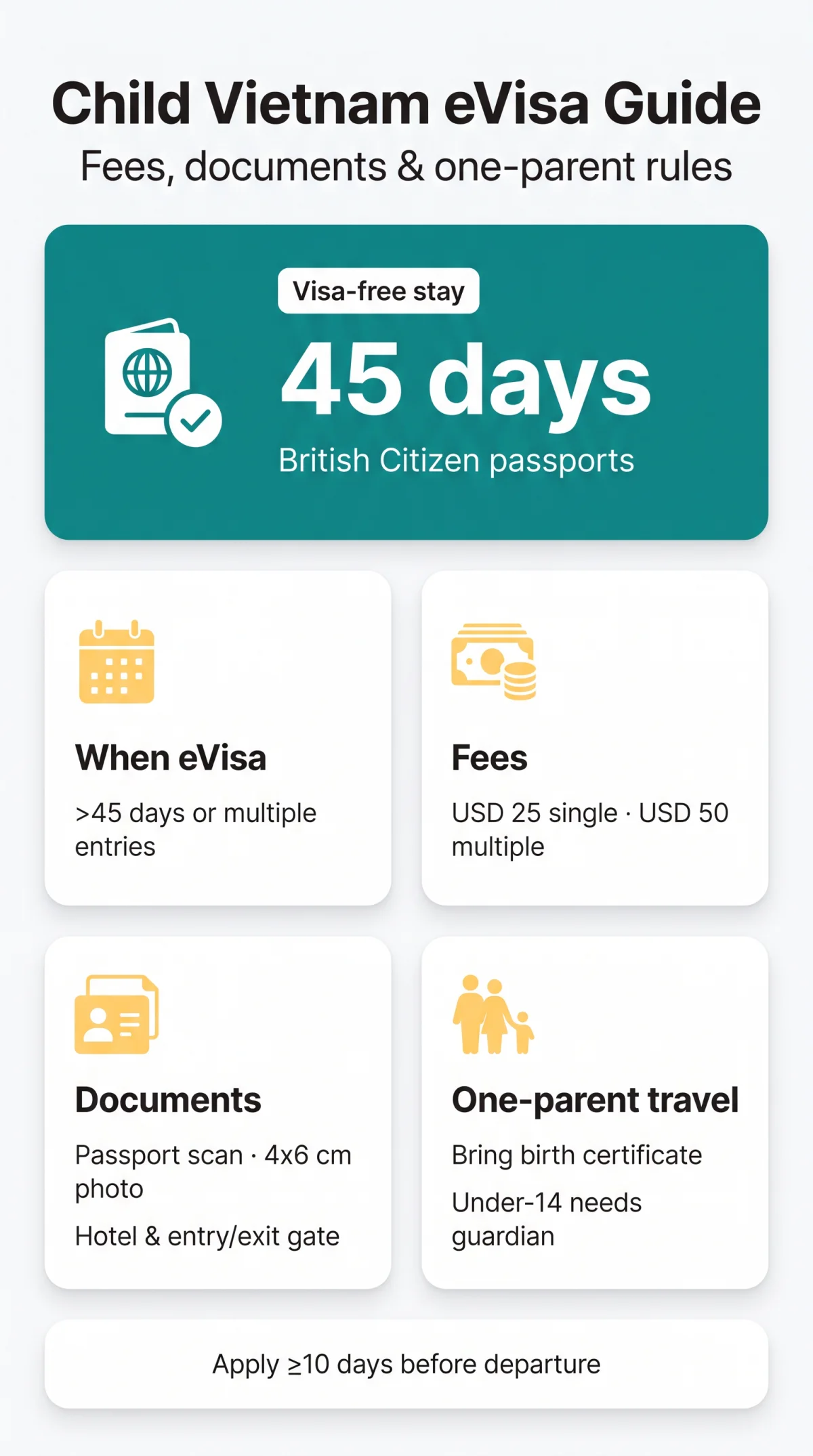
If you’re applying for a child Vietnam eVisa (guide below), start with the basics: UK children holding their own passports enter Vietnam under Vietnam’s unilateral visa exemption, currently a 45-day stay – check the exemption list on the portal before you book. Longer stays need an individual eVisa costing USD 25 single entry or USD 50 multiple entry. If you fly alone with your child, pack the child’s birth certificate – airlines often ask for it to verify guardianship before boarding.
This is an independent guide, not a government page – you apply yourself on the Vietnamese immigration portal, so check current rules there before you travel.
Does Your Child Need an eVisa or the 45-Day Exemption?
British Citizen passport holders, including infants, can stay visa-free for up to 45 days, so a two- or three-week family holiday needs no visa at all.
You do need an eVisa when your trip runs longer than 45 days, when you need a visa covering more than one entry, or when your child holds a travel document other than a standard British passport – eligibility for an eVisa depends on the passport type, so check the conditions on the portal. Whichever route you take, the passport must be valid for at least 6 months beyond entry, and the eVisa validity must end at least 30 days before the passport expires.
| Your trip | What your child needs |
|---|---|
| Up to 45 days, single entry, British Citizen passport | Nothing – visa-free entry |
| 46 – 90 days, tourism | Single-entry eVisa, USD 25 |
| More than one entry on one visa | Multiple-entry eVisa, USD 50 |
| Non-British Citizen passport (e.g. BNO) | Check the portal’s eligibility list |
One rule sits above all of this: whenever a visa is required, every child with their own passport needs their own eVisa, from newborn to 17. Only under-14s included in a parent’s physical passport can be added to that parent’s form via the “Accompanying child(ren) under 14” field – a rare case for UK families.
Child eVisa Fees and Payment Rules
Children pay the same as adults – there’s no discount for age:
- Single-entry eVisa (up to 90 days): USD 25 per child
- Multiple-entry eVisa (up to 90 days): USD 50 per child
- Payment: international credit or debit cards (Visa, Mastercard, JCB) through the portal’s payment gateway
- No refunds: the fee is non-refundable whether or not the visa is granted.
There’s no way to fix a submitted form online either. If you spot a mistake, you submit a fresh application and pay again – so check every field before checkout.
Documents and Photos for a Child’s Application
You’ll need four things ready before you open the form:
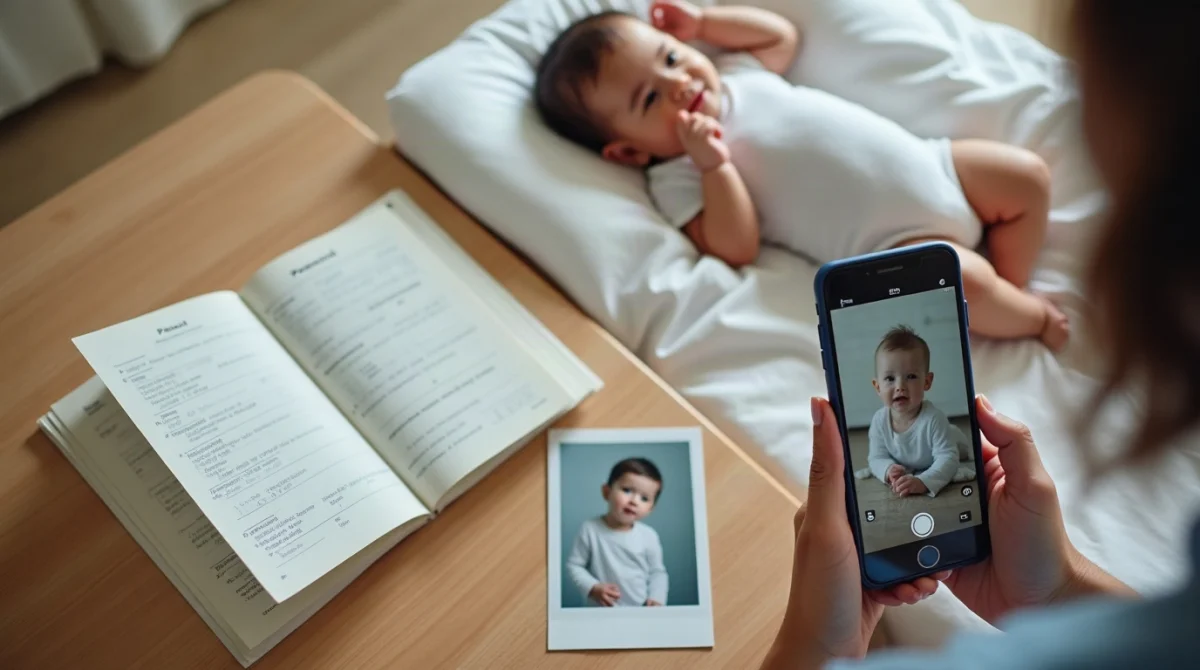
- A scan of the child’s passport personal data page only – JPG/JPEG, clear, uncropped and fully visible
- A 4×6 cm portrait photo, JPG/JPEG, under 2MB, taken within 6 months, white background without shadows, front-facing, formal attire, no hats or glasses
- Your first hotel or place of stay in Vietnam
- Your planned entry and exit checkpoint, chosen from the government-approved list of international border gates (27 land, 15 air and 39 sea gates)
Pick the ports from the approved list. You must enter and leave through gates on that list, though you are not required to exit through the gate you entered by.
How to Photograph an Infant for the eVisa
Babies who can’t sit up are the trickiest part of a child application. Here’s what works:
Lay the baby flat
On their back on a smooth white sheet.
Shoot straight down from above
In diffuse daylight, avoiding facial shadows.
Keep the frame clear
Hands, pacifiers, toys, and bibs stay out of the frame.
Crop to 4×6 cm
Without distorting the perspective.
One more habit worth building: if your child has a different surname from yours, keep a physical copy of the birth certificate in your hand luggage. Airlines frequently check it before boarding.
How to Apply: Step-by-Step for Minors
Apply on the Vietnamese immigration portal. The workflow runs like this:
Upload the portrait photo and passport scan
The portal parses the MRZ automatically.
Enter the child’s full name in UPPERCASE
Exactly as printed on the ICAO MRZ line (Surname + Middle Name + Given Name).
Enter a contact email you control
The decision and the e-visa PDF go to the registered email address.
Select your entry and exit ports
Chosen from the approved list.
Check the declaration and pay
Enter the verification code, pay, then save the application code the system issues.
Can you submit one family application? No – each child with their own passport needs their own application and their own fee. Keep a simple spreadsheet tracking each child’s name, application code, date of birth and the email used.
Processing takes 3 working days (UTC+7), but apply at least 10 days before departure, and earlier around Tet. You can apply up to a year ahead. Check status with the application code, your email, and the child’s date of birth, then print two copies of the approved visa per child. Optionally, complete the digital pre-arrival declaration at prearrival.immigration.gov.vn for a QR code that speeds up airport clearance.
Travelling with One Parent: Consent and Legal Documents
Under Article 21, Clause 2 of the Law on Entry, Exit, Transit, and Residence (Law No. 47/2014/QH13), children under 14 are prohibited from entry unless accompanied by a parent, legal guardian, or authorised person.
In practice, two different checks matter: airlines often ask for the birth certificate to verify guardianship before boarding, and an under-14 must be accompanied by a parent, guardian or authorised person to be admitted. Prepare this folder before you fly:
- The child’s birth certificate, original or a copy, showing both parents – airlines often check it before boarding
- Evidence that you are the parent, guardian or authorised person accompanying the child, as required for under-14s; no official form is prescribed for this
There’s a lesser-known rule too: on the temporary residence declaration (Form CT01) for a minor, the declaration must state that the father, mother or guardian consents, unless written consent has already been provided.
Common Mistakes in Child Applications
Most rejections come from a handful of avoidable errors:
- Omitting a middle name or swapping the name order against the ICAO line – the name must match the passport exactly.
- Entering your passport number instead of your child’s – always work from the child’s own bio-page.
- Arriving at a border gate that is not on the approved list – the eVisa is only valid at the listed gates.
- Shadowed or blurry infant photos – a non-compliant photo is rejected, and an invalid upload will not let you submit at all.
Also apply for the eVisa directly rather than Visa on Arrival, which needs an approval letter arranged through an agency, a stamping fee in cash (USD or VND) and time at the airport visa counter, and works only for air arrivals. The eVisa lets your family walk straight to passport control with a printout – and it keeps you away from unofficial sites charging inflated fees.
Frequently Asked Questions (FAQ)
Do babies and toddlers need a separate eVisa for Vietnam if they have a UK passport?
Not for short trips – British Citizen passport holders of any age get the 45-day exemption. Longer stays, or trips that need a visa covering more than one entry, mean even a newborn with their own passport needs a separate eVisa.
How much does a Vietnam eVisa cost for a child?
USD 25 single entry, USD 50 multiple entry – identical to adult rates, with no discount for infants or students. The fee is non-refundable, whether or not the visa is granted.
Can I submit one family application when applying for a child Vietnam eVisa?
No. Each child with their own passport needs their own application and their own fee.
What should I enter under ‘Occupation’ for an infant on the Vietnam eVisa form?
There’s no fixed entry prescribed for a child in these fields. Declare all information sufficiently, accurately and honestly in English, and enter what truthfully describes your child.
What documents does a child need when travelling to Vietnam with only one parent?
Pack the child’s birth certificate, which airlines often check before boarding, along with evidence that you are the parent, guardian or authorised person travelling with them; no official form is prescribed for this evidence.
How long does a child’s Vietnam eVisa take to process?
Three working days from receipt of a complete application and payment, in UTC+7. Apply at least 10 days before departure, and earlier around Tet; you can submit up to a year in advance.
Can an unaccompanied child under 14 enter Vietnam with an eVisa?
No. Under Article 21, Clause 2 of Law No. 47/2014/QH13, children under 14 are prohibited from entry unless accompanied by a parent, legal guardian, or authorised person. An approved eVisa doesn’t override this.
Where can I apply for a child Vietnam eVisa online?
On the Vietnamese immigration portal at evisa.gov.vn. Read the instruction page first, and avoid unofficial sites charging inflated fees.
Sources and Further Reading
- evisa.gov.vn – the Vietnamese immigration portal where you submit each application.
- evisa.gov.vn/instruction – photo specs, form steps and the list of approved border gates.
- evisa.gov.vn/faq – eVisa conditions, validity rules, name format and border-gate questions.
Rules can change, so check the portal before your trip.