
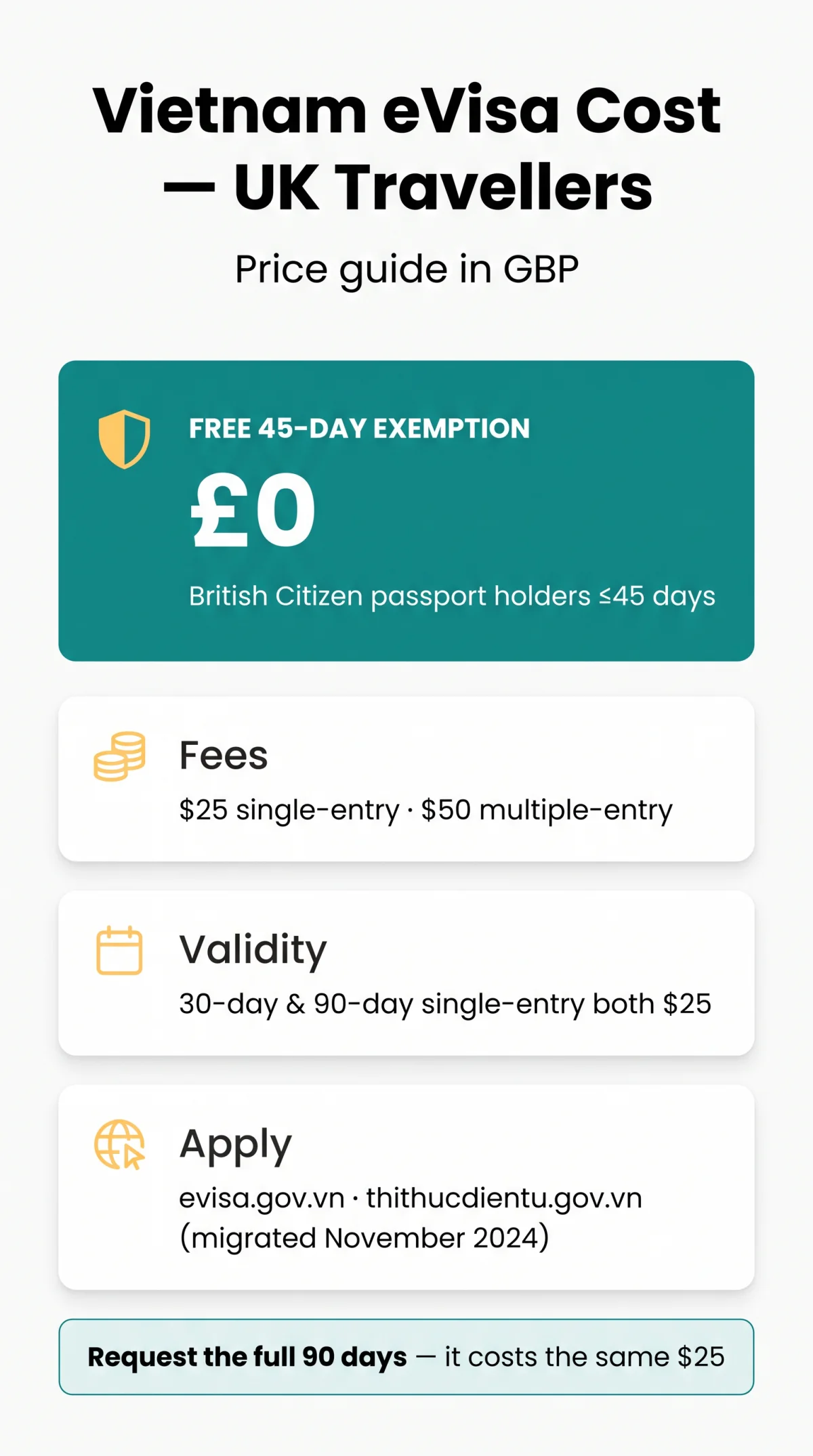
The Vietnam eVisa cost is fixed at $25 USD (approx. £19 – £21) for a single-entry visa and $50 USD (approx. £39 – £41) for a multiple-entry visa. The fee scales with the number of entries, not the length of validity: a 30-day and a 90-day single-entry visa both cost $25. Under the exemption rules currently in force, British Citizen passport holders staying 45 days or fewer pay £0 – exemption terms can change, so confirm them before you travel.
This is an independent guide for UK travellers, not a government site – you apply and pay on the public portals evisa.gov.vn or thithucdientu.gov.vn (migrated there in November 2024). We don’t collect fees or submit applications on your behalf, and you should confirm current fees and terms on the portal before you travel. Below you’ll find the full price list, the real GBP maths including UK card fees, and the traps that make travellers overpay.
Free 45-Day Exemption vs Paid Vietnam eVisa
Before you reach for your card, check whether you need a visa at all. Holders of an ordinary British Citizen passport enter Vietnam visa-free for up to 45 days. Your passport needs to be valid well beyond your arrival date – the eVisa rules require at least six months – and entry conditions are always assessed by the immigration officer at the border.
Here’s the decision checklist:
- British Citizen passport, stay of 45 days or fewer, one entry – you pay £0, no eVisa needed.
- Stay of 46 – 90 days – you need a paid eVisa: $25 single entry or $50 multiple entry.
- Planning more than one entry – check the current exemption conditions for your passport before assuming free entry; a paid multiple-entry eVisa costs $50.
- British National (Overseas) – BNO – passport – the exemption doesn’t apply. You pay for a visa from day one.
Check your passport type before assuming free entry – the words on your photo page decide which row applies to you. If you do need the visa, you’ll complete everything and pay online on the national immigration portal.
Vietnam eVisa Cost: Single vs Multiple Entry Price List
The government fee is simple: $25 USD (~£19 – £21) for single entry and $50 USD (~£39 – £41) for multiple entry. You pay it online when you submit the application, and the payment gateway settles it in Vietnamese Dong (VND), converted at the time of payment.
| Visa type | Entries | Validity | Government fee | Approx. GBP |
|---|---|---|---|---|
| Single-entry eVisa | One | 30 days | $25 USD | ~£19 – £21 |
| Single-entry eVisa | One | 90 days | $25 USD | ~£19 – £21 |
| Multiple-entry eVisa | Multiple | 30 days | $50 USD | ~£39 – £41 |
| Multiple-entry eVisa | Multiple | 90 days | $50 USD | ~£39 – £41 |
The 90-day window runs from the entry date you declare in the application, so time it to your actual arrival. One tip worth the money: at single entry, request the full 90 days – it costs the same $25 and gives you a buffer if your flights shift.
30-Day vs 90-Day Validity: The Zero-Price Difference
Many travellers assume a 90-day eVisa costs more. It doesn’t. The single-entry fee is $25 whether you pick 30 or 90 days, because the fee scales with entries, not duration. The only jump in the price list is from single entry to multiple entry. So when you’re budgeting, the question isn’t “how long” – it’s “how many times will I cross the border”.
Single vs Multiple Entries: Calculating the Price Gap
The multiple-entry upgrade costs an extra $25 USD, roughly £20. You’d pay it once and re-enter Vietnam as often as you like within the validity window. If you’re only flying in and out once, the single entry at $25 is all you need. Planning side trips to Laos or Cambodia by land? That’s when the $50 permit earns its keep.
Agency Fees vs Public Portals: Spotting the Markup
Apply on the public portals – evisa.gov.vn or thithucdientu.gov.vn – and you pay only the $25/$50 government fee. Commercial agencies add their own service fee on top of the government fee, for form checking and faster handling.
| Public portal (.gov.vn) | Commercial agency | |
|---|---|---|
| Base fee | $25 / $50 USD only | $25 / $50 plus the agency’s service fee |
| Processing time | Standard, 3 – 5 working days | Standard plus paid expedited options |
| Support | You complete the form yourself; the portal has an e-visa support section | Form help and error checking |
| Peak season pricing | Government fee stays fixed year-round | Service charges may vary |
How do you spot an intermediary? Look at the domain. If it doesn’t end in .gov.vn and the price is quoted as a package in pounds, you’re looking at an agency site. That’s not automatically bad – some travellers happily pay for hand-holding – but you should know which one you’re on.
The Real Vietnam eVisa Cost in GBP: Bank Fees and DCC Traps
The sticker price isn’t your final price. Your $25 travels through a chain of conversions before it leaves your UK account, and each link can add a little. Here’s the path your payment takes:
Pay in USD
You pay the government fee in USD on the portal.
Gateway converts to VND
The electronic payment gateway converts the fee to Vietnamese Dong (VND) at the time of payment.
Bank converts to GBP
Your UK bank converts the charge to pounds and may add its own surcharge.
Final amount
You see the final GBP amount on your statement.
Many UK cards add a non-sterling transaction fee of a few percent when the charge is settled in a foreign currency – check your own card’s terms. Cards that advertise no foreign transaction fee avoid that charge. And because the GBP/USD rate moves, the ranges ~£19 – £21 and ~£39 – £41 are estimates, not fixed prices.
UK Bank Foreign Transaction Fees vs Zero-FX Cards
Running the numbers makes the card choice concrete. A $25 single-entry visa costs about £19 – £21 at the exchange rate before card fees. A non-sterling transaction fee of a few percent adds well under £1 on the single-entry fee and around £1 on the multiple-entry fee. It’s not a fortune, but it’s avoidable.
What the Government Fee Actually Covers
Your $25 or $50 pays the Vietnam Immigration Department to review your application and issue the visa. Here’s what’s included and what isn’t:
- Verification of your data
- A check that you are not subject to entry suspension under Vietnam’s law on entry and exit
- Digital issuance as a PDF carrying your visa code and the Immigration Department’s electronic stamp
- Processing that normally takes 3 – 5 working days, though it can take longer during busy periods or public holidays
- Any guarantee of acceptance
- Correction of your errors
- Travel insurance
- Consular support
- Expedited processing
Standard processing takes 3 – 5 working days, so build that into your timeline – some agencies quote 5 – 7 to be safe. The public portal has no urgent option; some agencies advertise expedited handling for an extra fee.
Airport Stamping Fees: Why You Pay £0 at the Border
Myth buster: you pay nothing in cash at passport control with an eVisa. The cash stamping fee belongs to the Visa on Arrival route, which is based on a pre-approval letter and paid on arrival – it does not apply to eVisas. eVisa holders skip that window entirely – the fee is £0/$0 on arrival. Your eVisa works only at the designated checkpoints – airports, land crossings and seaports – listed on the eVisa portal, and you must enter through the port you selected. Don’t carry cash for immigration; there’s nothing to pay.
Non-Refundable Policy and the Cost of Application Errors
Warning: the fee is non-refundable, even if your application is rejected. Refunds only happen in narrow legal circumstances, and refund terms for an agency’s own service fee depend on that agency’s conditions – the government portion stays paid.
There’s a second sting. Once you’ve submitted and paid, you can’t edit your own data. A typo in your name, birth date or passport number either invalidates the visa at the border or forces you to submit a fresh application – and pay the $25 or $50 again. If the Immigration Department asks you to supply extra details, you submit them using your registration code – but that is not a route for fixing your own typos.
Five Costly Mistakes to Eliminate Before Paying
Run this audit before you reach the payment screen:
- Name order: match the ICAO machine-readable line on your passport, not what you casually use.
- Middle names: don’t drop them – the name must match the passport exactly.
- Date format: enter dates the way the form asks, not the UK day/month habit.
- Letter O vs digit 0: check your passport number character by character.
- Photo specs: portrait 4×6 cm, JPG/JPEG under 2 MB, white background, no glasses or headwear.
Two minutes of checking beats a second $25 fee and a re-run of the 3 – 5 day wait.
Family and Border Run Travel Costs
Travelling with children? Each child with their own UK passport pays the full adult rate: $25 single entry or $50 multiple entry. Children under 14 entered in a parent’s passport are declared on that parent’s application, and the government fee schedule lists $25 for a child under 14. You’ll also need a photo or scan of the passport data page for every applicant, plus each person’s entry and exit points.
For a family of two adults and two children, all with their own passports, you pay four full fees – $100 USD (~£78 – £82) single entry or $200 USD (~£156 – £164) multiple entry.
Border Run Economics: Multiple-Entry vs Two Single Visas
Two single-entry visas cost $25 + $25 = $50 – the same headline price as one multiple-entry permit. But the doubles cost more in practice: you go through payment and processing twice, and you wait 3 – 5 working days for the second visa while sitting outside Vietnam. One $50 multiple-entry permit means one payment and the freedom to re-enter. If a land crossing is anywhere in your plans, the multiple entry is the safer buy.
Common Mistakes That Inflate Your Vietnam eVisa Cost
- Paying an agency by default. You’d pay an agency service fee on top when the public portal charges the base fee only – use an agency only if you want the support.
- Paying with a high-street card. A non-sterling transaction fee is avoidable with a card that charges no foreign transaction fee.
- Requesting 30 days at single entry. The 90-day option costs the same $25, so take the extra validity as insurance.
- Submitting typos. There is no self-service edit after payment (see above).
- Budgeting for an airport stamping fee. There is nothing to pay at the border with an eVisa (see above).
- Assuming the 45-day exemption. The exemption depends on your passport type – see the checklist above.
Frequently Asked Questions (FAQ)
How much does a Vietnam eVisa cost in GBP for UK citizens?
The government fee is $25 USD (about £19 – £21) for single entry and $50 USD (about £39 – £41) for multiple entry. Your final statement amount also depends on the exchange rate applied at payment and on your card’s foreign transaction charges, so treat these as ranges.
Is a 90-day single-entry eVisa more expensive than a 30-day one?
No. Both cost $25 USD. The Vietnam eVisa cost scales with the number of entries, not the validity length, so the 90-day single entry is the same price – request it for the extra buffer.
Do British citizens pay for a Vietnam visa on short holidays?
Not if you hold a British Citizen passport and stay 45 days or fewer – the visa exemption covers you. BNO passport holders are excluded and must pay for a visa from day one.
Can I get a refund if my Vietnam eVisa application is rejected?
No. The government fee is not refunded if your application is refused. Refunds are issued only in narrow cases, such as when the applicant is found ineligible for a passport, travel document or AB stamp. If you used an agency, any refund of its own service fee depends on that agency’s terms, while the government portion stays paid.
Are there cash stamping fees to pay at the airport in Vietnam?
No. With an eVisa you pay nothing in cash at passport control, because the fee is settled online when you submit the application. The cash stamping fee belongs to the Visa on Arrival route, which is based on a pre-approval letter and is paid to immigration officers on arrival, so eVisa holders do not need cash for immigration.
What extra fees do UK banks charge when paying for the eVisa online?
Many UK cards add a non-sterling transaction fee of a few percent because the eVisa fee is settled in Vietnamese Dong. Cards advertised as having no foreign transaction fee avoid that charge, so check your card’s terms before you pay.
How much do commercial visa agencies charge compared to applying through evisa.gov.vn directly?
Agencies add their own service fee on top of the $25/$50 government fee, and the amount varies between providers. Applying yourself on the public portal costs the base fee only, with standard processing in 3 – 5 working days.
Do babies and young children pay the same Vietnam eVisa fee?
Children with their own passports pay the full adult rate: $25 single or $50 multiple entry. A child under 14 entered in a parent’s passport is declared on that parent’s application, and the fee schedule lists $25 for a child under 14.
Sources and Further Reading
- Vietnam National Portal on Immigration – the eVisa portal where you apply and pay, operating since 11 November 2024 at evisa.gov.vn and thithucdientu.gov.vn.
Fees and rules can change, so confirm them on the eVisa portal before you apply.