
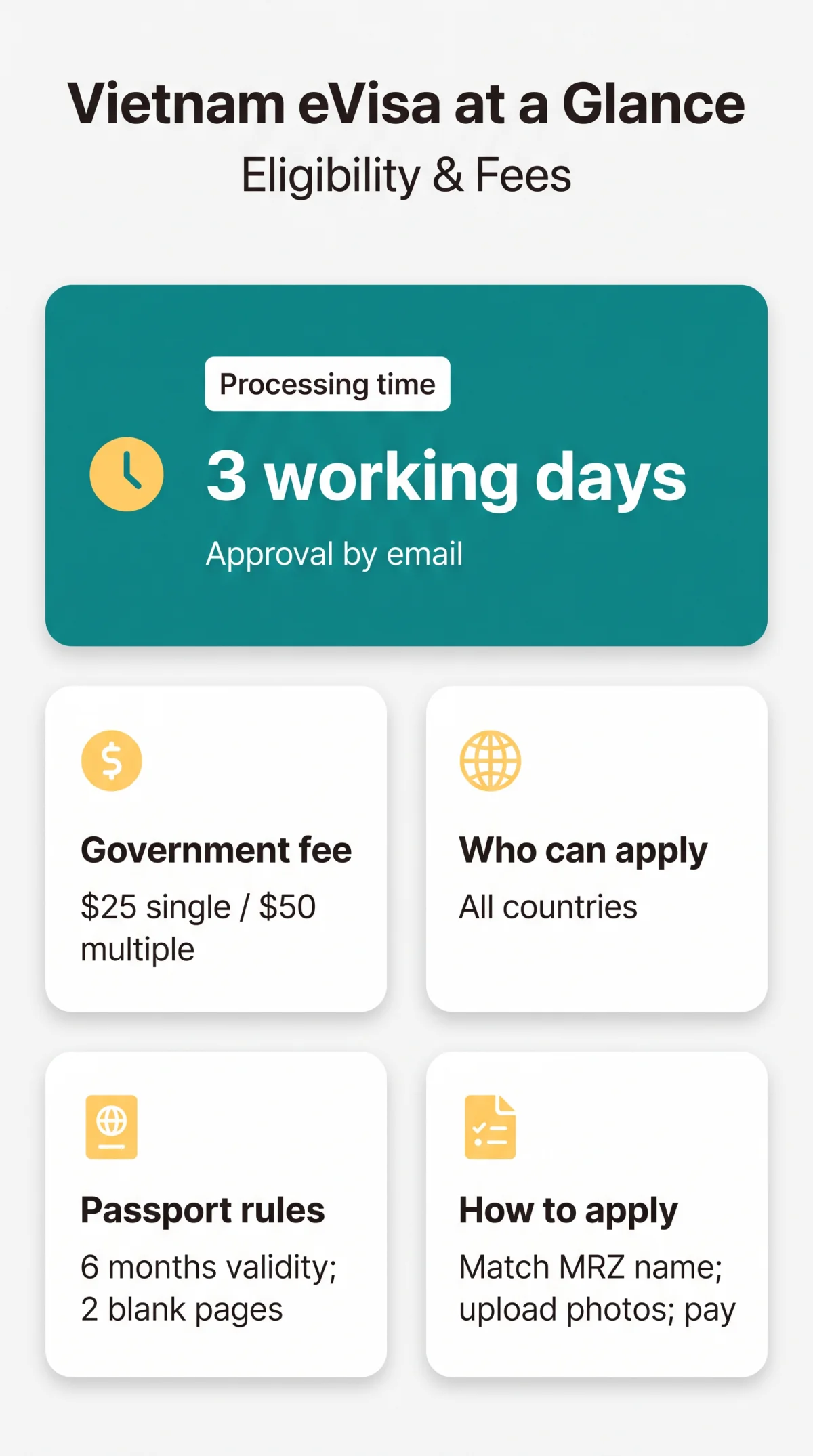
The Vietnam eVisa allows stays up to 90 days, single or multiple entry, and it’s open to citizens of all countries. British Citizen passport holders can also enter visa-free for 45 days. Processing takes 3 working days and costs $25 single entry or $50 multiple entry on the government portal evisa.gov.vn.
This is an independent guide for UK travellers – we’re not a government site, we don’t take fees, and we don’t submit applications on your behalf. We explain the vietnam evisa requirements step by step so you can check every date and rule on the government portal yourself before you travel.
Visa-Free Entry vs the 90-Day eVisa
If you hold a British Citizen passport, you get a 45-day visa exemption stamped free at the border. Stays longer than 45 days need an eVisa – and an eVisa obtained while you are in Vietnam only starts once you leave and re-enter.
| Feature | 45-Day Unilateral Visa Exemption | 90-Day eVisa |
|---|---|---|
| Maximum stay | 45 consecutive days | Up to 90 days |
| Entry type | Single stamp at border | Single or multiple entry |
| Government fee | Free | $25 single / $50 multiple |
| Extension in Vietnam | No extension – exit and reapply | No extension – exit and reapply |
| Who qualifies | British Citizen passports | Citizens of all countries (Article 8(1) – (4) cases excluded) |
Pick the exemption for short holidays. Get the eVisa if your trip runs past 45 days or if you plan to cross into Laos or Cambodia and come back.
A common problem at the border: if you hold a valid eVisa but don’t hand the officer your printed approval, and your nationality is visa-exempt, you may be stamped in under the exemption instead. Check the stamp and tell immigration control at the border at once if it is wrong.
Two other paths exist. Phú Quốc has a separate 30-day visa exemption for visitors arriving directly by air or sea from abroad, or via Hanoi or Ho Chi Minh City, where they clear immigration before the domestic flight. And overseas Vietnamese and their spouses and children can hold a Certificate of Visa Exemption valid up to 5 years (or until 6 months before the passport expires), allowing 180 consecutive days per entry.
Who Is Eligible: Nationalities and Passport Categories
Citizens of all countries and territories worldwide can apply for the eVisa – the scheme opened globally in 2023, except members of official delegations and diplomatic/consular staff covered by Article 8(1) – (4), who apply through a sponsoring body. But not every British passport carries the 45-day waiver.
- British Citizen – 45-day visa exemption plus eVisa eligibility.
- British National (Overseas) – eVisa only, no 45-day waiver.
- Other classes of British nationality – the 45-day exemption covers all classes of British nationality except British National (Overseas), which is eVisa only.
- Other nationalities – eVisa open to all; check the exemption list separately.
Travelling with children? Every child needs their own application and their own fee – there is no group application in Vietnam.
Core Passport and Photo Requirements
Your passport must be valid at least 6 months beyond your arrival date, and the eVisa validity must be at least 30 days shorter than the passport’s remaining validity. Your passport also needs at least 2 blank pages and no damage.
Damaged passports are a real risk: British nationals have been denied both entry and exit because of passport damage. Give it a once-over before you book.
Technical Upload Specifications
- Portrait photo: 4×6 cm, JPG/JPEG, under 2MB, white background, frontal view, taken within 6 months, no glasses, no headwear, formal attire.
- Passport data page scan: full bio-data page including the ICAO/MRZ lines, JPG/JPEG, unobstructed and uncropped.
How to Apply: The Online Form Step by Step
Enter your name exactly as it appears in your passport’s MRZ lines – after you pay, the application can’t be modified. Any mistake means a brand-new application and a new fee.
You can apply up to 1 year before your intended entry date. With 3 working days of statutory processing, give yourself a buffer of at least 10 days.
Open the application form
Go to evisa.gov.vn (or thithucdientu.gov.vn) and open the application form.
Enter your full name
In uppercase, matching the ICAO/MRZ lines including your middle name.
Fill in your personal details
Gender, date of birth, nationality, passport number and expiry date.
Add your entry details
Purpose of entry, intended entry date, entry port and exit port.
Give your address and travel history
Your first temporary residential address in Vietnam and your travel history from the past year.
Upload documents and pay the fee
Upload the photo and passport scan, then pay the fee.
Name Transcription: Matching Your Passport MRZ
Read the two lines of machine-readable text at the bottom of your photo page. Copy the surname, middle name and given name exactly as they appear in the machine-readable lines, in uppercase, in the same order. The middle name must be included – leaving it out means the name no longer matches the passport.
Fees, Processing Times and Payment Issues
The fee is $25 for a single-entry visa and $50 for a multiple-entry visa, and it’s a non-refundable processing fee – you pay it whether the application succeeds or not. Processing takes 3 working days; the approval arrives by email.
UK cards sometimes fail on the payment gateway. Use an international credit or debit card enabled for online payments, and be ready for the one-time-password step; if it fails, try later or use another card. If your card is charged but no application code appears, contact the portal’s support to verify the transaction before paying again.
Genuine submissions happen only on .gov.vn domains. Commercial agencies add their own service fee on top of the government fee for a form you can submit yourself; sites that pose as the immigration authority are a different problem and charge unauthorised fees.
Entry Points and Airport Transit Rules
The eVisa works only at the checkpoints on the government list: 15 airports currently in operation (17 once Long Thanh and Gia Binh open), 27 land gates and 39 seaports. Airports include Noi Bai, Tan Son Nhat, Da Nang, Cam Ranh, Cat Bi, Can Tho, Phu Quoc, Phu Bai, Van Don, Tho Xuan, Dong Hoi, Phu Cat, Lien Khuong, Vinh and Chu Lai, plus Long Thanh and Gia Binh once operational. Land gates include Moc Bai, Lao Bao, Lao Cai, Huu Nghi, Mong Cai, Ha Tien and Cau Treo, among others; the 39 seaports cover Hon Gai, Hai Phong, Da Nang, Nha Trang, Ho Chi Minh City and more.
Your eVisa ties you to the entry point you selected when applying, so a reroute to another airport needs checking with the portal’s support before you fly. Exit is more flexible – you may leave through a different designated gate. But arriving at a checkpoint that isn’t on the list invalidates it.
Sterile Transit vs Landside Self-Transfer
Staying inside the sterile transit area for less than 24 hours? You don’t need a visa. But transferring from an international flight to a domestic one in Hanoi or Ho Chi Minh City means going through immigration and entering Vietnam – even if your final destination is abroad – so you need an eVisa or the exemption.
Dual Citizenship, Entry Bans and Refusal Grounds
Hold both British and Vietnamese nationality? The rule is simple: enter and exit Vietnam on the same travel document.
Carry your British passport for the return to the UK – British citizens need a valid British passport or certificate of entitlement to come home. In Vietnam, use your Vietnamese passport or your 5-year exemption certificate.
Under Article 21 of the Law on Entry, Exit, Transit and Residence of Foreigners in Vietnam, officers can refuse entry for eight reasons: failing entry conditions, unaccompanied children under 14, forged documents or false statements, mental illness or infectious diseases endangering public health, deportation within the last 3 years, expulsion within the last 6 months, epidemic prevention, and natural disasters.
Separately, exit bans can stop you leaving Vietnam – for active criminal or civil investigations, unresolved business disputes, traffic accident investigations, working without a permit, or unpaid financial debts. If you overstay, the authorities can stop you leaving until you pay a fine, and you can be deported and barred from returning. Neither an eVisa nor the 45-day stamp can be extended; you leave and reapply, though eVisa holders already in Vietnam may be considered for a new visa if an authority, organisation or individual there invites or sponsors them.
Arrival Protocols and Related Border Requirements
Declare cash over 15,000,000 VND or USD $5,000, and prescription medication worth over USD $100, at customs. Then check your stamp before you walk away from the desk.
Complete the Digital Arrival Card
Before flying, complete the voluntary Digital Arrival Card at prearrival.immigration.gov.vn – it was introduced on 15 April 2026 and is currently encouraged at Tan Son Nhat. It doesn’t replace an eVisa.
Complete a health declaration if required
For entry, exit or transit – complete it within the 7 days before you cross the border, on paper or online, and be ready to show proof of vaccination if the Ministry of Health asks (Decree No. 165/2026/ND-CP, effective 1 July 2026). If officers suspect a communicable disease they may run a more detailed screening, capped at two hours per person.
Hand over your documents
At the desk, hand over your passport and the printed eVisa.
Check the stamp
Check the stamped permission-to-stay date matches the stay granted on your eVisa, not the visa-exemption default.
Complete the temporary residence declaration
At your accommodation.
Checking the stamp before you leave the desk is the last chance to have it corrected.
Common Mistakes That Cost Travellers Money
- Typing your name from the photo page, not the MRZ. A mismatched middle name gets the application rejected – and you pay the fee again.
- Applying through a commercial intermediary site. Commercial agencies add their own service fee on top of the government fee for a form you can submit yourself on the .gov.vn portal; sites posing as the immigration authority charge unauthorised fees.
- Forgetting the printed eVisa at the border. Present it at the desk and check the stamp before you leave – corrections must be raised with immigration control there and then.
- Transferring onto a domestic flight in Hanoi or Ho Chi Minh City. You pass through immigration, so you need an eVisa or the exemption.
- Arriving at an unlisted checkpoint. Only the checkpoints on the government list of designated international border checkpoints accept the eVisa.
Frequently Asked Questions (FAQ)
Do UK citizens need a visa for Vietnam?
Not for trips up to 45 days – British Citizen passport holders get a unilateral visa exemption stamped free at the border. For longer stays, you’ll need an eVisa valid up to 90 days. British National (Overseas) passports don’t qualify for the waiver.
What are the Vietnam eVisa requirements for passport validity?
Your passport must be valid at least 6 months beyond your arrival date, and the eVisa validity must be at least 30 days shorter than the passport’s remaining validity. It also needs at least 2 blank pages and no damage.
How far in advance should I apply for a Vietnam eVisa?
You can apply up to 1 year before your intended entry date. Processing takes 3 working days, so apply at least 10 days ahead to leave room for corrections – remember, a mistake after payment means a new application and a new fee.
Can I enter Vietnam through a different port than the one on my eVisa?
Your eVisa restricts you to the entry and exit points you selected when applying, so contact the portal’s support if your route changes. You are not, however, required to exit through the same gate you entered – any designated gate will do.
Which website should I use to apply for a Vietnam eVisa?
Use the government portal at evisa.gov.vn or thithucdientu.gov.vn, where the fee is $25 single entry or $50 multiple entry. Commercial agencies add their own service fee for a form you can submit yourself.
Can dual British-Vietnamese citizens use two passports when travelling to Vietnam?
Yes, but enter and exit Vietnam on the same single document. Carry your British passport for the return to the UK – British citizens need a valid British passport or certificate of entitlement to come home – and use your Vietnamese passport or 5-year exemption certificate while in Vietnam.
Can a criminal record or previous overstay get me refused entry to Vietnam?
It can. Article 21 allows refusal if you were deported within the last 3 years or expelled within the last 6 months, and if you overstay, the authorities can stop you leaving until you pay a fine, and you can be deported and barred from returning. You must also declare any past immigration violations truthfully – withholding them is itself grounds for refusing the eVisa.
What do Vietnam eVisa requirements include for children travelling with parents?
Every child needs a separate application and a separate fee, as there is no group application in Vietnam. Unaccompanied children under 14 can be refused entry under Article 21.
Sources and Further Reading
- evisa.gov.vn – the Vietnam National Electronic Visa system: application form, fees, and processing rules.
- evisa.xuatnhapcanh.gov.vn – legacy immigration portal; applications now go through evisa.gov.vn or thithucdientu.gov.vn.
- evisa.gov.vn/faq – answers on name entry, the application window and border-gate rules.
- evisa.gov.vn/instruction – step-by-step application instructions and upload specifications.
- gov.uk – Vietnam entry requirements – FCDO guidance on passport validity, blank pages and border rules for British travellers.
Rules can change, so check the government portal before you travel.