
Yes, the Moc Bai land border Cambodia Vietnam eVisa route works, and it’s the busiest overland gate between the two countries. Vietnam authorises 27 land border checkpoints for eVisa entry, including Moc Bai. You apply online first at evisa.gov.vn: US$25 single entry, US$50 multiple entry, up to 90 days.
This is an independent guide for UK travellers, not a government site. We don’t take payments or file applications for you. Check your details and current rules on the official portal before you travel.
Can You Use a Vietnam eVisa at Moc Bai?
Yes, you can. The Moc Bai international border gate in Tay Ninh province accepts pre-approved eVisas, but there’s no visa on arrival at land borders, so your application must be approved before you set off.

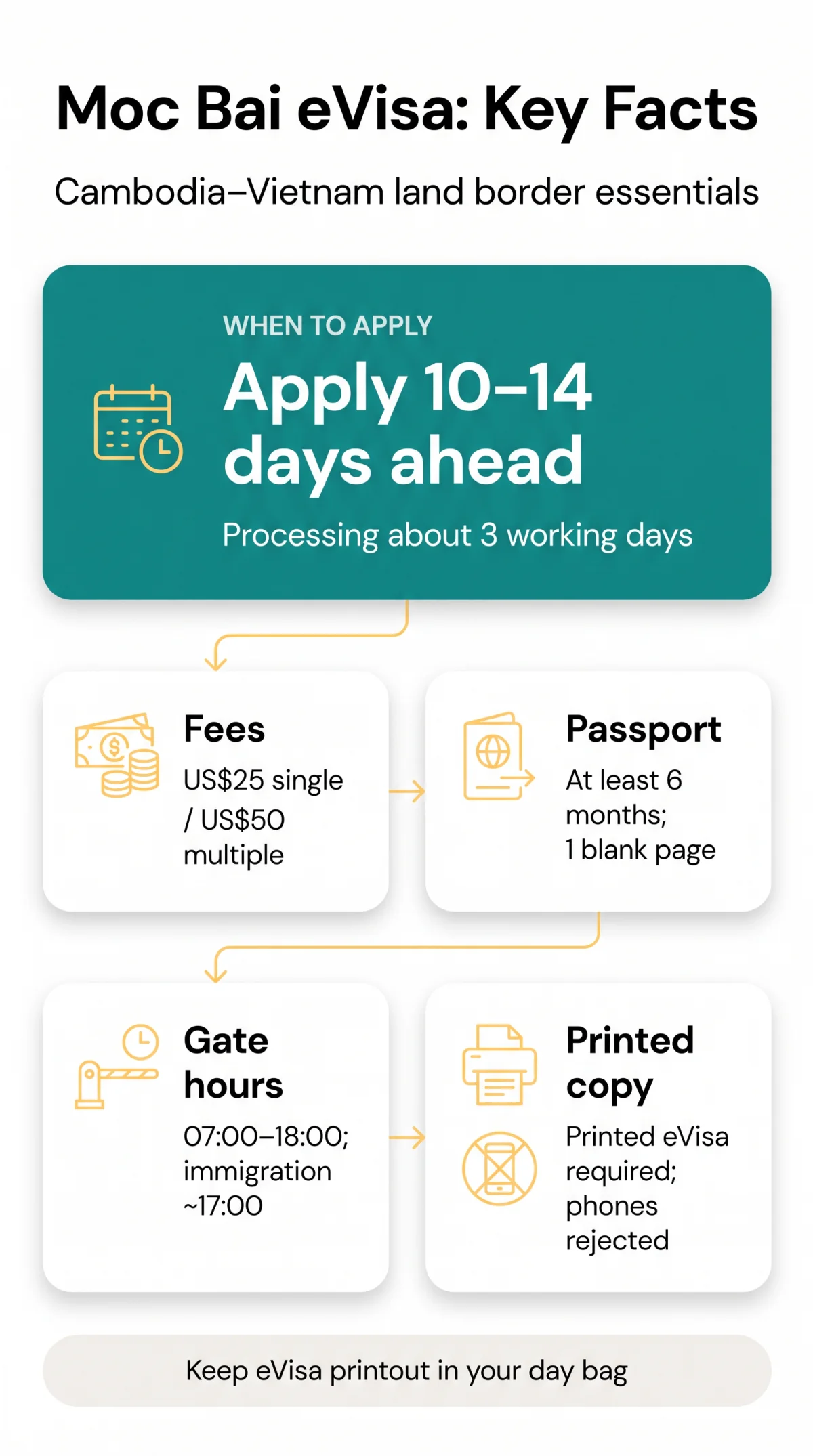
Processing usually takes about three working days, and sometimes longer, so we recommend applying 10 – 14 days ahead. Your passport needs at least six months’ validity beyond your entry date and at least one blank page. You’ll declare your entry checkpoint when you apply, and that choice is fixed.
Moc Bai sits 70 km from Ho Chi Minh City, 34 km south of Tay Ninh City, and roughly 165 km from Phnom Penh. The gate runs 07:00 – 18:00 daily, but immigration processing runs only until around 17:00. Mid-morning is usually the quietest, because the big international sleeper coaches arrive very early or mid-afternoon.
Approved Overland Checkpoints: Cambodia, Laos and China Gates
Vietnam authorises 27 land gates for eVisa entry, and your eVisa is tied to the one you declare; entering through a different gate means applying for a new one, as the pitfalls table below explains.
| Country | Vietnamese gate | Opposite checkpoint | Transport | Recommendation |
|---|---|---|---|---|
| Cambodia | Moc Bai (Tay Ninh) | Bavet | Frequent international coaches | Best for Ho Chi Minh City routes |
| Cambodia | Ha Tien (Kien Giang) | Prek Chak | Regular buses and minivans | Handy for Phu Quoc and the Mekong Delta |
| Cambodia | Tinh Bien (An Giang) | Phnom Den | Local minivans | Quieter route between Chau Doc and Takeo |
| Cambodia | Vinh Xuong (An Giang) | Kaam Samnar | Boats between Chau Doc and Phnom Penh | Land-and-river gate |
| Cambodia | Xa Mat, Tan Nam, Binh Hiep, Le Thanh, Thuong Phuoc, Dinh Ba | Various Cambodian posts | Local transport only | Check links carefully before choosing |
| Laos | Lao Bao (Quang Tri) | Densavan | Coaches and minivans from Savannakhet | Most popular Laos crossing |
| Laos | Bo Y, Cha Lo, Cau Treo, La Lay, Nam Can, Na Meo, Tay Trang, Long Sap, Nam Giang | Various Lao posts | Shared regional minivans | Bring cash; hours can be short |
| China | Huu Nghi (Lang Son) | Ping Xian | Road from Ping Xian / Nanning | Main China – Vietnam corridor |
| China | Lao Cai (and Lao Cai Railway), Dong Dang (Lang Son), Mong Cai, Tra Linh, Thanh Thuy | Various Chinese posts | Rail from Kunming, road via Dongxing | Rail gates suit train travellers |
Le Thanh (Gia Lai) is on the current list of eVisa gates. Cambodia’s own eVisa is not accepted at every land crossing, so check the Cambodian side before choosing this route.
Crossing from Cambodia: How Moc Bai Actually Works
Crossing Moc Bai means taking your luggage off the coach and walking 300 – 500 metres across no-man’s-land. You can also pay 25,000 VND (about $1) for an electric shuttle cart.
Bus Transfer Logistics from Phnom Penh
Ride a cross-border coach to the border terminal.
Take your luggage off the bus.
Clear Vietnamese formalities on foot.
Cross the buffer zone on foot or take the electric cart.
Reboard the coach on the Vietnamese side.
Keep your eVisa printout in your day bag rather than buried in a suitcase.
Passport Control and eVisa Validation
At the stamping desk, hand over your passport and a printed copy of your eVisa. Phone screens are frequently rejected here. The officer validates the visa and stamps you in. Check the entry stamp date before you step away; mistakes are easier to fix at the desk than down the road.
Crossing from Laos and China: Northern and Central Gates
Quieter gates like Bo Y and Tay Trang rely on regional minivans, and you may be asked for a dollar or so in informal ‘overtime’ at weekends and late hours, while China crossings such as Lao Cai offer rail links. The eVisa rules stay the same everywhere: printed copy, locked port of entry, six-month passport validity.
- Cambodia corridors: Moc Bai and Ha Tien have frequent international coaches and predictable hours.
- Laos mountain passes: Lao Bao is the busiest, served from Savannakhet. Bo Y, Tay Trang and Na Meo need shared minivans and their hours vary, so carry small notes for the occasional dollar of informal ‘overtime’.
- China ports: Huu Nghi and Dong Dang connect from Nanning; Lao Cai Railway runs from Kunming; Mong Cai links to Dongxing.
Hours differ from gate to gate; some close in the early evening and Huu Nghi runs around the clock, so confirm opening times before you commit to a remote crossing.
UK Travellers: 45-Day Exemption vs 90-Day eVisa
British citizens can enter overland visa-free for 45 days with no waiting period between visits, or pay for a 90-day eVisa. Here’s how to choose:
- Short trips: the 45-day unilateral visa exemption covers around 24 nationalities, including the UK, and it’s valid at land borders including Moc Bai.
- Longer stays: pay US$25 (single) or US$50 (multiple entry) for the eVisa if you’ll stay past 45 days or re-enter repeatedly.
- Border runs: you can exit at Bavet and re-enter on a fresh 45-day exemption, as no waiting period is required between visa-free entries. Confirm current conditions before planning a border run.
Don’t overstay either way. Fines run 500,000 – 2,000,000 VND for a stay of up to 10 days past your permit.
Border Pitfalls: Port Mismatches, Typos and Scams
Guards reject phone screens, mismatched ports and typo-ridden eVisas, so verify every detail before travelling. Here’s the problem-and-fix view:
| Problem | Risk | What to do on the spot |
|---|---|---|
| eVisa lists Tan Son Nhat, you arrive at Moc Bai | Refused entry; guards can’t edit it | File a new application, use the 45-day UK waiver, or fly instead |
| Typo in name or passport number | Zero tolerance; no on-site edits | Submit a fresh application online |
| eVisa only on your phone | Turned away at the desk | Carry a printed copy |
| ‘Helpers’ at the gates offering to speed up your stamps | You pay for nothing | Official fees are posted at the counters, so pay nothing to helpers or touts |
| ‘VIP pass’ touts | Informal ‘overtime’ of a dollar or so is common at weekends and late hours; anything more is a tout’s invention | Use the normal desks and decline extras |
Cambodia-Side Entry: Bavet Cash Rules and Declarations
Entering Cambodia at Bavet? Prepare this before you leave:
- Visa on arrival is paid in cash US dollars, around US$35, so bring the fee with you.
- Complete the Cambodia e-Arrival Card at arrival.gov.kh before arrival; about a week ahead is advised. It generates a QR code but doesn’t replace a visa.
- The Cambodian eVisa, applied for about three working days ahead, lets you skip the VOA queue at Bavet.
Common Mistakes at the Moc Bai Crossing
- Leaving luggage on the coach. You carry your own bags through the crossing, so unload everything at the terminal.
- Arriving close to 17:00. The gate says 18:00, but passport desks stop earlier, and you could be stuck overnight.
- Assuming guards can fix a wrong port or a misspelled surname; see the pitfalls table above for the fix.
- Paying ‘fees’ at unofficial desks. Official fees are posted at the counters, so decline anything asked elsewhere.
Frequently Asked Questions (FAQ)
Does the Moc Bai land border Cambodia Vietnam eVisa entry work the same as at airports?
Yes, the same eVisa document is validated and stamped either way. The difference is logistics: at Moc Bai you need a printed copy, you take your luggage off the coach, and you cross the buffer zone on foot or by cart.
Which land border checkpoints accept the Vietnam eVisa?
Vietnam authorises 27 land gates: 10 on the Cambodia border (including Moc Bai, Ha Tien and Tinh Bien), 10 on the Laos border (including Lao Bao and Bo Y), and 7 on the China border (including Huu Nghi and Lao Cai). Your eVisa only works at the gate you declared.
Do I need a printed copy of my eVisa at Moc Bai?
Yes. Guards frequently reject phone or tablet screens. Print a paper copy of the eVisa and keep it in your hand luggage, along with a passport valid for at least six months beyond entry.
What are the opening hours of the Moc Bai border gate?
The gate operates 07:00 – 18:00 daily, though immigration processing usually ends at around 17:00. Mid-morning tends to be quietest, because the big sleeper coaches arrive very early or in the mid-afternoon.
Can UK citizens cross at Moc Bai without a visa?
Yes, for up to 45 days under the unilateral visa exemption, which applies at land borders including Moc Bai. No waiting period is required between visa-free entries, so you can exit to Bavet and re-enter on a fresh 45-day exemption.
What happens if my eVisa shows the wrong border checkpoint?
You’ll be refused entry; the declared gate is fixed, so see the pitfalls table earlier in this guide for your options.
How much does it cost to cross the Moc Bai land border with a Cambodia Vietnam eVisa?
The eVisa costs US$25 single entry or US$50 multiple entry. Any official fees at the border are posted at the counters, so don’t hand anything over to helpers or touts. The optional electric shuttle costs 25,000 VND (about $1). Cambodia’s side costs extra if you need a visa there.
Where do I apply for the Vietnam eVisa before crossing at Moc Bai?
Apply at evisa.gov.vn, the national electronic visa portal. Processing usually takes about three working days and can run longer, so apply 10 – 14 days ahead. Declare Moc Bai as your entry checkpoint during the application.
Sources and Further Reading
- evisa.gov.vn – Vietnam’s national electronic visa portal, including the official list of 27 eVisa-eligible land border gates.
Rules can change, so check the portal before you travel.