
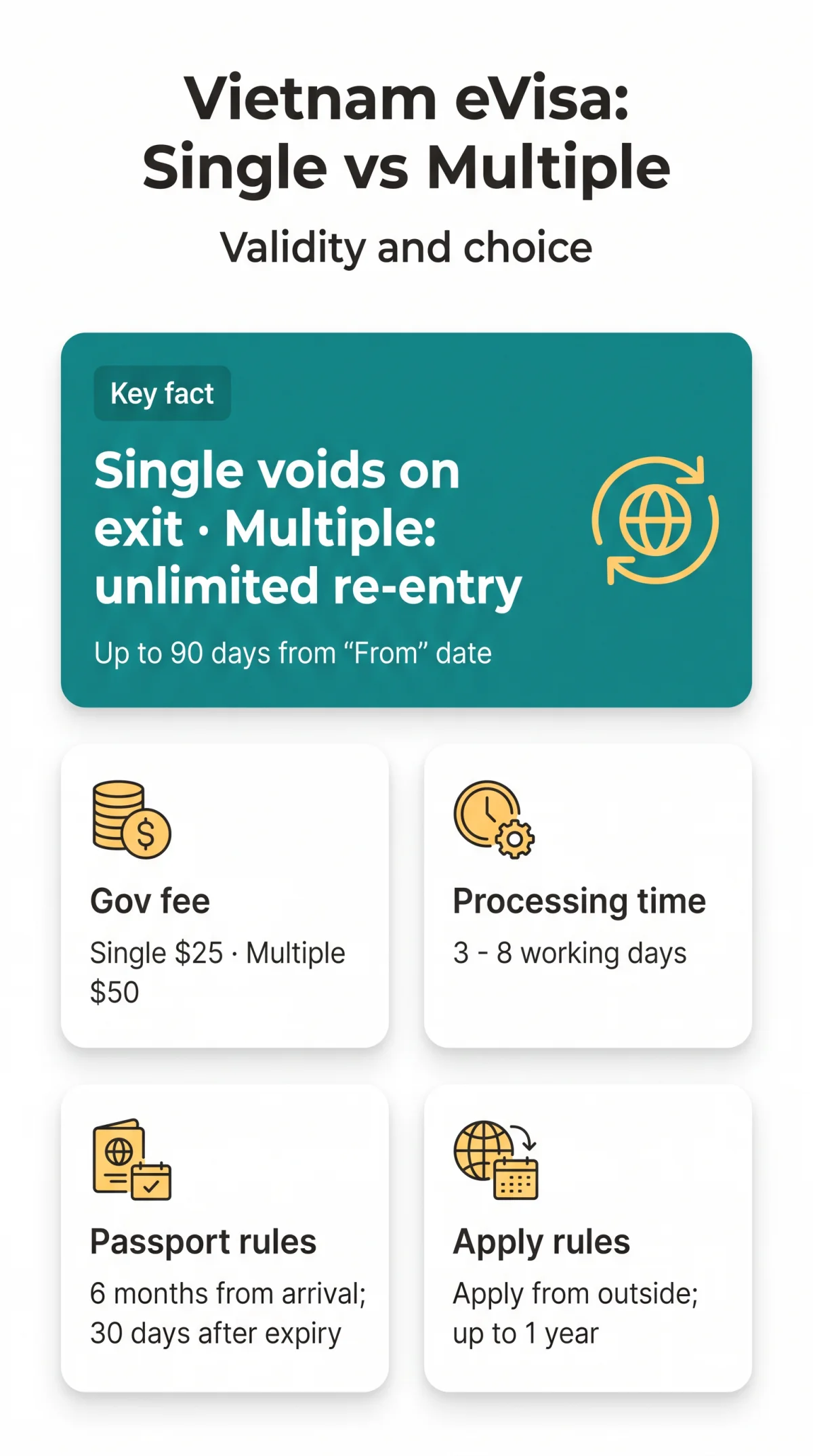
Deciding between a Vietnam single entry vs multiple entry eVisa comes down to one question: will you leave the country and come back? The $25 single-entry permit expires the moment you pass exit immigration. The $50 multiple-entry permit lets you cross the border as many times as you like. Both run up to 90 days in a fixed window that starts on the arrival date you declared, not the day you actually land.
This guide is for UK travellers still shaping their itinerary. We’re an independent travel-information site, not a government service; you can apply directly at evisa.gov.vn. Double-check every rule and date on the official portal before you fly.
Single vs Multiple Entry: Quick Comparison
The fee is the smallest difference; what changes is what happens at the border gate when you leave.
| Parameter | Single-Entry eVisa | Multiple-Entry eVisa |
|---|---|---|
| Government fee | 25 USD | 50 USD |
| Entries allowed | One entry, one exit | Unlimited entries and exits |
| What happens on exit | Visa is void immediately | Visa stays valid |
| Maximum validity | Up to 90 days | Up to 90 days |
| Purpose covered | Tourism or business | Tourism or business |
| Processing time | 3 – 8 working days | 3 – 8 working days |
Fees are paid online through the portal’s payment gateway and are not refunded if the visa is not granted. The 90-day cap for both categories comes from Law No. 23/2023/QH15, and the current tariffs follow Circular No. 28/2026/TT-BTC. Processing is counted in Vietnam local time, UTC+07:00.
Your passport has to clear two complementary rules: at least 6 months of validity from your arrival date, and at least 30 days beyond your eVisa’s expiry date. You can only apply from outside Vietnam, and no earlier than one year before your intended entry. Once you arrive, the manager of your accommodation must declare your stay with the local police, and again each time you change address.
When Validity Starts and How Stay Is Counted
Your validity clock starts on the intended date of entry you gave in the application, and runs to the end date shown on the eVisa.
The window is fixed between the “From” and “To” dates printed on the eVisa. Arriving late simply shortens the stay, because the final permitted exit date does not move.
Nor does arriving early help: the window only opens on the “From” date, so build a small buffer into it for flight delays.
Declaration and processing of applications are counted in Vietnam time, UTC+07:00. Your final exit must take place by the “To” date; if you overstay, the authorities can stop you leaving until you pay a fine.
Does Leaving Vietnam Pause Your 90-Day Clock?
No, and this trips up a lot of people. The multiple-entry eVisa gives you a continuous calendar window, not 90 accumulated days of physical presence. Spend 14 days in Cambodia and the expiry date doesn’t shift; that time is simply forfeited.
It works differently from the Schengen 90/180 rule, where only the days you actually spend inside the area count toward your allowance. In Vietnam, the “To” date on your document is the hard limit regardless of where you’ve been.
Which eVisa Type Fits Your Itinerary?
Match the visa to your route, not to your budget.
- North-to-south domestic trip (Hanoi, Da Nang, Ho Chi Minh City): single-entry covers you fully.
- Indochina loop (Vietnam, then Cambodia, then back to fly home): if you travel on an eVisa it must be multiple-entry; British citizens whose each stay is within the 45-day waiver can instead re-enter on the exemption.
- Halong Bay or domestic Mekong cruises: these stay in Vietnamese waters, so no extra entry is consumed.
- International Mekong cruise to Phnom Penh and back: that’s a border crossing, so you need multiple entry.
You can’t upgrade a single-entry eVisa to multiple-entry once you are in Vietnam. Normally you have to exit and apply again from abroad; only narrow cases, such as applicants sponsored by an agency, organisation or individual in Vietnam, can be issued a new visa in country, so decide before you apply.
Connecting Flights: Landside vs Airside Pitfalls
Flying through Hanoi or Ho Chi Minh City on separate tickets? Check whether your baggage is through-checked. If it isn’t, you must clear immigration, collect your bags landside, and check in again.
That immigration crossing consumes your single-entry visa, and when you return through Vietnam a few days later with no new visa, you’ll be refused entry. Staying airside on an international-to-international connection avoids the problem, but a transfer to a domestic flight in Hanoi or Ho Chi Minh City always means clearing immigration and entering Vietnam.
Selecting Entry Type on the Application Form
You make the key choices in three steps on the evisa.gov.vn portal.

Choose your entry type
Tick “Single entry” or “Multiple entries” as your visa category.
Set your validity window
Fill in your intended date of entry and the final date of your window, leaving buffer room for delays.
Declare your checkpoints
Declare your first entry checkpoint and your final intended exit checkpoint.
The form only allows one entry and one exit border gate, which feels odd for a multiple-entry visa. The rule: declare your first arrival port and your planned final exit port. After that, you may re-enter and exit through any designated international checkpoint, air, land, or sea.
Authorised checkpoints include the airports at Noi Bai, Tan Son Nhat, Da Nang, Cam Ranh, Phu Quoc and Cat Bi, land gates such as Moc Bai, Huu Nghi and Lao Cai, and seaports at Da Nang, Ho Chi Minh City and Nha Trang.
Type your name in UPPERCASE, in the exact order and spelling of the ICAO line in your passport; mismatches can lead to denied boarding or refusal of entry. Review everything before paying, since fees aren’t refunded on rejection.
Submit your application at evisa.gov.vn; sites imitating the portal may charge unauthorised fees on top of the government fee, and paid agents charge a service fee for a form you can complete yourself. If you’re flying into Tan Son Nhat, you have been encouraged since 15 April 2026 to complete a digital arrival card online before arrival; it is not a mandatory requirement, but that may change.
Common Mistakes and the UK 45-Day Exemption Trap
Holders of full British citizen passports get a 45-day unilateral visa exemption (British National Overseas passports are excluded), and that creates a specific risk at the desk. If you don’t hand over your printed 90-day eVisa, the officer stamps the 45-day exemption by default. That stamp then defines your legal stay, and it cannot be changed once you have left the airport or land border, so check it at the counter and tell the officer straight away if it is wrong. Always present the printout actively, and check the stamp date before you walk away.
- Assuming 90 days run from landing: they run from your declared start date, so late arrivals lose days.
- Picking single-entry for a Vietnam – Cambodia – Vietnam route: the visa dies at the first exit.
- Booking a departure after the “To” date: your last exit must happen on or before the final day of the window.
Overstaying brings a fine that has to be settled before you can leave, and in serious cases deportation or a ban on future visits.
Frequently Asked Questions (FAQ)
What is the difference between a single-entry and a multiple-entry Vietnam eVisa?
A single-entry eVisa becomes invalid the moment you leave Vietnam, while a multiple-entry eVisa allows unlimited exits and re-entries throughout its validity. Both can be granted for up to 90 days for tourism or business.
In the vietnam single entry vs multiple entry evisa choice, which suits Cambodia or Laos side trips?
If you travel on an eVisa, it has to be multiple-entry: crossing into Cambodia or Laos and returning counts as a second entry, which a single-entry permit does not allow. British citizens can instead re-enter under the 45-day visa waiver if each stay stays within that limit; a longer return stay means applying for a new eVisa from abroad.
When does the validity period of a Vietnam eVisa start?
Validity begins on the intended date of entry you specified in your application, not the approval date or your actual arrival. The end date is fixed, so arriving late shortens your stay.
Does leaving Vietnam pause the 90-day clock on a multiple-entry eVisa?
No. The 90 days form a continuous calendar window, not an accumulated allowance. Two weeks in Cambodia doesn’t pause or extend your expiry date; your final exit must happen by the “To” date.
Can I re-enter Vietnam on a single-entry eVisa after visiting Cambodia for two days?
No. The single-entry visa is cancelled as soon as you pass exit immigration, even if most of its validity remains. Returning requires a new visa applied for from outside the country.
Which port should I list on my multiple-entry eVisa application?
Declare the border gate of your first planned entry and the gate of your final intended exit, since the form allows one of each. Subsequent crossings can go through any designated checkpoint.
How much does a single vs multiple entry eVisa cost and where do I apply?
The government fee is 25 USD for single entry and 50 USD for multiple entry, paid online and non-refundable if rejected. Apply directly at evisa.gov.vn, from outside Vietnam, up to one year in advance.
Do British citizens need a multiple-entry eVisa for a short stay?
Not for a single visit of up to 45 days, thanks to the visa waiver for British citizens. You need an eVisa when a single stay exceeds 45 days; a short trip to a neighbouring country and back gives you a fresh 45-day exemption on re-entry. If you hold an eVisa, present it to avoid the default 45-day stamp.
Sources and Further Reading
- evisa.gov.vn, the Vietnam National Electronic Visa system, where you apply and pay the government fee.
- evisa.gov.vn FAQs, covering validity dates, checkpoints and entry rules in detail.
- gov.uk entry requirements for Vietnam, UK Foreign Office guidance on the 45-day exemption and passport validity.
Rules can change, so check the official portal before your trip.