
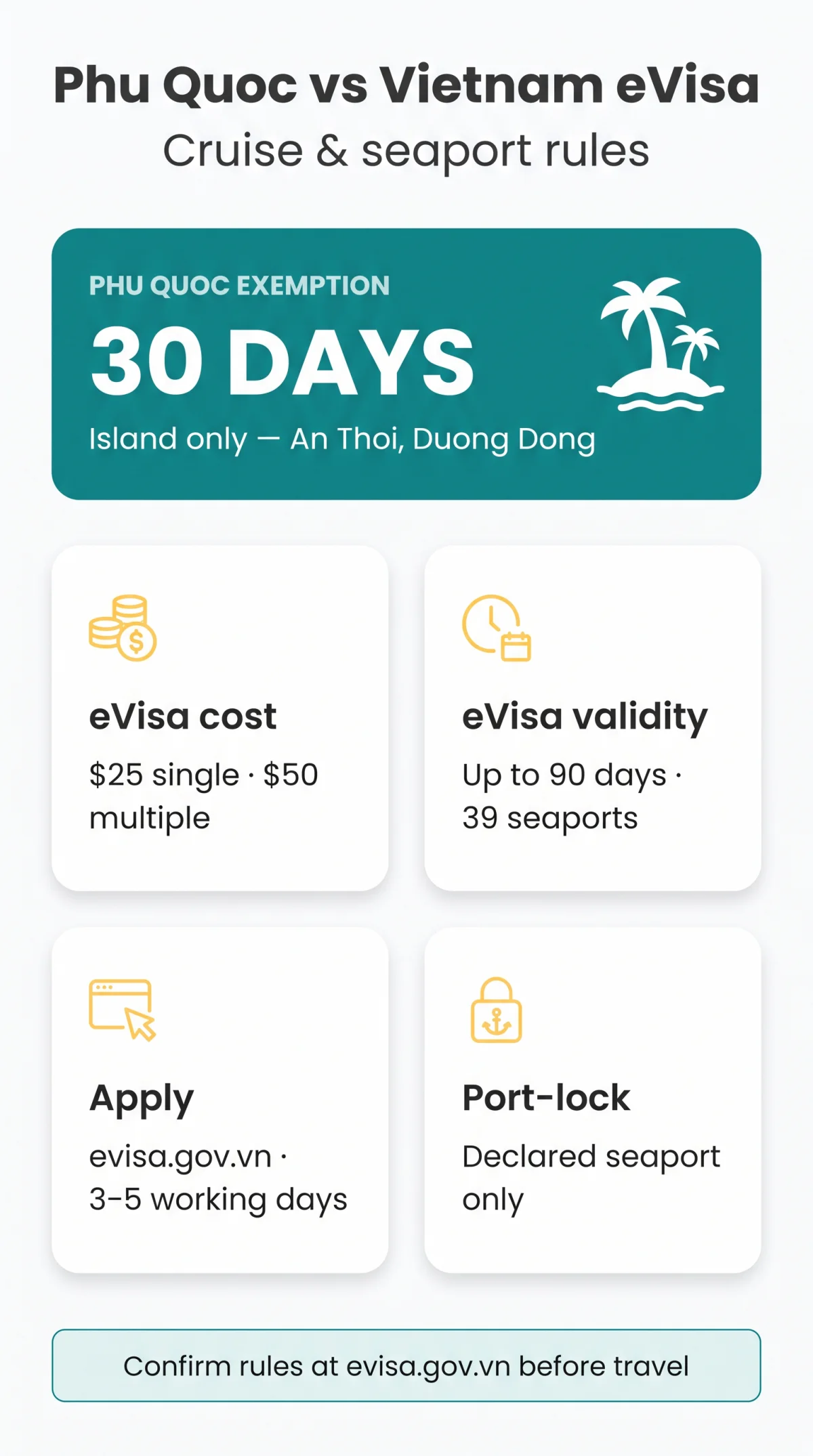
The Phu Quoc visa exemption gives every nationality a free 30-day stay confined to the island, while the Vietnam eVisa costs $25 single-entry or $50 multiple-entry and is valid nationwide, including 39 seaport border gates, for up to 90 days at the port you declare. Cruise passengers calling at mainland ports after Phu Quoc need an eVisa, unless they hold a UK passport and qualify for the free 45-day nationwide waiver. You apply for the eVisa at evisa.gov.vn.
This is an independent guide, not a government site. Always confirm current rules on the official portal before you travel.
Phu Quoc Exemption vs Vietnam eVisa at a Glance
The free 30-day island waiver covers only Phu Quoc; the $25/$50 eVisa is valid across the country’s 83 border gates, including 39 seaports, but you enter only at the checkpoint you declare.
| Criterion | 30-Day Phu Quoc Exemption | Vietnam eVisa |
|---|---|---|
| Geographic coverage | Phu Quoc island only | Entire country (83 border gates) |
| Maximum stay | 30 days | Up to 90 days |
| Government fee | $0 (free) | $25 single / $50 multiple |
| Eligible seaports | An Thoi and Duong Dong only | 39 seaports nationwide |
| Processing | Automatic on arrival | 3 – 5 working days |
| Extension | No (visa run or conversion) | Temporary residence extension handled by the Immigration Department ($10 official fee) |
To use the exemption when arriving by sea, you need to meet every point on this checklist:
- Any nationality qualifies, including Vietnamese citizens holding foreign passports.
- Your passport must be valid for at least 6 months from arrival; airlines and cruise lines check this at check-in.
- Proof of onward travel within 30 days, such as your cruise departure ticket.
- Accommodation details, such as a hotel reservation.
- You arrive on Phu Quoc directly from outside Vietnam and leave the island for another country, with no earlier entry on the mainland.
You enter at An Thoi International Seaport (added under Resolution 389/NQ-CP of 2 December 2025) or Duong Dong Port, where immigration stamps a handwritten exit-by date into your passport.
Vietnam eVisa Requirements for Cruise Ship Passengers
Apply online at evisa.gov.vn three to five working days ahead; the statutory processing time is three working days from a complete, paid application under Article 16b of the immigration law, so apply two to three weeks before your cruise departs, as any correction restarts the clock. The fee is $25 single-entry or $50 multiple-entry, and it is not refunded if your application is refused.
Approved Seaports and the Port-Lock Rule
The eVisa covers 39 seaport border gates, but the port you declare is legally binding. Arriving at a different checkpoint invalidates the visa. Key cruise ports: North – Hon Gai, Cam Pha, Hai Phong; Central – Chan May, Da Nang, Nha Trang; South – Ho Chi Minh City Port, Duong Dong, An Thoi.
Step-by-Step Application and Rejection Traps
Type your name exactly as it appears in your passport
Given and family names in the right order. Name mismatch is the most frequent rejection cause.
Upload a straight-view photo
Plain white background, with no glasses or headwear.
Scan the passport data page
Clearly and uncropped, with no glare or shadows.
Select “Seaport” and your exact port
Choosing an airport voids the visa for a cruise arrival.
Pay online and print the approved eVisa
Track your registration code, then print it for cruise terminal check-in.
An error on an approved eVisa means applying again and paying the fee again. Only apply through evisa.gov.vn or thithucdientu.gov.vn, operational since late 2024; third-party sites charging above $25/$50 add a commercial markup.
Multi-Port Cruise Itineraries and Shore Landing Permits
Sailing from Phu Quoc to any mainland port invalidates the island exemption, so your itinerary determines your document. If your ship leaves Vietnam and returns during the cruise, you need a multiple-entry eVisa; otherwise single entry is enough. Confirm the pattern with your cruise line.
| Cruise Itinerary Pattern | Required Document |
|---|---|
| International → Phu Quoc only → International | 30-day Phu Quoc exemption (free) |
| Phu Quoc → mainland ports | Single-entry eVisa ($25); multiple-entry ($50) if the ship exits and re-enters Vietnam |
| UK passport, any combination ≤ 45 days total | 45-day unilateral exemption (free) |
Without a valid eVisa you can be refused boarding when mainland Vietnamese ports are on the itinerary.
Shore Landing Slip vs Full eVisa for Day Calls
For a single day call, ask your cruise line what it arranges; passengers from nationalities without a visa exemption are generally expected to hold a visa or eVisa. Some ships arrange a shore pass for a day call; the cost and availability depend on the cruise line and the port, so confirm with your line. You must return to the vessel that night, and you can’t travel independently.
| Feature | Vietnam eVisa |
|---|---|
| Validity | Up to 90 days |
| Independent travel | Permitted |
| Overnight on land | Permitted |
You need the full eVisa if you want independent excursions, an overnight stay ashore, or to embark or disembark in Vietnam. Shore passes aren’t available at every port, so confirm with your cruise line before departure.
Transit Traps: Airport Transfers and Mainland Ferries
Self-transfers at Ho Chi Minh City or Hanoi airports, and ferries from Ha Tien or Rach Gia, all trigger mainland immigration, which disqualifies you from visa-free island entry.
Sterile Transit Checklist for SGN and HAN
A self-transfer on separate tickets means clearing immigration and collecting your bags, which is a legal entry into mainland Vietnam and requires a visa.
Visa-free transit works only if all these conditions hold, and an international-to-domestic transfer in Hanoi or Ho Chi Minh City normally means going through immigration, so confirm with your airline first:
- One through-ticket under a single booking reference (PNR).
- Baggage checked through to Phu Quoc at your origin.
- You stay inside the international transit area and never cross immigration.
Ha Tien and Rach Gia Ferry Restrictions
Both ferry terminals sit on the mainland, in An Giang province since the 2025 merger, so sailings to Phu Quoc are domestic services. To board one, you must already be legally present in mainland Vietnam with a visa or exemption.
Warning: if you cross from Kampot or Kep in Cambodia via the Prek Chak / Ha Tien (Xa Xia) land border claiming “transit to Phu Quoc”, the officer at the Ha Tien land gate will require a visa or a valid eVisa. Only arrivals from outside Vietnam qualify, either direct or continuing from a Vietnamese international gate without leaving the transit area.
Staying Longer, Extension Limits and Other Requirements
The 30-day exemption stamp is non-extendable for tourism. To stay past 30 days, you either do a visa run to a neighbouring country such as Thailand, Cambodia or Laos and re-enter, or apply for a proper visa at the Duong Dong immigration office, where the official temporary residence fee is $10 under Circular 28/2026/TT-BTC, with supporting documentation required. Overstaying can mean a fine, being stopped from leaving until it is paid, deportation and a future entry ban.
UK Passport Holders: The 45-Day Exemption Advantage
Under Resolution 44/NQ-CP, valid through 14 March 2028, British passport holders, all classes of British nationality except British National (Overseas), get a free 45-day nationwide stamp on arrival for any purpose, covering Phu Quoc and the mainland. Your decision tree is short: up to 45 days, use the free stamp; 46 – 90 days, apply for a 90-day eVisa; re-entries are also free, as the 30-day gap between exemption stays was removed in July 2020, so an eVisa is only needed for stays over 45 days.
Resolution 229/NQ-CP, in force 15 August 2025 to 14 August 2028, adds 12 more European countries (Poland, Czechia, Switzerland, Netherlands, Belgium, Luxembourg, Croatia, Hungary, Romania, Slovakia, Slovenia, Bulgaria) for tourism only.
Whatever route you take, keep your passport valid for 6 months with at least two blank pages, and carry proof of onward travel and accommodation. For air arrivals at SGN, HAN, DAD or CXR, submit the pre-arrival declaration at prearrival.immigration.gov.vn for expedited lanes; it doesn’t apply to visa-exempt passengers who arrive at Tan Son Nhat and connect straight to Phu Quoc. Check rules on the Immigration Department’s portal at evisa.gov.vn; some other government pages are years out of date.
Common Mistakes Cruise Passengers Make
- Selecting an airport instead of your seaport on the eVisa form, which means you would have to apply and pay again.
- Booking separate tickets through SGN or HAN to reach Phu Quoc. You’d clear mainland immigration and need a visa on the spot.
- Crossing at Ha Tien from Cambodia without a visa, expecting the island exemption to apply. It doesn’t, and you’ll be refused entry.
- Assuming the exemption covers a mainland port call later in your cruise. Cruise lines will deny boarding before you ever reach Vietnam.
- Paying a third-party site above the $25/$50 official fee. Apply only via evisa.gov.vn or thithucdientu.gov.vn.
Frequently Asked Questions (FAQ)
Can I use the Phu Quoc visa exemption if my cruise ship calls at Nha Trang or Da Nang first?
No. Any mainland port entry before Phu Quoc requires a national eVisa, or the 45-day exemption, if your nationality is on Vietnam’s unilateral exemption list. The island waiver only applies to direct international arrivals at Phu Quoc.
Does a UK passport holder need a Vietnam eVisa for a 10-day cruise visiting Phu Quoc and the mainland?
No, as long as your total stay doesn’t exceed 45 days. British passport holders, all classes of British nationality except British National (Overseas), get the free 45-day nationwide stamp under Resolution 44/NQ-CP, valid through 14 March 2028. Re-entries are also free, as the 30-day gap between exemption stays was removed in July 2020, so an eVisa is only needed for stays over 45 days.
What is the difference between an onboard cruise landing permit and the Vietnam eVisa?
Some ships arrange a shore pass for a day call; the cost and availability depend on the cruise line and the port, so confirm with your line. The eVisa, at $25/$50, permits independent excursions, overnight stays and disembarkation at the checkpoint you declared.
Can I fly to Phu Quoc via Ho Chi Minh City without a visa?
Only with a single through-ticket, baggage checked to Phu Quoc, and a transfer that never crosses immigration. Separate tickets mean clearing immigration and collecting your bags, which requires a valid visa.
Can I cross the land border from Cambodia at Ha Tien and take the ferry to Phu Quoc visa-free?
No. The Prek Chak / Ha Tien (Xa Xia) crossing enters mainland Vietnam, and claiming transit to Phu Quoc won’t get you through. Only arrivals from outside Vietnam qualify, either direct or continuing from a Vietnamese international gate without leaving the transit area.
How much does the Vietnam eVisa cost for seaport entry, and is it refundable if my cruise itinerary changes?
The official fee is $25 USD single-entry or $50 USD multiple-entry, paid at evisa.gov.vn. The fee is not refunded if your application is refused. A new application always requires a new full payment.
What happens if bad weather forces my cruise ship to divert to a port not listed on my eVisa?
The eVisa is valid only at the checkpoint you declared, so if your itinerary or port changes, contact your cruise line and check the entry point on your visa before departure.
In the phu quoc visa exemption vs vietnam evisa choice, can I switch after arrival, and can the 30-day stamp be extended?
You can’t convert the exemption into an eVisa from inside Phu Quoc, and the 30-day stamp is non-extendable for tourism. To stay longer, do a visa run and re-enter, or apply for a proper visa at the Duong Dong immigration office, where the official temporary residence fee is $10.
Sources and Further Reading
- National Portal on Immigration – official eVisa application and fee details.
- gov.uk – UK-specific entry requirements for Vietnam.
- Vietnamese embassy, Japan – Resolution 44/NQ-CP exemption details.
Rules can change, so confirm them on evisa.gov.vn before your trip.