
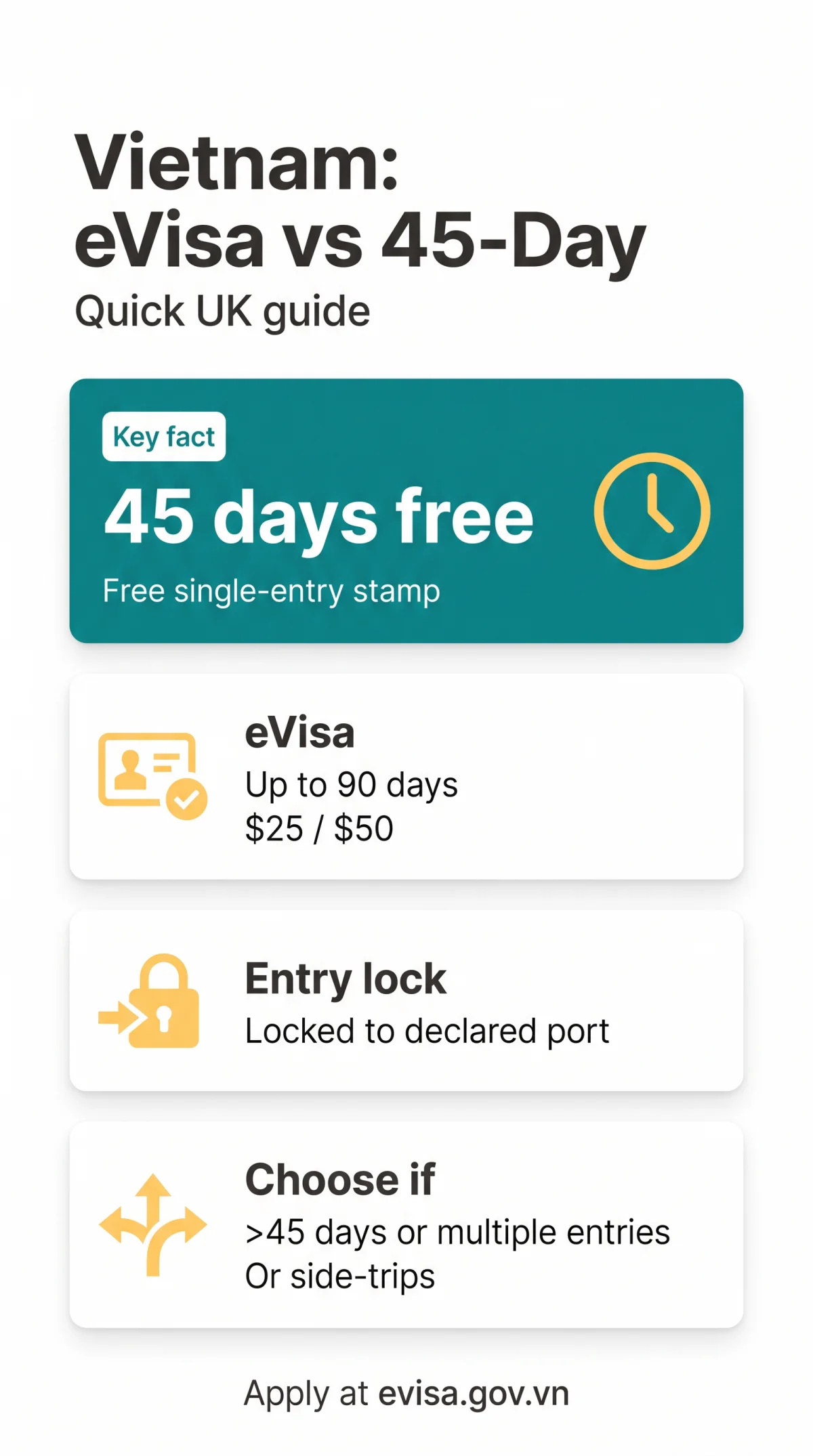
Deciding between the Vietnam eVisa vs 45 day visa exemption comes down to three things: how long you’ll stay, how many times you’ll enter, and how fixed your route is. British travellers staying under 45 days get a free single-entry stamp at the border. Stays up to 90 days or trips with regional side-visits need an eVisa or another visa type; the eVisa costs $25 single entry or $50 multiple entry, applied for via evisa.gov.vn.
This is an independent guide, not a government site, so we don’t take fees or submit applications on your behalf. We explain how both routes work, including the repealed cooling-off rule and how to switch between them mid-trip. Before you fly, double-check current rules on the official portals linked below.
eVisa vs 45-Day Exemption: The Basics
The exemption is a unilateral visa waiver: eligible passport holders get a stamp on arrival, free of charge, for up to 45 days, single entry. The eVisa is a pre-approved electronic visa you apply for online, valid up to 90 days, single or multiple entry, with a fee. Standard processing runs about 3 to 5 working days, and you can apply up to a year in advance.
| Feature | 45-Day Exemption | 90-Day eVisa |
|---|---|---|
| Maximum stay | 45 days from arrival | Up to 90 days |
| Cost | Free | $25 single / $50 multiple |
| Entries | Single only | Single or multiple |
| How you get it | Stamped at the border | Online, about 3 to 5 working days |
| Entry point | Not tied to a declared port | Locked to your declared port |
Who Qualifies for Each Route
British Citizen passports qualify for both routes. The waiver covers 13 unilateral countries, including the UK, Germany, France, Italy, Spain, Japan, South Korea, Russia, Denmark, Sweden, Norway and Finland, extended to 14 March 2028. A further 12 European countries, including Switzerland, were added under Resolution 229 for tourism stays, valid 15 August 2025 to 14 August 2028.
British National (Overseas) passports don’t qualify for the waiver. The eVisa, by contrast, is open to citizens of all countries and territories, except individuals restricted under Articles 8 and 21 of the immigration law.
Choosing the Right Option for Your Itinerary
Match the document to your route, not just your dates. Leaving Vietnam voids the single-entry waiver, so a Vietnam plus Cambodia or Thailand trip needs either a multiple-entry eVisa or a fresh entry stamp each time.
- Choose the 45-day exemption if you’re on a single-entry holiday of up to 45 days, want zero paperwork and zero fees, or might change your entry route at the last minute.
- Choose the 90-day eVisa if you’re staying over 45 days, planning side-trips to Cambodia, Laos or Thailand, or needing more than one entry on the same document.
The eVisa Entry Checkpoint Lock
Here’s the trap most guides miss. When you apply, you declare your entry port, and the visa is locked to it. If you arrive at a border gate other than the one you declared, the eVisa cannot be used there. The exit port can differ from the entry port, but the entry point can’t be switched once the visa is issued.
The exemption has no such lock. It is not tied to an entry point you declare in advance. Overland backpackers crossing from Cambodia or Laos should lean towards the waiver if they’re eligible.
Entry Requirements and Border Documentation
Whatever route you take, bring a passport valid at least six months from arrival, with two blank pages and no damage. The eVisa rule asks for 30 days of validity beyond the visa’s expiry, but Vietnam’s entry rules require six months’ validity from your arrival date, so keep that buffer.
- Proof of onward or return travel departing within 45 days
- Accommodation details or a booking confirmation
- A digital arrival card, recommended when entering via Tan Son Nhat (SGN)
- For the eVisa: a printed copy of your eVisa with details matching your passport exactly
One practical point for worn passports: every entry and exit adds stamps, so keep the two blank pages the rules require.
How to Apply for the eVisa and Avoid Rejection
You apply through the government immigration portal at evisa.gov.vn. Watch out for lookalike commercial sites charging markups; check the address bar before paying.
Prepare your documents
A digital portrait photo and a scan of your passport’s bio-data page.
Fill in your name exactly
As it appears on the ICAO/MRZ line, including middle names.
Declare your entry and exit ports
Choose them carefully.
Pay the fee
$25 for single entry or $50 for multiple entry; the fee is non-refundable even if you’re rejected.
Allow about 3 to 5 working days
Apply well before your flight.
You can’t edit the application after submitting, and you can’t fix an issued visa either. A single wrong letter in your name or passport number means a brand-new application and a new fee.
Cooling-Off Rule and Back-to-Back Visa Runs
The old 30-day waiting gap between visa-free entries is gone. It was repealed on 1 July 2020 under the amended Law on Entry, Exit, Transit and Residence, so the cooling-off period is now zero days. You can exit to Cambodia, Laos or Thailand and re-enter the same day for a fresh 45-day stamp, and there’s no statutory quota on how many times.
The catch is discretion at the desk. Officers can refuse entry on the grounds listed in Article 21 of the immigration law, and working in Vietnam requires a work permit whatever route you use. Repeated stamps invite questions, so carry evidence.
| Consecutive waiver entries | What the rules say | Evidence worth carrying |
|---|---|---|
| First entry | A 45-day stamp is granted on arrival | Onward ticket, hotel booking |
| Second in a row | No re-entry limit; you can return the same day for a new stamp | Bank statement, UK return ticket |
| Third or more | Still no statutory limit; each entry grants a fresh 45-day stamp | All of the above plus clear travel plans |
Switching, Stamp Checks and Overstay Penalties
You can’t convert a waiver into an eVisa from inside Vietnam. If your eVisa is approved while you’re there, it stays dormant until you exit and re-enter through an international border gate. The 45-day waiver also can’t be extended at immigration offices without a licensed sponsor filing Form NA5.
So if you fall for Vietnam and want to stay longer, plan the switch around the border:
Leave Vietnam
Before your 45-day stamp expires
Apply for the eVisa
Once you are outside the country
Re-enter Vietnam
Through the border gate you declared
If an eVisa is issued while you are still in Vietnam, it only starts after you exit and re-enter.
Before you walk away from the immigration desk, check your temporary residence certificate stamp. Your arrival day counts as day 1, so the leave-by date should be 45 days out. If the stamped date is wrong, tell immigration control at the border gate straight away, before you leave. Once you’ve left the arrivals hall, the date can’t be corrected.
Overstaying isn’t worth it. The authorities can stop you leaving until you pay a fine, and you could be deported and barred from returning.
| Overstay situation | Typical consequence |
|---|---|
| Any overstay | The authorities can prevent you from leaving until you pay a fine |
| Overstay or working illegally | Fines apply, and deportation is possible |
| Serious cases | Deportation and being prevented from visiting Vietnam in the future |
Common Mistakes and How to Avoid Them
- Declaring the wrong entry port on the eVisa. Arriving elsewhere means refusal. Pick your port only once your route is fixed.
- Flying without onward travel proof on the waiver. A return or onward ticket is one of the entry conditions, so have one ready.
- Typing your name loosely on the application. It must match the MRZ line letter for letter, or you’ll pay the fee twice.
- Assuming you can extend the 45-day stamp locally. You can’t, so plan the border run or the eVisa before day 45, not after.
Frequently Asked Questions (FAQ)
Is the 45-day Vietnam visa exemption completely free for UK citizens?
Yes. There’s no border fee or application charge for eligible British Citizen passports. The eVisa costs $25 single entry or $50 multiple entry.
Does the 30-day cooling-off period still apply between visa exemptions?
No. The gap was repealed on 1 July 2020 under the amended immigration law, so you can re-enter immediately. Officers still hold discretionary power to question repeated back-to-back entries, so carry proof of funds and onward travel.
Can I extend my 45-day visa exemption without leaving Vietnam?
No, not as an ordinary tourist. Immigration offices won’t extend the stamp without a licensed sponsor filing Form NA5 or qualifying family ties. You’ll need a border run or a fresh eVisa activated by re-entry.
What happens if my eVisa application is delayed and my flight is today?
As a UK passport holder, you can fly on the 45-day waiver instead, provided you hold an onward ticket within 45 days. An eVisa can only be used within its validity dates and at the entry gate you declared, and you must present it to officers on arrival for it to apply.
Can I enter Vietnam at an overland border crossing with an eVisa?
Yes, if you declared that land crossing as your entry port on the application. The eVisa works at designated land, air and sea border gates, but you cannot use it to enter at a gate other than the one you named.
How do I settle the vietnam evisa vs 45 day visa exemption question mid-trip?
You can’t switch documents inside Vietnam. The eVisa is issued to travellers who are outside the country, so exit before your 45-day stamp runs out, apply from abroad and re-enter through the gate you declared. An eVisa issued while you are in Vietnam only starts after you exit and re-enter.
What should I do if the border officer stamps fewer than 45 days?
Tell immigration control at the border gate straight away, before you leave the immigration area. The date cannot be changed once you have left border control, and the printed date is what counts against overstaying.
Can I work remotely on a 45-day exemption or an eVisa?
No. The waiver covers tourism and business visits and the eVisa covers short visits, but neither authorises employment: working in Vietnam requires a work permit or written confirmation that a permit is not needed.
Sources and Further Reading
- gov.uk: Vietnam entry requirements – UK government travel advice on visas and exemptions
- evisa.gov.vn – Vietnam’s national electronic visa application portal
- evisa.gov.vn FAQ – answers on fees, validity and passport rules
- vietnam.gov.vn – general visa and customs procedure information (not updated with the 45-day exemption)
Rules can change, so confirm details on the portals before you travel.