
To activate a newly approved Vietnam eVisa, you leave Vietnam at Mộc Bài, stamp into Cambodia at Bavet, and re-enter the same day. Your eVisa must name the Mộc Bài land border gate as your entry checkpoint. UK passport holders can also re-enter on a fresh 45-day visa exemption, since the old 30-day gap rule no longer applies.
This guide covers the whole vietnam visa run to cambodia 2026 process: paperwork, costs, timing, and what to do when things go wrong. It’s an independent travel guide, not a government site. Before you travel, check the current rules on the FCDO Cambodia entry requirements page and verify your eVisa details yourself.
How a Vietnam Visa Run Works
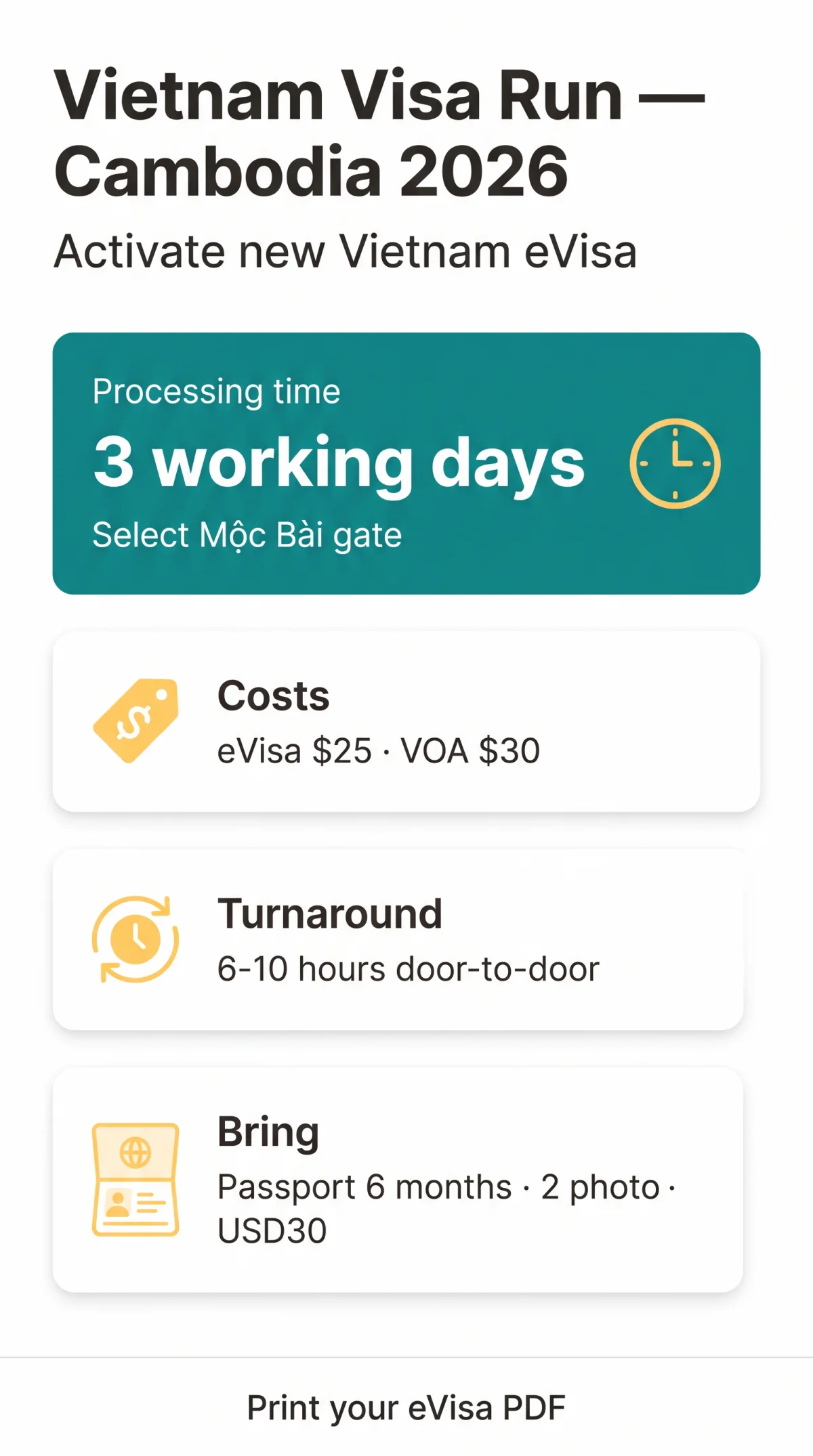
A border run resets your legal stay by pairing a physical exit stamp from Vietnam with a newly approved entry permission. Tourist eVisas can’t be extended inside the country, so the exit is the only way to start a new stay. A single-entry eVisa costs US$25, a multiple-entry one US$50, and both can run up to 90 days. Processing takes around 3 working days, so apply before you run out of time. Apply on Vietnam’s government eVisa portal at evisa.xuatnhapcanh.gov.vn and select the Mộc Bài land border gate as your entry checkpoint.
There’s one catch worth knowing early: practice differs here. In some cases you cannot get a new eVisa while still inside Vietnam and must exit first; in others, you apply online in advance and travel to the border with the approved PDF. Two safer paths exist: apply well ahead of your expiry date, allowing at least the three working days of standard processing, with a future entry date and Mộc Bài as your port, or apply after you’ve already exited to Cambodia or Thailand. Treat this as a systemic risk, not a certainty.
Legal status in 2026: A same-day return from Cambodia is legal. The 30-day waiting period between visa-exempt entries was abolished (Law No. 51/2019/QH14), so a traveller eligible for the exemption can re-enter the same day.
Applying from Thailand or Cambodia, or from Inside Vietnam
Applying from Bangkok or Phnom Penh is the cleanest option, because your location matches your application. If you’re already in Vietnam, don’t leave it to the last day; apply in advance with a future entry date and the Mộc Bài gate as your checkpoint. If the system suspends your application anyway, UK travellers can fall back on the 45-day visa exemption for re-entry.
The 45-Day Exemption Alternative for UK Passport Holders
British passports qualify for Vietnam’s unilateral 45-day visa exemption. Since the 30-day gap rule is gone, you can exit at Mộc Bài and return the same afternoon on a fresh 45-day stamp, no new eVisa needed. That makes the exemption a workable backup if your eVisa application stalls; it is granted at the border to eligible nationalities and is single entry, so check the current rules before you rely on it.
The Checkpoint Trap: Your eVisa Must Match Mộc Bài Landport
Your eVisa is tied to the checkpoint you selected, so an approval issued for an airport is not the right document for a land crossing. If you change your port of entry, you need a new approval. If your approval PDF says “Tan Son Nhat Int Airport” but you show up at Mộc Bài, you would have to stay in Cambodia and apply for a new eVisa issued for the Mộc Bài land border gate, or fly into Vietnam instead.

In the application, select the Mộc Bài land border gate from the list of permitted checkpoints. Five Vietnam-Cambodia crossings accept the eVisa:
- Mộc Bài – Bavet
- Hà Tiên – Prek Chak
- Tịnh Biên – Phnom Den
- Vĩnh Xương – Kaam Samnar
- Xa Mát – Trapeang Phlong
Note that Lệ Thanh – Oyadav does not accept eVisas, so don’t plan a run through that crossing.
| What your eVisa says | Where you arrive | What happens |
|---|---|---|
| Mộc Bài land border gate | Mộc Bài road crossing | Correct document for this gate |
| A Ho Chi Minh City airport | Mộc Bài road crossing | Wrong checkpoint; you need a new approval for the Mộc Bài gate |
| Mộc Bài land border gate | Any other land crossing | Wrong checkpoint; the approval is valid only for the gate you selected |
Documents and Money You Need for the Mộc Bài Run
Bring a passport valid for at least six months, a printed eVisa approval, and US$30 in clean, unmarked dollar bills for your Cambodian visa on arrival. Here’s the full checklist:
- Original passport, valid at least 6 months, with 1 – 2 blank pages.
- Printed eVisa approval; officers work from the paper print-out.
- Two 4×6 cm passport photos; one is needed for the Cambodian visa on arrival, and they are required if you re-enter on a visa-on-arrival approval letter.
- USD cash for Cambodia, plus a pen for any forms.
- An entry-exit form, needed mainly if you re-enter on a visa-on-arrival approval letter.
Cambodia Entry: Visa on Arrival, USD Condition, e-Arrival Card
Cambodia’s tourist visa on arrival is valid 30 days from entry, single entry, costs US$30 in cash and requires a passport photo. The Cambodian eVisa is an alternative at about US$36 (a US$30 visa fee plus a processing fee); allow three to four working days and enter within three months of issue.
Cambodia’s e-Arrival Card is required for arrivals by air at Phnom Penh, Siem Reap and Sihanoukville airports, submitted free of charge at arrival.gov.kh within the 7 days before arrival. Land crossings such as Bavet still use the paper arrival form, which you fill in at the counter. Vietnam’s digital arrival card applies to arrivals at the main international airports (SGN, HAN, DAD, CXR, PQC) and is submitted within three days before arrival; check the current scope before you travel.
One detail saves real hassle: your USD bills should be clean, unmarked and in small denominations; torn or written-on notes get rejected, and the nearest exchange stalls offer poor rates. Officers may also ask for unofficial “tea money” of 100,000 VND or $1 – 10 USD, especially on weekends, early mornings, or after 16:00. It is not an official fee and you will not get a receipt.
Step-by-Step: Walking the Mộc Bài to Bavet Crossing
Complete outbound clearance at Mộc Bài, stamp into Cambodia at Bavet, and re-enter the same day; border formalities take about 30 minutes if you arrive early and up to 3 – 5 hours once queues build. The Mộc Bài gate operates 07:00 – 20:00 daily (some listings say 08:00); start early, as travellers who reach the border between 07:30 and 09:00 clear it fastest, and the last buses back leave in the late afternoon.
Get your Vietnam exit stamp
At the Mộc Bài Border Gate.
Walk or ride through the neutral zone
Between the two posts.
Buy the Cambodia visa on arrival
At the Bavet checkpoint, and fill in the paper arrival form.
Get your Bavet exit stamp
Once Cambodia has stamped you in.
Return to Mộc Bài
Present your printed eVisa for the re-entry stamp.
Catch your return transport
To Ho Chi Minh City.
Getting from Ho Chi Minh City to Mộc Bài
Mộc Bài sits about 70 km from HCMC, a 2 – 3 hour drive each way. Express buses leave from Phạm Ngũ Lão with Danh Danh Express, Sapaco, Kumho or Mekong Express for 260,000 VND (roughly 10 – 12 USD) one way. Organised visa-run vans and private cars with a driver are also available; agencies quote per trip. Older guides still list public bus 703 for 40,000 VND; travellers report that service has stopped, so plan on a long-distance bus to Phnom Penh instead.
Costs and Timeline for a Same-Day Return
A same-day turnaround takes 6 – 10 hours door-to-door from HCMC. Budget roughly 80 – 90 USD for a self-organized return trip.
| Item | Cost |
|---|---|
| Cambodia visa on arrival | $30 USD cash |
| Vietnam eVisa, single entry | $25 USD |
| Express bus, both ways | 520,000 VND (~$21) |
| Incidentals and buffer | $5 – 10 USD |
Common Mistakes and Contingency Plans
Settle any overstay fine before exiting, and arrange backup lodging in Bavet if your new eVisa approval stalls. Vietnam fines overstays of up to 10 days at 500,000 – 2,000,000 VND, payable at the border. In Cambodia, overstays are fined for every day over; travellers report around US$10 a day, and there is no upper limit on the fine. If you overstay by more than 30 days, you must leave the country and pay the fine, with detention and deportation possible.
- Wrong entry port on the eVisa: you need a new approval for the gate you’ll use. Check the port line on your PDF before you leave HCMC.
- Worn USD bills: visa payment rejected. Bring clean, unmarked notes in small denominations.
- Phone-only eVisa copy: bring a printed copy of the approval, not just the file on your phone.
- Applying from inside Vietnam too late: suspension risk. Apply with the standard three working days of processing to spare, or after exiting.
If your eVisa has not been approved after you’ve exited, you wait on the Cambodian side or travel on to Phnom Penh, where the Vietnam Embassy at 436 Preah Monivong Blvd handles visa applications in about 3 – 7 working days.
Alternatives: Flying to Thailand vs the Land Crossing
Flying from Saigon to Bangkok costs considerably more than the land run, but UK passport holders enter Thailand visa-free as tourists (a shorter stay applies at land borders) and avoid the cash hassle. Laos and China have land crossings too, and most of them accept the Vietnam eVisa. Choose the flight if your eVisa is delayed and Bavet lodging doesn’t appeal.
| Factor | Land run via Mộc Bài | Flight to Bangkok |
|---|---|---|
| Typical cost | $80 – 90 total | Airfare plus a night’s accommodation |
| Time needed | 6 – 10 hours same day | Overnight or longer |
| Cash handling | Clean USD cash required | No US-dollar cash needed at the border |
Frequently Asked Questions (FAQ)
Do you need a visa to enter Cambodia from Vietnam?
Yes, UK passport holders need a Cambodia tourist visa. Buy a visa on arrival at Bavet for $30 USD cash, or apply online for the $36 eVisa. Both allow a 30-day stay, single entry.
How do I activate my Vietnam eVisa with a border run to Cambodia 2026?
Exit Vietnam at Mộc Bài, get stamped into Cambodia at Bavet, then return the same day and present your printed eVisa. The re-entry stamp activates it. Your eVisa must be issued for the Mộc Bài land border gate.
Are visa runs to Cambodia legal for Vietnam?
Yes, a same-day exit and return is legal for travellers eligible to re-enter. The 30-day waiting rule was abolished by Law No. 51/2019/QH14.
Can I apply for a Vietnam eVisa while still inside Vietnam?
You can try, but applications filed from inside the country are sometimes suspended. Apply early enough to cover the three working days of standard processing before your visa expires, or apply after exiting to Cambodia or Thailand.
How much does a Vietnam visa run to Cambodia cost?
A self-organized same-day return runs roughly 80 – 90 USD: $30 for the Cambodian visa on arrival, $25 for a single-entry Vietnam eVisa, and about 520,000 VND for return buses from HCMC.
How long does the Moc Bai to Bavet border run take?
Expect 6 – 10 hours door-to-door from Ho Chi Minh City, with the drive taking 2 – 3 hours each way and border formalities ranging from about 30 minutes early in the day to 3 – 5 hours once queues build. The gate operates 07:00 – 20:00 daily, and an early start means the fastest clearance.
What happens if my eVisa lists the wrong entry port?
The eVisa is tied to the checkpoint selected in the application, so one issued for an airport or another crossing is not valid at Mộc Bài. You’d need to stay in Cambodia and apply for a new eVisa for the Mộc Bài land border gate, or fly into Vietnam instead.
Do I need Cambodia’s e-Arrival Card at the Bavet land border?
No. The electronic arrival card is required for arrivals by air at Phnom Penh, Siem Reap and Sihanoukville airports, where you submit it free at arrival.gov.kh within the 7 days before landing. At Bavet you still fill in a paper arrival form at the counter, and you still need a Cambodian visa.
Sources and Further Reading
- Vietnam government eVisa portal – online eVisa applications and fees.
- FCDO: Cambodia entry requirements – Cambodian visa costs, e-Arrival Card rules, and overstay penalties.
- Cambodia official eVisa portal – online tourist visa applications and fees.
- Cambodia Digital Arrival Card – online arrival declaration for air arrivals.
- Government of Canada: Cambodia travel advice – entry requirements and border conditions.
Rules can change, so confirm the details on the official portals before you travel.