
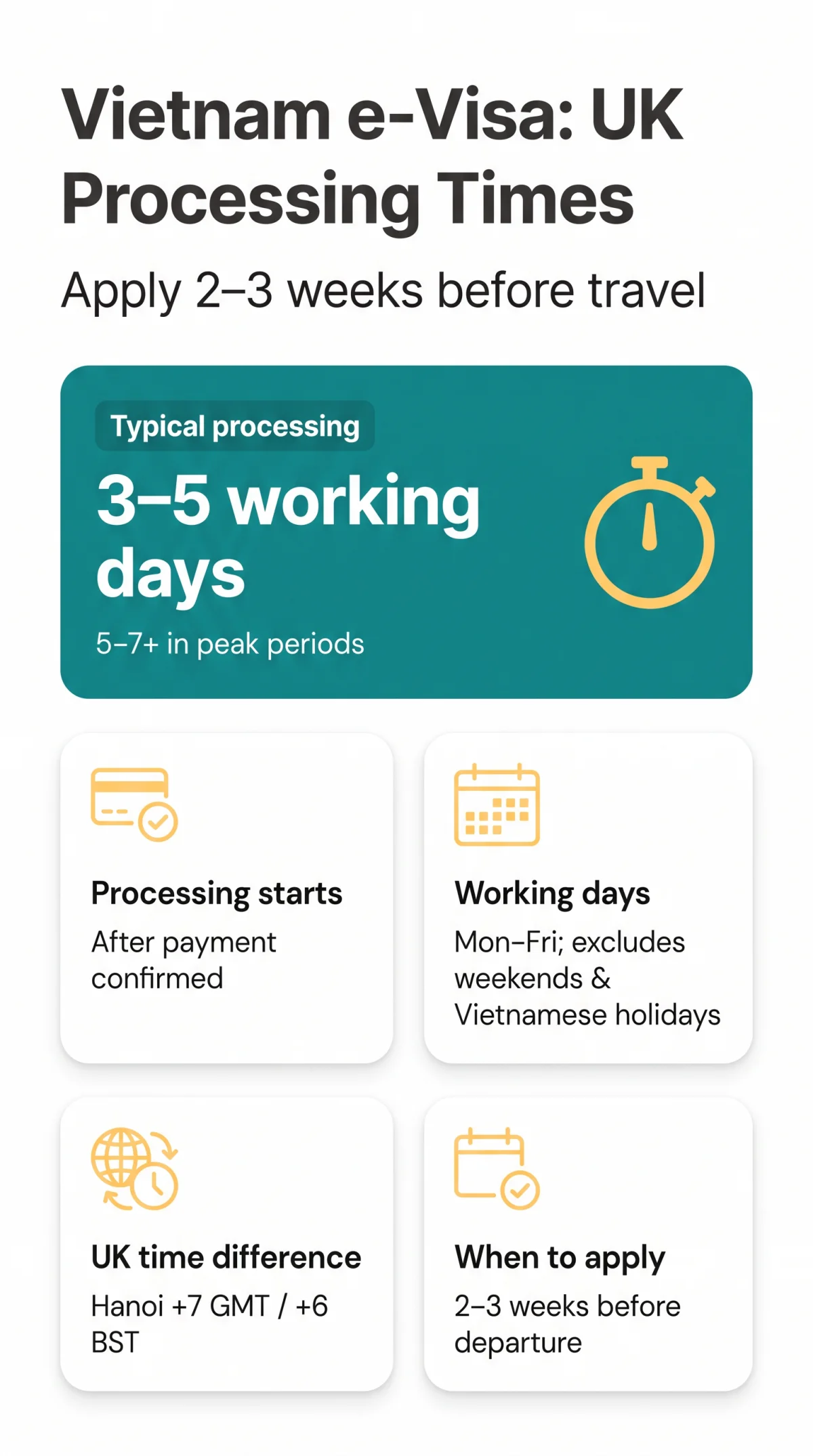
The Vietnam evisa processing time is officially 3 working days, but UK travellers should allow 3 to 5 working days, and 5 to 7 or more in busy periods. The clock starts only after your fee payment is confirmed, and weekends and Vietnamese public holidays pause it entirely. Apply 2 to 3 weeks before departure to stay safe.
This guide is for UK tourists planning a trip to Vietnam and covers everything that affects your e-Visa turnaround: submission cut-offs, the holiday closures still ahead, and what to do when an application stalls. We’re an independent travel information site, not a government page – you apply and pay on the official portal at evisa.gov.vn, and we don’t collect fees or submit applications on your behalf. Always confirm current rules and timelines on the official portal before you travel.
The 3-Working-Day Rule: What It Really Means
The Vietnam Immigration Department declares a standard 3 working days for e-Visa review. In practice, you’ll often wait 3 to 5 working days, and 5 to 7 or more during peak periods. Working days mean Monday to Friday, excluding Vietnamese public holidays.
One detail catches many applicants out: the clock doesn’t start when you submit the form. It starts on the first working day after your fee is confirmed – US$25 for single entry, US$50 for multiple entry. The fee is non-refundable, even if your application is rejected, and the three-working-day period is a target, not a guaranteed decision date.
Applications are reviewed on Vietnamese working days, Monday to Friday, with all times counted in the UTC+07:00 time zone.
Tuesday
Form submitted, payment confirmed
Wednesday
Working day 1
Thursday
Working day 2
Friday
Working day 3
UK – Hanoi Time Difference and Submission Cut-Offs
Here’s where UK applicants lose a day without realising. Hanoi runs 7 hours ahead of GMT and 6 hours ahead of BST, so a UK afternoon submission reaches the system after the Vietnamese working day has ended.
A 13:00 Tuesday submission from London arrives in Hanoi after the working day, so Wednesday is the first day counted. Submit early in the UK day and your file registers in Hanoi the same working day, with the count starting the next working day.
| When you submit from the UK | When processing starts in Hanoi |
|---|---|
| Monday 08:00 GMT | Tuesday – first working day after submission |
| Tuesday 13:00 GMT | Wednesday morning |
| Friday 14:00 BST | Monday morning – next week |
| Any day, UK afternoon or evening | Next working day in Hanoi |
Weekend Dead Zones and the Holiday Calendar
Processing stops on Saturdays and Sundays. Submitting early on a Monday is the fastest path, and with no amendments a decision usually arrives by Thursday.
| Upcoming holiday | Offices closed | Safe submission window |
|---|---|---|
| Vietnam Culture Day | 24 November 2026 | Submit by mid-November 2026 |
| New Year’s Day | 1 January 2027 (up to 4 days) | Submit by mid-December 2026 |
| Tết (Lunar New Year) | 3 – 11 February 2027 (9 days) | At least 4 weeks ahead – by early January 2027 |
| Hùng Kings’ Festival | 16 April 2027 | Submit by early April 2027 |
| Reunification & Labour Day | 30 April – 3 May 2027 | Submit by mid-April 2027 |
| National Day | 2 – 3 September 2027 | Submit by mid-August 2027 |
Tết is the big one. Applications pile up during the nine-day shutdown, and around Tết the whole turnaround typically stretches to 7 to 10 working days. People’s Public Security Traditional Day (19 August) and Vietnam Culture Day (24 November) are also public holidays, so they are not counted as working days.
When to Apply: Safe Timelines for UK Travellers
Submit 2 to 3 weeks (14 – 21 calendar days) before you fly. At the very least, leave 10 days before departure and never fewer than 5 to 7 working days. You can apply up to a year before your intended entry date.
Your visa’s validity – up to 90 days, single or multiple entry – is anchored to the Date of entry you declare, not the date the visa is issued. Your passport needs at least 6 months’ validity beyond your arrival date, and it must stay valid for at least 30 days beyond the e-Visa expiry.
| You submit on | Realistic decision day (no disruptions) |
|---|---|
| Monday, early in the UK morning | Thursday or Friday same week |
| Wednesday, early in the UK morning | Monday or Tuesday next week |
| Friday, any time | Thursday or Friday next week |
| Day before a holiday closure | 3 working days after reopening, plus backlog |
Documents That Prevent Delays: Photos, Scans and Names
Most stalls trace back to a name that doesn’t match the passport, a non-compliant photo or a poor scan. Fixing these before you submit removes the most common reasons for delay, though holidays and application volumes can still stretch the wait.
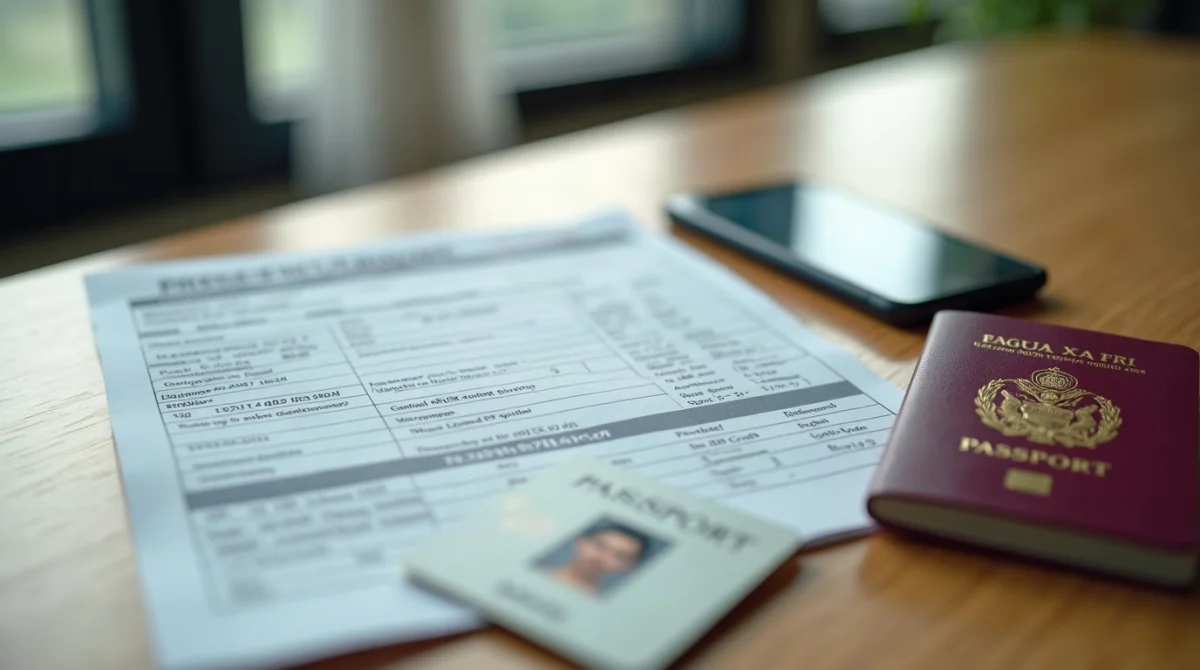
- Name order: copy your surname, middle name and given name exactly as they appear on the ICAO line at the bottom of your passport’s biodata page, in uppercase. Omitting a middle name or swapping surname and given name is a frequent cause of amendment requests.
- Portrait photo: 4×6 cm, white background, facing forward, no glasses, no headwear, formal attire. JPEG, under 2 MB.
- Passport scan: clear colour image of the biodata page with the full ICAO lines visible – no glare, no shadows, no cut-off edges. JPEG, under 2 MB.
- Accommodation: give the hotel name, street address and ward or commune – not just the city.
Before you hit submit, run through this checklist: passport valid 6 months beyond arrival, compliant scan and photo, full hotel address, an international credit or debit card that can complete the OTP verification step, and your physical location outside Vietnam.
Why Applications Stall Beyond a Week
If your application passes the 7-day mark, a common cause is an amendment request you haven’t noticed. The portal can switch your status to “Amending” or “Amendment Required” without any email, so the file sits there until you notice.
Worse, once you upload corrections, expect another 1 to 2 working days on top of the standard review, counted from the next working day. Fix something on a Friday and the count starts on Monday. When immigration unlocks your file, you can edit personal data, replace the photo, update your accommodation address, or remove dependents.
Check your status daily
Use the e-visa search section at evisa.gov.vn.
Enter your details
Your Registration Code (it starts with “E…”), the email you registered, and your date of birth.
Complete the CAPTCHA
Then read your status.
If it says “Amending”
Correct the flagged fields and resubmit.
Expect another 1 to 2 working days
Counted from the next working day.
Statuses are plain: “In Processing” means wait; “Amending” means act; “Granted” means download the PDF; “Rejected” means reapply. If the system says “Application not found”, remember that the search only returns your file when the registration code, registered email and date of birth all match what you submitted.
A few other things stretch the timeline. The clock only starts once your payment shows as confirmed, and children who hold their own passports need separate applications, as listing them as accompanying travellers triggers an amendment request. Applying from inside Vietnam gets your application rejected automatically. And after Tết or long weekends, backlogs extend turnaround to 7 – 10 working days.
Boarding Gate Reality: Why a Pending Visa Grounds You
Airline check-in staff need to see a granted e-Visa before they will issue a boarding pass. Without a granted e-Visa PDF, they won’t let you on the plane – even if you land in Vietnam a day later.
On connecting flights the check happens where you first check in, so you cannot leave the UK expecting approval to arrive during a layover.
Once your status shows “Granted”, download the PDF and print at least one copy to carry with your passport.
Alternatives: Embassy, ETD Holders and Expedited Options
The government portal has no express lane. Private visa agencies offer expedited handling of an application you have already submitted, typically from a few hours to one working day, for a service fee on top of the government charge. That speed applies only during Vietnamese working hours, and the fastest tiers can be limited to certain entry airports.
| Route | Turnaround | Cost basis | Main risk |
|---|---|---|---|
| Government portal (standard) | 3 – 5 working days | US$25 single / US$50 multiple | Holiday and Tết backlogs |
| Private expedited service | 1 hour – 1 working day (Vietnamese working hours only) | Government fee plus premium | Cost; verify the agency first |
| Embassy in London | 5 – 7 working days | Consular fees apply; a premium service shortens the turnaround for an extra fee | Slower; passport needed in person or by post |
The e-Visa is issued to passport holders, so if you travel on a UK Emergency Travel Document, check with the Embassy of Vietnam in London before booking. The embassy, at 35 Victoria Road, London W8 5RF, is open 09:30 – 12:30 Monday to Friday, with a 5 to 7 working-day turnaround.
For everyone else holding a standard British passport, the e-Visa remains the cheapest route – provided you keep the lead time described above.
Frequently Asked Questions (FAQ)
How long does the Vietnam evisa processing time actually take for UK citizens?
The declared standard is 3 working days, but UK travellers should plan for 3 to 5 working days, and 5 to 7 or more when demand is high. Weekends, Vietnamese public holidays and the time difference add to the wait. During peak periods such as Tết, allow 7 to 10 working days or more.
Does the Vietnam e-Visa processing time count weekends and public holidays?
No. Processing runs on Vietnamese working days, Monday to Friday, with times counted in the UTC+07:00 zone, and stops on Vietnamese public holidays. A Friday submission is normally first counted on the following Monday.
Why is my Vietnam e-Visa taking more than a week to arrive?
Often the hold-up is an amendment request you haven’t spotted – the portal can flag an error without emailing you. Check your status daily at evisa.gov.vn. Other causes include payment verification lag, name mismatches with your passport’s MRZ, and post-holiday backlogs.
When should I apply for a Vietnam e-Visa before my trip?
Submit 2 to 3 weeks before departure. If you’re short on time, leave at least 10 days and never fewer than 5 to 7 working days. Around Tết, allow 4 weeks or more. You can apply up to a year before your intended entry date.
Can I board my flight from the UK if my e-Visa is still ‘In Processing’?
No. Airlines refuse boarding without a granted e-Visa, as an application ‘In Processing’ is not a valid travel document. This applies to the first leg of connecting flights too – you can’t board in London hoping approval lands mid-journey.
How does the Tết holiday affect Vietnam evisa processing time?
The next Tết closure runs from 3 to 11 February 2027, nine days in total, and turnaround around it typically stretches to 7 to 10 working days. If you travel in February or March 2027, submit by early January.
Is there an urgent or express processing option on the government website?
No, the official portal offers only standard processing. Private agencies offer expedited handling from a few hours to one working day, during Vietnamese working hours only, for a service fee on top of the government charge. If your flight is imminent, compare that cost against rescheduling.
How can I check my Vietnam e-Visa status if I haven’t received an email update?
Go to the search section of evisa.gov.vn and enter your Registration Code, registered email and date of birth. Email notifications are not always sent, so treat the portal as your primary source and check your spam folder as well.
Sources and Further Reading
- evisa.gov.vn – the Vietnam National Electronic Visa system, where you apply and track your application.
- evisa.gov.vn FAQ – official answers on processing rules, amendments and eligibility.
- evisa.gov.vn Instruction – official guidance on documents, photo specs and working hours.
- Embassy of Vietnam in London – processing times – consular turnaround for embassy applications.
Rules can change, so confirm current details on the official portal before you apply.