
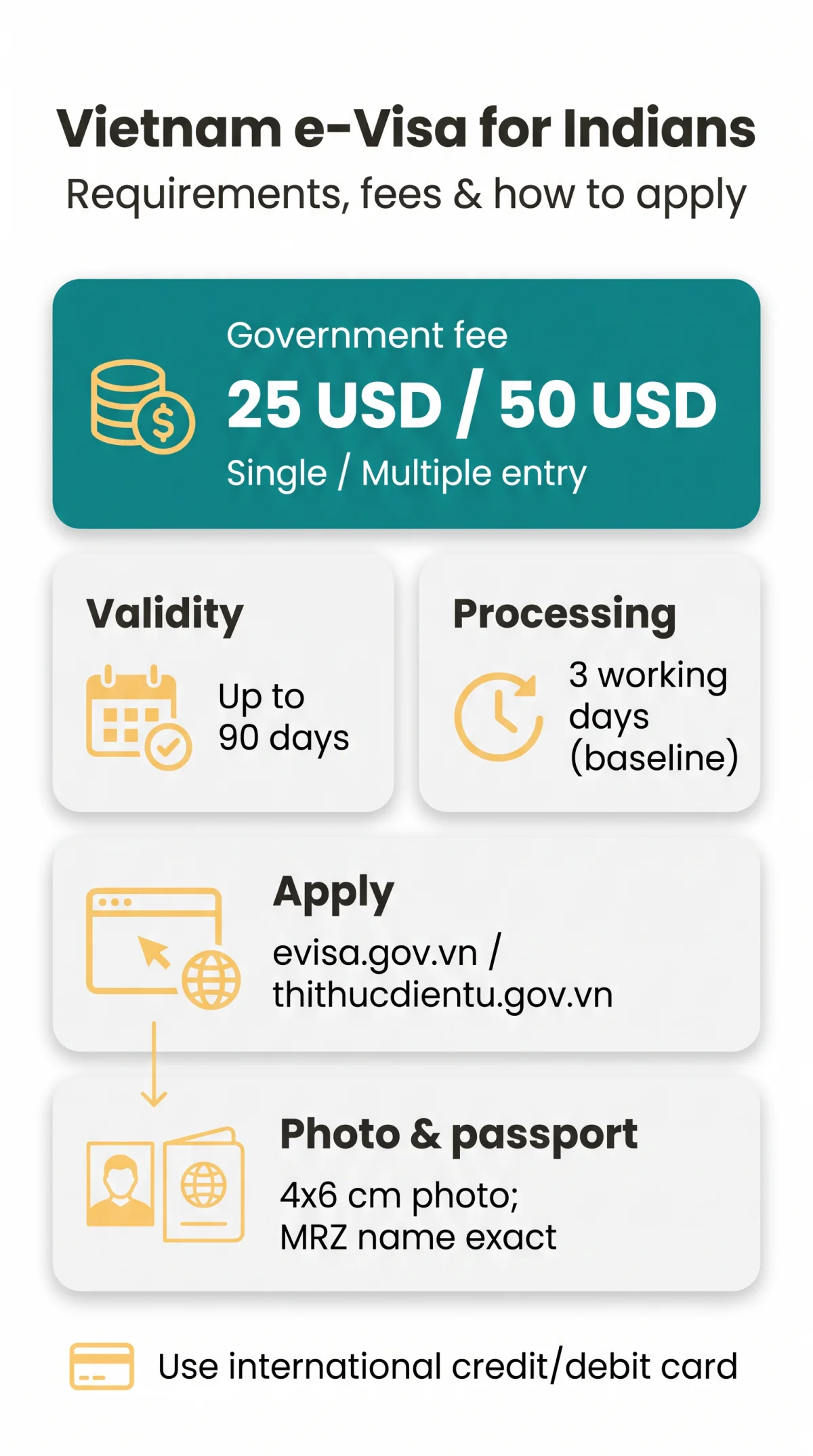
Indian passport holders need a visa to enter Vietnam, because no bilateral visa waiver is in place. The Vietnam e-visa for Indian travellers allows stays of up to 90 days, with single or multiple entries, and costs 25 USD or 50 USD. Standard processing takes three working days.
This guide walks Indian citizens applying from India or the UK through fees, documents, the form and the traps that cause rejections. It’s an independent guide, not a government page – you apply yourself on the state portal evisa.gov.vn. We don’t charge fees or file applications for you, so check your details and current rules on the portal before you travel.
Do Indian Citizens Need a Visa for Vietnam?
Yes, you must hold a valid visa before you arrive. India has no visa-exempt status for Vietnam, so you need the visa before you travel – airlines can check e-visa data before departure. The e-visa is the simplest route: up to 90 days, single or multiple entry, granted online.
- Visa required: Indian nationals are not covered by Vietnam’s visa exemption schemes.
- Validity: up to 90 days, single or multiple entry – extended from 30 days by the 2023 amendment to the Law on Entry, Exit, Transit, and Residence of Foreigners in Viet Nam.
- Fees: 25 USD single entry, 50 USD multiple entry, non-refundable.
- Processing: 3 working days as the baseline, but 5 – 30 working days once the application needs checks or corrections.
- Where to apply: evisa.gov.vn and thithucdientu.gov.vn, the state domains launched in November 2024.
- How early: you can submit up to one year before your planned entry date.
Why India Is Not Visa-Exempt for Vietnam
Vietnam grants visa-free entry only under bilateral reciprocity agreements or unilateral exemption schemes, and India isn’t covered by either – the full eligibility rules and country list show who does qualify.
One myth worth ending here: a valid US or Schengen visa gives you no exemption for Vietnam. Vietnam applies its own bilateral rules, so you still need the e-visa.
E Visa Fees, Validity and Processing Times
The fee is fixed and non-refundable: if your application is rejected, you don’t get the money back.
| Visa type | Validity | Fee | Processing time |
|---|---|---|---|
| Single-entry e-visa | Up to 90 days | 25 USD | 3 working days (baseline) |
| Multiple-entry e-visa | Up to 90 days | 50 USD | 3 working days (baseline) |
Validity runs from the start date shown on your approved e-visa, not from the issue date, so enter the dates you actually plan to travel.
The three working days exclude the submission day, weekends and Vietnamese holidays. The full cycle can run to 5 – 30 working days if the application needs checks or corrections, so apply at least 7 – 40 working days before departure to stay safe. Don’t count on an email notification – check your e-visa status yourself on the portal with your registration code.
Required Documents and Indian Passport Rules
Before you start the form, get these ready:
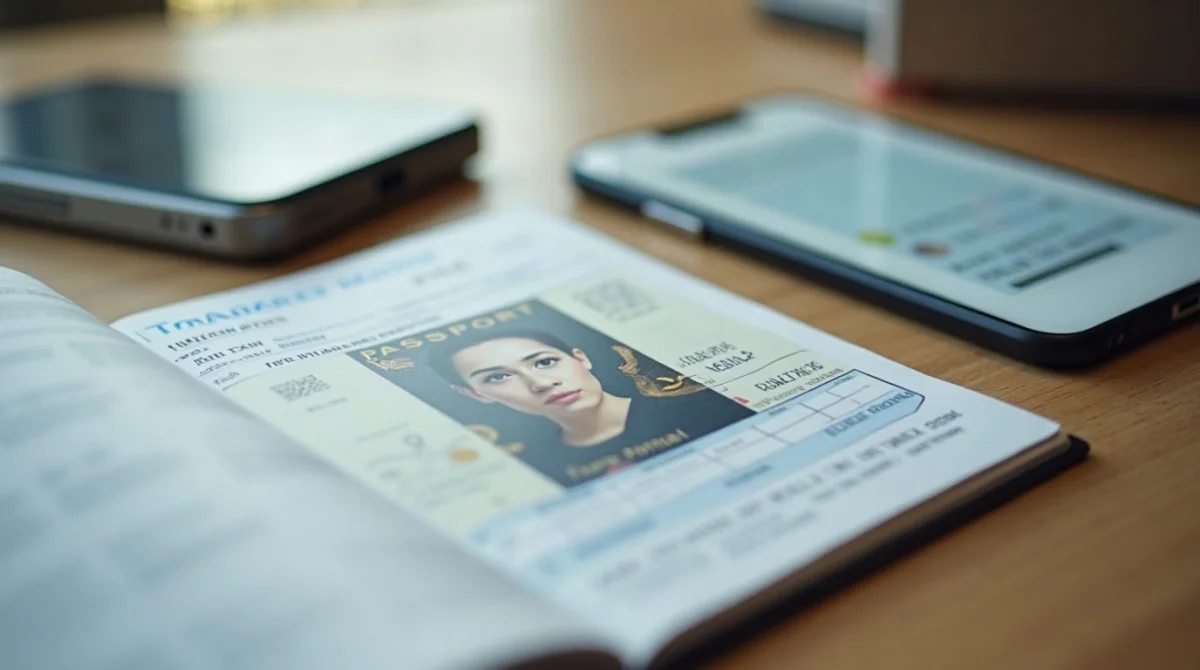
- Passport: valid at least 6 months from your entry date, with at least 2 blank pages, and valid at least 30 days longer than the e-visa.
- Digital photo: 4×6 cm, .JPG, max 2 MB, white background, facing forward, no glasses, no headwear, proper attire.
- Bio-page scan: the full passport data page with the machine-readable zone visible, .JPG, max 2 MB, no cut corners or glare.
- Active email address: used for registration and status checks.
- Temporary address in Vietnam: your first accommodation – the field is required.
- Entry and exit dates: you declare both in the form.
Photo and scan quality together with name errors cause most delays and rejections, so check them against the 4×6 cm photo specifications before uploading.
Single Names and Blank Surnames on Indian Passports
Many Indian passports have a single name with no surname, and the form handles this fine. You enter your names in uppercase letters, exactly as they appear in the ICAO machine-readable zone (MRZ) at the bottom of your data page.
Field by field: copy the name sequence from the MRZ line into the form in the same order. If your passport has no surname, the Surname field isn’t mandatory – leave it empty and put your full name in as it reads on the MRZ. Don’t rearrange anything. An issued e-visa can’t be corrected, so a name error means paying for a new application.
How to Apply for a Vietnam E Visa from India
The whole application happens online. Here’s the sequence:
Go to evisa.gov.vn
The state e-visa portal.
Fill in the form
Full names per the MRZ, nationality, passport number and expiry, intended entry and exit dates, temporary address, and entry and exit checkpoints.
Upload your photo and bio-page scan
Your 4×6 cm photo and the full bio-page scan.
Note your Registration Code
Write it down immediately.
Pay the fee
25 USD or 50 USD with an international credit or debit card (for example Visa or Mastercard) enabled for foreign-currency transactions.
Check status on the portal
Use your Registration Code, registered email and date of birth.
Download the e-visa PDF from the portal yourself and print it before flying.
Avoiding Payment Failures with Indian Bank Cards
This is where many Indian applicants get stuck. Domestic-only cards and internet banking won’t work on the portal – you need an international credit or debit card, such as Visa or Mastercard, enabled for foreign-currency transactions.
Before paying, run this quick check on your card:
- International transactions enabled in your banking app.
- A sufficient international spend limit for the day.
If the payment page fails, check the card settings above before trying again – our guide to fixing Vietnam e-visa payment failures covers gateway errors, declined cards and double charges.
Tracking Status and Correcting Errors
Once you’ve paid, you can’t edit the form yourself. If an officer returns the application for correction (status “amendment”), you fix it then. After the visa is issued, the passport number, names, date of birth and validity dates can’t be changed – a new application is the only fix for a real error.
So before you pay, re-read your entries against the passport. Two minutes of checking beats a 25 USD re-application and a delayed trip.
Entry Points, Transit Rules and Phu Quoc
Your e-visa works only at the checkpoints designated by the government – currently 27 land border gates, 15 airports and 39 seaports on the portal’s list. Your exit point doesn’t have to match your entry point, and you can change your entry port as long as the new one is on the list.
Phu Quoc has its own visa exemption, but only if both your entry and exit are Phu Quoc – arriving directly from abroad, or transiting Hanoi or Ho Chi Minh City without leaving the transit zone. Here’s the decision table:
| Your route | E-visa required? |
|---|---|
| Direct international flight to Phu Quoc | No – the exemption applies |
| Layover in Hanoi/HCMC, staying in transit zone | No, if one ticket and checked-through baggage |
| Domestic flight from Hanoi/HCMC to Phu Quoc | Yes |
| Self-transfer on separate tickets, collecting baggage | Yes |
The transit exemption works only with a single booking reference (one PNR) and checked-through baggage. If you’re on separate tickets, or you switch terminals, you need the e-visa.
Inside Vietnam, there’s no automatic extension of the e-visa. An extension or change of status needs an agency, organization or individual in Vietnam to guarantee your stay and apply on your behalf.
Common Mistakes and E Visa vs Visa on Arrival
Indians have three routes to a Vietnam visa. Here’s how they compare:
| Method | Cost | Time | Drawback |
|---|---|---|---|
| E-visa | 25 / 50 USD | 3 working days | No self-editing after payment |
| Visa on arrival | Approval letter via agency + stamping fee on arrival (25 USD single entry / 50 USD multiple) | 3 – 5 working days for the approval letter, plus stamping on arrival | Needs a pre-approval letter; queues at the counter |
| Embassy sticker visa | Consular fee | 10 – 12 working days from Delhi, 14 – 15 from other locations | In person or by post; slowest option |
For most Indian tourists, the e-visa wins: you apply at home, pay a fixed fee, and there’s no stamping fee at the airport – see the full e-visa vs visa on arrival comparison for the details.
Now the mistakes that cause rejections or extra costs:
- Name mismatch with the MRZ – copy the MRZ line character by character.
- Photo with glasses or headwear – rejected. Follow the 4×6 cm, white-background spec.
- Incomplete bio-page scan – include the full page with both MRZ lines.
- Paying with a domestic-only card or internet banking – the payment fails. Use a card enabled for international transactions.
- Sites imitating the government portal – an agency may charge a service fee on top of the government fee, but a site posing as the immigration authority is a scam. Apply only on the .gov.vn domains.
If you need consular help, the Embassy of Vietnam in New Delhi is at EP-7A, Chandragupta Marg, Chanakyapuri, New Delhi-110021, phone +91 70 4203 5588.
Final Checklist Before You Fly
Run through this before you leave for the airport:
- Passport valid 6 months beyond entry, with 2 blank pages.
- A printed copy of your e-visa PDF.
- Names on the e-visa matching the passport MRZ exactly.
- Entry and exit through checkpoints on the portal’s designated list.
- At immigration, check that the entry stamp shows the correct date before you leave the counter.
Keep the Registration Code in your email until you’re back home – you may need it if anything goes sideways.
Frequently Asked Questions (FAQ)
How much does a Vietnam e visa for Indian passport holders cost?
The government fee is 25 USD for single entry and 50 USD for multiple entry, non-refundable even if rejected.
How long does Vietnam e visa processing take for Indian applicants?
Standard processing is 3 working days, excluding the submission day, weekends and Vietnamese holidays. The cycle can stretch to 5 – 30 working days when checks or corrections are needed, so apply at least 7 – 40 working days before you fly.
Can I pay the Vietnam e-visa fee with RuPay or UPI?
No. The portal doesn’t accept domestic-only cards or internet banking. Use an international credit or debit card, for example Visa or Mastercard, enabled for foreign-currency transactions, or the payment will fail.
My Indian passport has no surname. How do I fill in the e-visa form?
Copy your name exactly from the ICAO MRZ line at the bottom of your passport data page, in the same order. If your passport has no surname, leave the Surname field empty – it’s optional in that case.
Can Indian citizens extend their Vietnam e-visa inside Vietnam?
There’s no automatic extension for tourist e-visas. An extension depends on an agency, organization or individual in Vietnam guaranteeing your stay and applying on your behalf. Otherwise, you exit and return on a newly approved e-visa.
Can I visit Phu Quoc without a visa on a layover through Hanoi?
Only if you stay in the transit zone on a single booking with checked-through baggage and both your entry and exit are Phu Quoc. If you take a domestic flight from Hanoi or HCMC to Phu Quoc, you need an e-visa first.
Does a valid US or Schengen visa exempt Indians from a Vietnam visa?
No. Vietnam sets its visa policy through bilateral reciprocity, and third-country visas carry no weight. You need a Vietnam e-visa regardless of what’s in your passport.
Where can I check my Vietnam e-visa application status?
Use the search function on evisa.gov.vn with your Registration Code, registered email, and date of birth; check manually rather than waiting for a notification.
Sources and Further Reading
- evisa.gov.vn – the Vietnam National Electronic Visa system, where you apply and track your application.
- evisa.gov.vn FAQ – answers on fees, photos, checkpoints and processing rules.
- evisa.xuatnhapcanh.gov.vn – the national portal on immigration.
- Vietnam Embassy in New Delhi – e-visa guidance and consular contacts for Indian applicants.
- immigration.gov.vn – the Vietnam portal on immigration.
Rules can change, so check the portal before your trip.