
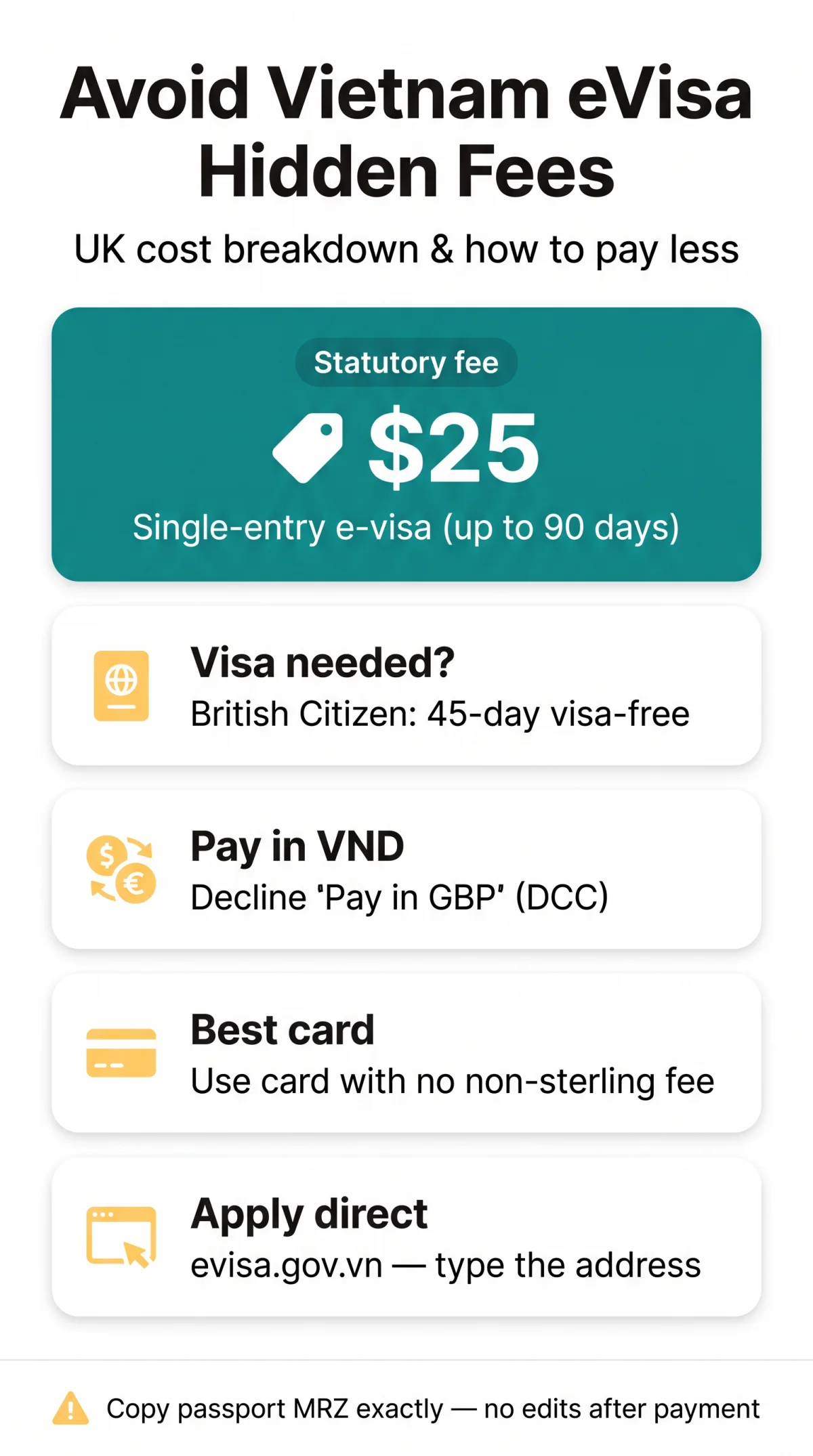
The statutory Vietnam electronic visa (e-visa) costs $25 single-entry or $50 multiple-entry, yet what leaves your account from the UK depends on your card’s foreign-currency charges and on whether you use an agent. Hidden fees Vietnam evisa traps come from three places: UK card issuers commonly add a non-sterling transaction fee when the charge arrives in a foreign currency, a “Pay in GBP” option at checkout converts at the provider’s own rate instead of your bank’s, and agent markups stacked on top. Paying directly on the government portal with a card that does not charge a foreign-transaction fee keeps you closest to the $25 statutory fee.
This guide is for UK travellers who want the cheapest total price, not just the headline fee. It’s an independent, unofficial travel guide – we don’t charge fees or apply on your behalf, and you’ll always verify details on the government portal, evisa.gov.vn, before paying. You’ll leave knowing which card to use, which checkout boxes to untick, and where the money actually goes.
Do You Actually Need to Pay?
If you hold a British Citizen passport, you enter Vietnam visa-free for up to 45 days, according to gov.uk entry requirements. Your passport needs at least six months’ validity from arrival, two blank pages and no damage. Many UK holidaymakers never need a visa at all.
It’s worth checking the exemption before you pay anyone. They’ll charge a service fee for a formality that’s free for a two-week tourist. Check before you spend anything:
- Pay $0 if you’re a British Citizen staying up to 45 days for tourism or business.
- You need an e-visa if you stay over 45 days on a single entry, plan paid work, investment projects or journalism, or hold a BNO passport – BNO holders don’t qualify for the exemption.
- Plan ahead – the e-visa can’t be extended inside Vietnam, and you must declare cash over 15,000,000 VND or $5,000 at the border.
The Baseline: Statutory Fees and What Gets Added
Immigration authorities set a non-refundable fee of $25 single-entry or $50 multiple-entry, both valid for up to 90 days, with standard processing of 3 – 5 working days, which can extend to 7 – 10 days in peak periods. The fee is set in USD, but the portal’s electronic payment gateway converts it to Vietnamese dong (roughly 657,250 – 668,503 VND for single entry), and your card is charged in VND. That conversion is where UK bank fees creep in.
| Visa type | Validity | Base fee | Currency charged | Refund policy |
|---|---|---|---|---|
| Single entry | Up to 90 days | $25 | Charged in VND, converted at the rate on the day of payment | Not refunded if the visa is not granted or the application is refused |
| Multiple entry | Up to 90 days | $50 | Charged in VND, converted at the rate on the day of payment | Not refunded if the visa is not granted or the application is refused |
The fee is not refunded if the visa is not granted. And ignore anyone selling you a stamping fee: with an e-visa you pay nothing on arrival. Stamping fees apply only to the separate Visa on Arrival route, which requires a pre-approval letter from an agency.
UK Bank Surcharges and the Cheapest Card
A foreign-transaction fee on a high-street card is added on top of the converted statutory fee. The charge travels as USD fee → VND via the portal’s electronic payment gateway → foreign transaction on your UK card → GBP on your statement. UK card issuers commonly add a non-sterling transaction fee when the charge arrives in a foreign currency – check the fee in your own card’s terms.
The Dynamic Currency Conversion Trap
At checkout the gateway may offer to charge you in pounds. Decline it. That “Pay in GBP” option converts at the provider’s own rate instead of your bank’s. Always choose to pay in VND and let your own bank convert – it’s the single easiest way to avoid hidden fees on the Vietnam eVisa payment.
High-Street Cards vs Travel Cards
If your card is blocked, check that international payments are enabled with your bank before trying again.
| Card type | FX fee | Conversion rate | $25 e-visa costs |
|---|---|---|---|
| High-street bank card | Check your card’s terms | Bank’s conversion rate | Statutory fee plus the issuer’s charge |
| Card with no non-sterling transaction fee | None | Your provider’s conversion rate | Closest to the $25 statutory fee |
If your card is declined anyway, don’t panic and retry repeatedly.
Agent Markups vs Applying Directly
Commercial agencies add a service markup on top of the statutory fee, which can be several times the fee itself.
Watch for the split-fee pattern: a low headline price, with the consular fee, VAT and an administrative handling fee added at checkout. Then the checkout add-ons:
- Airport fast-track assistance added as an optional extra
- Optional extras added on the agent’s form, such as a CO₂ compensation surcharge
- “Approval Letter” fees – an approval letter belongs to Visa on Arrival and is not needed for an e-visa
Expedited tiers cost extra, with separate prices for one to three working days and for same-day or few-hour handling; the surcharge rises sharply with urgency. Note that the immigration office doesn’t work weekends or Vietnamese holidays, whatever you’ve paid for express.
When is an agent worth it? If you want your ICAO details verified or have an unusual case, the markup buys real help.
Step-by-Step: Avoid Hidden Fees and Costly Typos
Follow these five steps and your total should stay closest to the statutory fee for a single-entry visa:
Confirm you need a visa at all
Check your trip against the 45-day exemption.
Go directly to evisa.gov.vn
Type the address yourself; paid results are usually agencies that charge a fee for the free government form, and some sites copy the portal’s look to appear official.
Enter your name exactly as in the ICAO machine-readable zone
Use the bottom line of your passport, including double surnames and middle names.
Decline DCC at checkout
Pay in VND, not GBP.
Pay with the right card
Use a card that charges no non-sterling transaction fee.
Your landed cost is the statutory fee converted into VND, plus whatever your card issuer adds.
Why step 3 matters so much: the system allows no edits after payment. A swapped name, a misread character in your passport number, or the wrong designated port of entry means a fresh application and a new $25/$50 fee. Reapplying at short notice means paying the statutory fee again plus any express handling, and you risk being denied boarding. Have ready: a passport scan (JPG under 2MB with a readable MRZ), a 4×6cm white-background photo, and your entry and exit ports – 81 checkpoints are eligible, including Noi Bai, Tan Son Nhat and Da Nang.
Flying into Ho Chi Minh City? Since 15 April 2026 travellers entering via Tan Son Nhat are encouraged, but not required, to complete a digital arrival card online before arrival at prearrival.immigration.gov.vn.
Common Mistakes That Cost You Money
- Paying an agency for a free entry. If your trip fits the 45-day exemption, you’ve paid an agency fee for nothing. Check the rule first.
- Accepting “Pay in GBP”. The GBP option converts at the provider’s own rate. Always choose VND.
- Using a high-street card by default. The non-sterling transaction fee is avoidable with a card that doesn’t charge one.
- Rushing the name fields. One MRZ mismatch means a full new fee and possible boarding denial. Copy from the passport’s bottom line, character by character.
- Buying an “Approval Letter”. It belongs to Visa on Arrival and is not needed for an e-visa.
Frequently Asked Questions (FAQ)
What is the statutory fee for a Vietnam e-visa for UK citizens?
The government fee is $25 for a single-entry visa valid for up to 90 days and $50 for multiple entry. The portal’s electronic payment gateway converts it to Vietnamese dong at the day’s rate before charging your card.
How do hidden fees on a Vietnam eVisa increase what my UK bank charges?
Many UK cards add a non-sterling transaction fee because the charge arrives in Vietnamese dong – the exact percentage is set out in your card’s terms. That is added on top of the converted statutory fee, so check the rate your issuer applies before paying.
Should I pay in GBP or Vietnamese dong when the payment gateway asks?
Always pay in VND. The GBP option is dynamic currency conversion, which uses the provider’s own rate rather than your bank’s. Declining it and letting your own bank convert is normally the cheaper route, though the exact cost depends on your card.
Can I get a refund if my Vietnam e-visa is delayed or rejected?
No. The fee is not refunded if the visa is not granted or the application is refused. Budget accordingly and apply well before your flight.
Do British passport holders need a visa for a two-week holiday in Vietnam?
Not if you hold a British Citizen passport – the 45-day visa exemption covers tourism and business. BNO passport holders are not covered by the exemption and need a visa – an e-visa or a visa from the Vietnamese Embassy – whatever the length of the trip.
Where do I apply directly for a Vietnam e-visa?
Apply at evisa.gov.vn. Type the address yourself rather than clicking sponsored results, which are usually agencies charging a fee for the government form.
Why was my UK card declined on the Vietnam e-visa payment gateway?
Declines on the government gateway are common with foreign cards. Check with your bank that international payments are allowed, then try again or use a different card.
Is there anything I can do if I’m unhappy with an e-visa-related payment?
For payments made directly on the government portal, the fee is not refunded if the visa is not granted, so apply carefully and early. If you paid a commercial agency, take up any dispute with that company under its own terms.
Sources and Further Reading
- evisa.gov.vn – the government portal where you apply and pay the statutory fee.
- gov.uk – Vietnam entry requirements – the 45-day exemption, BNO rules and border declarations.
Rules can change, so check the portal before you travel.