
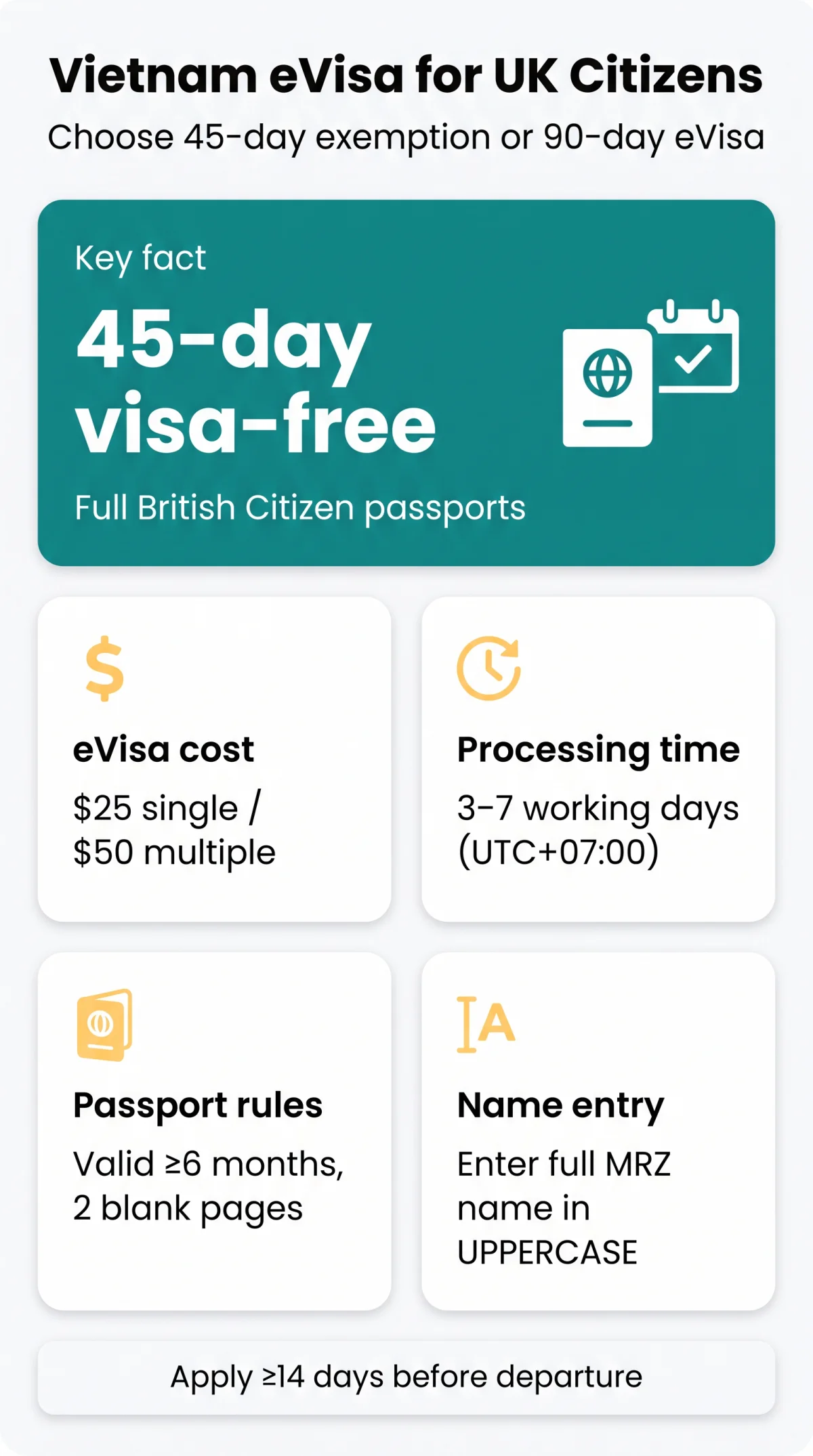
Full British Citizen passport holders can enter Vietnam visa-free for up to 45 days (entry day counts as day 1), provided their passport is valid for at least six months from arrival and has at least 2 blank pages. For longer stays or multi-country routes you’ll need a Vietnam eVisa for UK citizens, applied online in 3 to 7 working days at $25 single entry or $50 multiple entry, via evisa.gov.vn.
This guide helps British travellers decide between the free exemption and the 90-day eVisa, and walks you through the application step by step. It’s an independent travel-information portal, not a government site.
Do UK Citizens Need a Visa for Vietnam?
No, if you hold a full British Citizen passport and stay 45 days or fewer. Vietnam grants British nationals a unilateral visa exemption covering tourism and short-term business, stamped into your passport on arrival. Your passport must be valid for at least six months from arrival and have two blank pages.
Each entry gives you up to 45 days, and you can re-enter after leaving Vietnam. If you plan to stay longer than 45 days, you need a valid visa to board your flight.
Before you rely on the exemption, run through this checklist:
- Your passport says British Citizen – not BNO, BOTC or another category
- It’s valid for at least 6 months beyond arrival and has 2 blank pages
- Your stay will be 45 days or fewer, counted from the date of entry
- Your purpose is tourism or short-term business only
Since 11 November 2024, eVisa applications run on two domains: evisa.gov.vn and thithucdientu.gov.vn.
Which UK Passport Types Qualify for the Exemption?
The exemption covers full British Citizen passports only. If your passport says anything else, plan on an eVisa before you travel.
| UK passport type | Entry route for Vietnam |
|---|---|
| British Citizen | 45-day visa exemption, no application needed |
| British National (Overseas) | eVisa required before travel |
| British Overseas Territories Citizen | eVisa required before travel |
| British Overseas Citizen | eVisa required before travel |
| British Protected Person | eVisa required before travel |
Business Travel Under the 45-Day Rule
Short-term business is fine under the exemption. You can attend business meetings and conferences without a visa. What you can’t do is take paid employment, work as a journalist or join an investment project. If your trip crosses those lines, apply for an eVisa and declare the correct purpose of entry.
Vietnam eVisa vs 45-Day Exemption: Which Fits Your Trip?
If you’re flying out for a straightforward holiday under 45 days, use the free exemption. If your itinerary loops back through Vietnam or runs past 45 days, the $50 multiple-entry eVisa is the safer choice.
| What matters | 45-day exemption | 90-day eVisa |
|---|---|---|
| Cost | Free | $25 single / $50 multiple |
| Maximum stay | 45 days | 90 days |
| Entries | One | One, or unlimited with multiple-entry |
| Extend inside Vietnam | No | No, but holders in Vietnam may be granted a new visa only if a Vietnamese agency, organisation or individual invites or sponsors them |
| Land border crossings | Available | Any of 27 eligible land borders |
The exemption has no safety buffer. If your plans stretch even a day past day 45, you’re into overstay territory.
Multi-Country Indochina Routes and Re-entry Risk
A classic British itinerary looks like this: UK → Hanoi → Laos or Cambodia (Angkor Wat) → Ho Chi Minh City → UK. Each time you leave Vietnam and come back, you’re consuming a new entry. If your route loops back into Vietnam, a multiple-entry eVisa covers each entry through the designated international border gates, such as Moc Bai or Vinh Xuong.
Vietnam eVisa Options for British Travellers
You’re choosing between two products. The 90-day single-entry eVisa allows one entry only, so it cannot be used again once you have left Vietnam. The 90-day multiple-entry eVisa lets you cross in and out as often as you like within the validity window.
The fee is $25 for single entry and $50 for multiple entry, and it is not refunded if the visa is not granted. You can submit an application up to 1 year ahead of your entry date, and the eVisa validity must end at least 30 days before your passport expires.
Vietnam eVisa Requirements for UK Citizens
You’ll need your passport plus two compliant digital files. The passport must be valid at least six months from your declared entry date, carry two blank pages and be undamaged.
- Passport data page scan: under 200 KB, with the ICAO machine-readable line fully legible
- Portrait photo: under 50 KB, plain background, no glasses
- Accommodation address for your first night in Vietnam
- Travel dates and your planned entry and exit checkpoints
Formatting British Middle Names: The ICAO Line
Here’s the trap that catches more British applicants than anything else. Your name must be entered exactly as it appears on the ICAO machine-readable line of your passport data page, in uppercase.
Map the fields like this:
- MRZ surname block → form field Surname, typed in uppercase
- MRZ given-names block → form field Given Names, first name plus all middle names in passport order
Leave out a middle name and your eVisa will not match your passport, which can mean you are refused boarding. Reproduce every character of the name block as printed, including hyphens and apostrophes.
Passport Damage and Denied Boarding
Your passport must have no damage; British nationals have been denied entry and exit to Vietnam because of passport damage. If your passport has seen better days, renew it before you apply.
How to Apply for a Vietnam eVisa from the UK
You complete the form on evisa.gov.vn, pay by card, save your registration code, then download and print the PDF approval.

Gather your documents
Collect your passport scan, portrait photo, hotel address and travel dates.
Open the form
Open the form and select your current nationality.
Enter your name
Type your name exactly as it appears in the passport MRZ, including middle names.
Enter your accommodation address
Enter your full first accommodation address: hotel name, street, district, province.
Declare your checkpoints
Declare your entry and exit checkpoints from the dropdown lists.
Pay and print
Pay the fee, save the Registration Code, then download and print your approved eVisa.
The Registration Code is your lifeline for tracking the application and downloading the result. Print the approval to show at airline check-in and at border control. And remember, you can’t apply for a new eVisa while you’re physically inside Vietnam.
Field-by-Field Form Completion
The form asks for roughly 21 fields, including date and place of birth, current and birth nationality, religion, national ID number, and your occupation with employer details. You’ll also declare previous visits to Vietnam, any law violations there, and relatives currently living in the country. Trip-specific fields cover your purpose of entry, hosting organisation, intended stay length, and estimated trip expenses in USD with your funding source.
Enter your intended entry date carefully. You may arrive on any day within the validity window, but never before the start date. The visa expires on the date stated in the document, no matter when you actually entered.
Paying the eVisa Fee with a UK Card
The fee is paid through the portal’s electronic payment gateway and is not refunded if the visa is not granted.
Processing Time and Costs for British Applicants
Standard processing takes 3 to 7 working days, counted in the UTC+07:00 time zone, and costs $25 single entry or $50 multiple entry. If the visa is not granted, the fee is not refunded.
| Visa type | Cost in USD | Processing time |
|---|---|---|
| 90-day single entry | $25 | 3 to 7 working days |
| 90-day multiple entry | $50 | 3 to 7 working days |
Timezone and Holiday Delays Explained
Vietnam runs on UTC+07:00, six to seven hours ahead of the UK. Vietnamese public holidays, including Tet, Reunification Day on 30 April and National Day on 2 September, can add days to processing. Our advice: submit at least 14 days before you fly.
Direct Fees vs Agency Services
Applying directly on the public portals costs only the consular fee. Independent agencies add a service fee on top of the consular fee for data checks, faster handling and English-language support. If you’d rather ask in person, the Vietnam Embassy in London is at 35 Victoria Road, W8 5RF, open for consular matters 09:30 – 12:30 Monday to Friday by appointment, on 020 7937 1912.
Arriving in Vietnam: Entry Points and Border Clearance
Present your printed eVisa and passport at border control, then check the stamp before you walk away. The eVisa is valid at 15 international airports, including Hanoi (HAN), Ho Chi Minh City (SGN), Da Nang (DAD), Cam Ranh (CXR) and Phu Quoc (PQC), plus 27 land borders such as Moc Bai, Lao Bao, Huu Nghi and Lao Cai, and 39 seaports.
Your entry must happen through the checkpoint you declared on the application. Exit is more flexible: you may leave through any of the government-designated international border gates, not only the one you entered by. So flying into Hanoi and out of Ho Chi Minh City, or exiting overland to Cambodia, works fine.
Check Your Stamp: The 45-Day Override Trap
If you do not present your eVisa at immigration, you can be admitted under the 45-day visa exemption instead of your 90-day eVisa. Immigration will not change the stamp once you have left the airport or land border, and a wrong date can leave you accused of overstaying.
Before you leave the booth, read the permitted-stay date on your temporary residence certificate. If it shows 45 days instead of your 90-day eVisa, ask the officer to correct it immediately.
Entering and Leaving via Different Ports
To repeat the key rule: declare both checkpoints when you apply, enter through your declared one, and exit wherever suits your itinerary among the authorised ports. A Hanoi arrival with a Ho Chi Minh City departure, or a bus out through Moc Bai, are both standard scenarios the system accommodates.
Digital Arrival Card and Temporary Residence Registration
Vietnam is rolling out a Digital Arrival Card, submitted within 3 days before arrival at prearrival.immigration.gov.vn, which generates a QR code. At Tan Son Nhat it’s encouraged rather than mandatory from 15 April 2026, and it’s strongly advised at the major airports. You must show your passport to each accommodation, whose manager declares your temporary residence with the local police; repeat this whenever you change accommodation.
Common Mistakes and Related Travel Requirements
Most problems British travellers hit are avoidable. Check yourself against this list before you submit anything:
- Omitting middle names – your eVisa won’t match the passport MRZ, and airlines can deny boarding. Type every name exactly as printed.
- Applying too late – under 14 days before departure leaves no buffer for timezone shifts and Vietnamese holidays.
- Using copycat sites – agencies charge a service fee for completing the free application form for you, but sites imitating the immigration service can charge unauthorised fees. The genuine portals are evisa.gov.vn and thithucdientu.gov.vn.
- Travelling on a damaged passport – tears and water stains can mean denied boarding at your UK airport.
- Not checking the entry stamp – a 45-day stamp on a 90-day eVisa needs correcting at the counter, not after.
- Assuming you can extend – the exemption cannot be extended, and an eVisa holder in Vietnam may be granted a new visa only when a Vietnamese agency, organisation or individual invites or sponsors them; otherwise the only option is to leave Vietnam and return on a new permit. Overstay penalties range from fines to deportation and blacklisting.
A few related rules to know. You must declare cash over 15,000,000 VND or $5,000 USD at customs, and prescription medication worth over $100 USD. Phu Quoc island has its own 30-day exemption for travellers arriving and departing directly by air or sea with an onward international ticket, though UK citizens already get 45 days nationwide, so it only matters for Phu Quoc-only routing.
Frequently Asked Questions (FAQ)
Do UK citizens need a Vietnam eVisa for stays under 45 days?
No. Full British Citizen passport holders are exempt for up to 45 days for tourism or short-term business, provided their passport is valid for at least six months from arrival and has two blank pages. Other British passport types must apply for an eVisa.
How long does the Vietnam eVisa for UK citizens take to process?
Standard processing takes 3 to 7 working days, counted on Vietnam Standard Time (UTC+07:00). Because of the timezone gap and public holidays like Tet, submit at least 14 days before departure.
Can I extend the 45-day visa exemption from within Vietnam?
The 45-day exemption cannot be extended. An eVisa holder already in Vietnam may be granted a new visa only if a Vietnamese agency, organisation or individual invites or sponsors them; otherwise you must exit to a neighbouring country such as Cambodia or Laos and re-enter on a new eVisa or a fresh exemption.
Which website should British citizens use to apply for a Vietnam eVisa?
Use evisa.gov.vn or thithucdientu.gov.vn. These are the two active immigration domains and they charge only the consular fee of $25 or $50; agencies add a service fee, while sites imitating the immigration service can charge unauthorised fees.
Can I use my British National (Overseas) passport for the 45-day exemption?
No. The exemption applies only to full British Citizen passports. BNO, BOTC, BOC and British Protected Person document holders must obtain an eVisa before travelling to Vietnam.
Do I need a visa for a layover in Hanoi or Ho Chi Minh City?
If you stay airside on an international-to-international connection, you do not enter Vietnam. But if you transfer from an international flight to a domestic flight in Hanoi or Ho Chi Minh City, you must clear immigration and enter Vietnam, even if your final destination is outside the country. In that case you need the 45-day exemption or an eVisa. Check with your airline before departing.
How do I pay the Vietnam eVisa fee?
The fee is paid by card through the electronic payment gateway on the portal. If the visa is not granted, the fee is not refunded.
What if my middle name is missing from my approved Vietnam eVisa?
Your name must match your passport’s machine-readable line exactly, otherwise airlines may refuse boarding. You will need to submit a new application with the correct details, and the fee for the incorrect application is not refunded.
Sources and Further Reading
- gov.uk – Vietnam entry requirements – exemption rules and passport advice for British nationals
- evisa.gov.vn – the Vietnam National Electronic Visa application system
- thithucdientu.gov.vn – the second active eVisa application domain
- evisa.gov.vn FAQ – answers on ports, validity and entry dates
- immigration.gov.vn – the national immigration portal with upload specifications
- vietnamembassy.org.uk – Vietnam Embassy in London contact details and consular hours
Rules can change, so double-check evisa.gov.vn before you travel.