
UK travellers can get a 90-day Vietnam business eVisa online for $25 single-entry or $50 multiple-entry, without a visa approval letter from a Vietnamese company, via the government portal at evisa.gov.vn. This Vietnam business eVisa 2026 guide covers the application, the fees, and how the route compares with DN, work, investor and student visas. Processing takes 3 to 5 working days and covers meetings, audits and conferences.
This is an independent guide, not a government website, so check fees and deadlines on the portal before you travel.
Do You Need a Visa? 45-Day Exemption vs the Business eVisa
British citizens can enter Vietnam visa-free for up to 45 days under the unilateral exemption. You can’t extend it or convert it inside Vietnam, and repeat entries are no longer subject to a minimum gap. It works well for exploratory meetings or a conference.

Choose the exemption for first contacts under 45 days; choose the business eVisa when your trip is commercial in purpose, runs beyond 45 days, or needs multiple entries. Your passport must be valid for at least 6 months from your entry date and carry at least 2 blank pages.
Fees, Documents and Application Steps
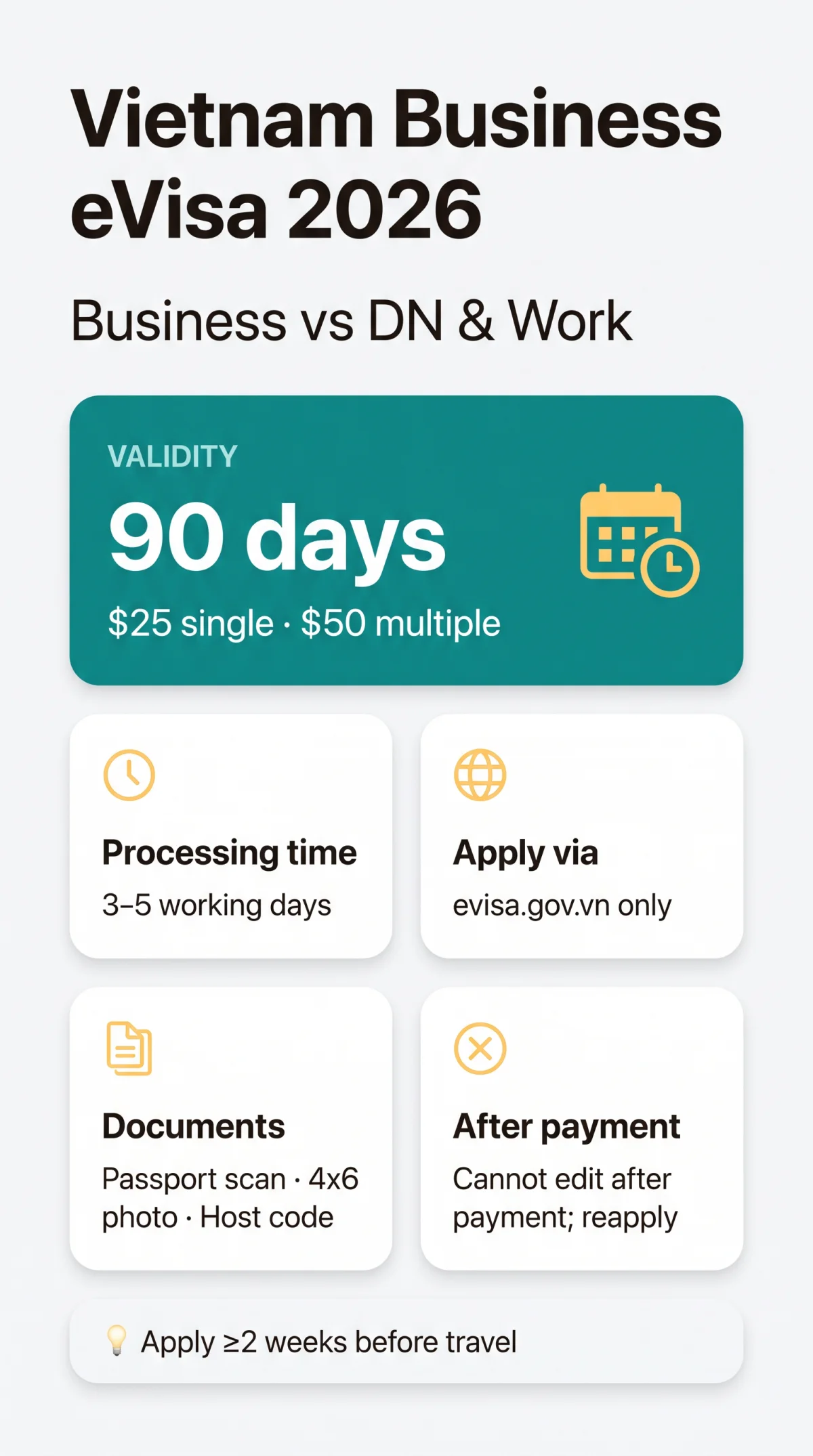
The government fee is $25 for single entry and $50 for multiple entry, both valid up to 90 days, and neither is refundable. Standard processing takes 3 to 5 working days, so apply at least two weeks before you fly. Express agency services can turn applications around in 24 to 48 hours if you’re out of time.
Apply only through the evisa.gov.vn portal (a .gov.vn domain); agency sites add a service fee on top of the same government fee, and sites imitating the immigration department are outright scams. Before you start, gather:
- A scan of your passport bio page, valid 6 months, with the whole page visible and nothing covering the text.
- A 4×6 cm portrait photo on a white background, no glasses, taken within the last 6 months.
- Your Vietnamese host’s details: name, Business Registration Code, address and phone.
- Your accommodation address in Vietnam and an emergency contact.
- A debit or credit card for payment.
Then work through the form in this order:
Upload your documents
Upload the passport scan and portrait photo.
Check every field
Check every field against your passport data page before you pay.
Select your purpose
Select “Business” as your Purpose of Entry.
Enter host details
Enter the host organisation’s details.
Pick your checkpoints
Pick your entry and exit checkpoint from the authorised ports listed on the portal.
Pay and track
Pay, then track the result with your registration code, email and date of birth.
On the ground, you can attend meetings, sign contracts, visit factories, do market research and go to conferences. You can’t take paid employment in Vietnam without a work permit.
Post-Payment Traps: Fields You Can’t Edit
Once you’ve paid, nothing can be changed: full name, date of birth, passport number, entry and exit checkpoints and Purpose of Entry are all fixed. Incorrect details make the eVisa invalid even after approval, so the airline can refuse boarding and immigration can refuse entry.
If you spot a typo before departure, submit a replacement application immediately, with a new fee. The system allows parallel applications, so the new one won’t cancel the old.
Arrival Rules, Extensions and Border Runs
Print two copies of the approved eVisa PDF and present one on arrival. Enter only through the checkpoint you declared, from the authorised air, land and sea ports, including Tan Son Nhat (SGN), Noi Bai (HAN) and Da Nang (DAD).
If you’re landing at Tan Son Nhat, complete the Digital Arrival Card at prearrival.immigration.gov.vn within 72 hours before arrival.
You can’t extend an eVisa inside Vietnam, and conversion in-country is limited to specific cases: investors, dependants of Vietnamese citizens and people already holding a work permit or exemption certificate. To renew your stay, do a border run to Cambodia (Moc Bai) or Laos (Lao Bao) and re-enter on a freshly approved eVisa. Don’t overstay: fines start at $10 to $20 per day, and overstaying by more than 15 days may lead to deportation and a re-entry ban of up to 3 years.
Business eVisa vs DN, Work, Investor and Student Visas
The eVisa gives you quick 90-day access on your own; the sponsored routes take longer, and some of them lead to a Temporary Residence Card (TRC). Here’s how they compare:
| Route | Max stay | Sponsor needed | TRC path | Typical use |
|---|---|---|---|---|
| Business eVisa | 90 days | No approval letter (host details required) | No | Meetings, audits, conferences |
| DN1 / DN2 visa | 30 – 90 days in practice | Yes (Forms NA2, NA16) | Only via work permit/investor status | Working with a licensed local entity |
| LD1 / LD2 work visa | Up to 2 years | Yes (work permit for LD2) | Yes | Salaried local employment |
| DT1 – DT4 investor | Up to 5 years (DT1 visa); TRC up to 10 years | Your own company | Yes (not DT4) | Capital investment |
| DH student visa | Up to 12 months (TRC up to 5 years) | Yes (institution) | Yes | Study only |
DN1 covers foreigners cooperating with a licensed Vietnamese entity; DN2 covers service providers establishing a commercial presence or working under international treaties. The sponsoring company files Forms NA2 and NA16 with the Immigration Department to get a Visa Approval Letter. DN visas can run to 12 months on paper, but UK applicants typically receive 30 to 90 days; one-year versions go almost only to US citizens.
LD1 suits work-permit-exempt transferees and executives; LD2 requires a Work Permit issued by the Department of Home Affairs, which takes 1.5 to 2 months and is valid up to 2 years, renewable once. Investor tiers scale with capital: DT1 from 100 billion VND (TRC up to 10 years), DT2 from 50 billion, DT3 from 3 billion, and DT4 under 3 billion VND, which gets a 12-month visa with no TRC. The DH student visa is for education only. There’s also a UD1/UD2 route for digital tech specialists: visas up to 5 years and TRC up to 10 years.
Digital Nomads, Remote Work and Compliance Risks
Vietnam has no digital nomad visa. Remote workers typically use a 90-day multiple-entry eVisa with periodic border runs. It works in practice but it isn’t a formal nomad status.
Repeated long stays can trigger Vietnamese personal income tax residency, so take tax advice before you plan them.
And don’t blur the work boundary. Non-remunerated commercial liaison is fine on an eVisa; productive local labour isn’t. Working without an LD work permit risks a fine of 15 to 25 million VND ($588 – $980) plus deportation, and your host company faces 30 to 75 million VND ($1,000 – $3,000).
Common Mistakes to Avoid
- Typing your name from memory instead of copying it from the passport data page. A single wrong character means a new application and a second fee.
- Booking flights to a different airport than your declared checkpoint. The eVisa is port-specific, and arriving elsewhere can mean refusal of entry.
- Assuming you can extend in-country. You can’t, so plan a border run or a fresh application before your 90 days end.
- Arriving at SGN without the Digital Arrival Card. Complete it within the 72 hours before arrival and keep the QR code ready for immigration.
- Paying an agency without realising the $25/$50 government fee is only part of the price. The portal charges the government fee alone.
Frequently Asked Questions (FAQ)
Can UK citizens use the 45-day visa exemption for business travel to Vietnam?
Yes, for up to 45 days. It suits exploratory discussions and conferences, but you can’t extend or convert it in-country. For longer stays or multiple entries, apply for the business eVisa.
How much does a Vietnam business eVisa cost?
The government fee is $25 single entry, $50 multiple entry, both valid up to 90 days. Fees are non-refundable, even if rejected. Pay only through evisa.gov.vn.
What is the difference between a business eVisa and a DN1 visa?
A business eVisa is obtained online by you, with no local company pre-approval. A DN1 visa requires a Vietnamese entity to file Forms NA2 and NA16 with the Immigration Department to get a Visa Approval Letter first.
Can I apply for a Vietnam business eVisa without a sponsoring company?
Yes. The eVisa needs no formal sponsor, only your host’s contact details and Business Registration Code on the form. That’s the main advantage over DN1/DN2 visas, which require a company to file paperwork on your behalf.
Does Vietnam offer a digital nomad visa?
No. Remote workers rely on 90-day multiple-entry eVisas plus border runs. UD1/UD2 visas exist for digital tech specialists, but not for general freelancers.
Can I convert my business eVisa into a work permit without leaving Vietnam?
In practice, no. In-country conversion is only open to a few categories, including foreigners who already hold a work permit or exemption certificate. Otherwise you exit Vietnam and re-enter on a sponsored LD visa.
What happens if there is a typo on my approved business eVisa?
An eVisa whose details don’t match your passport is invalid, so the airline can refuse boarding and immigration can refuse entry. Fields can’t be edited after payment, so submit a new application with the correct details.
Can I bring commercial samples or demo equipment on a business eVisa?
The eVisa covers your entry, not what you carry. Rules for commercial prototypes and technical equipment are set by customs rather than the visa, so confirm the current import requirements with Vietnamese customs before you fly.
Sources and Further Reading
- Vietnam Embassy in London: Business visa – consular business visa procedures for UK applicants.
- gov.uk: Visit the UK on business – the equivalent UK-side rules, useful for hosting Vietnamese partners.
- business.gov.uk: How to apply for a visa – visa types for international business visitors.
Rules can change, so confirm current requirements on the government portal before you travel.