
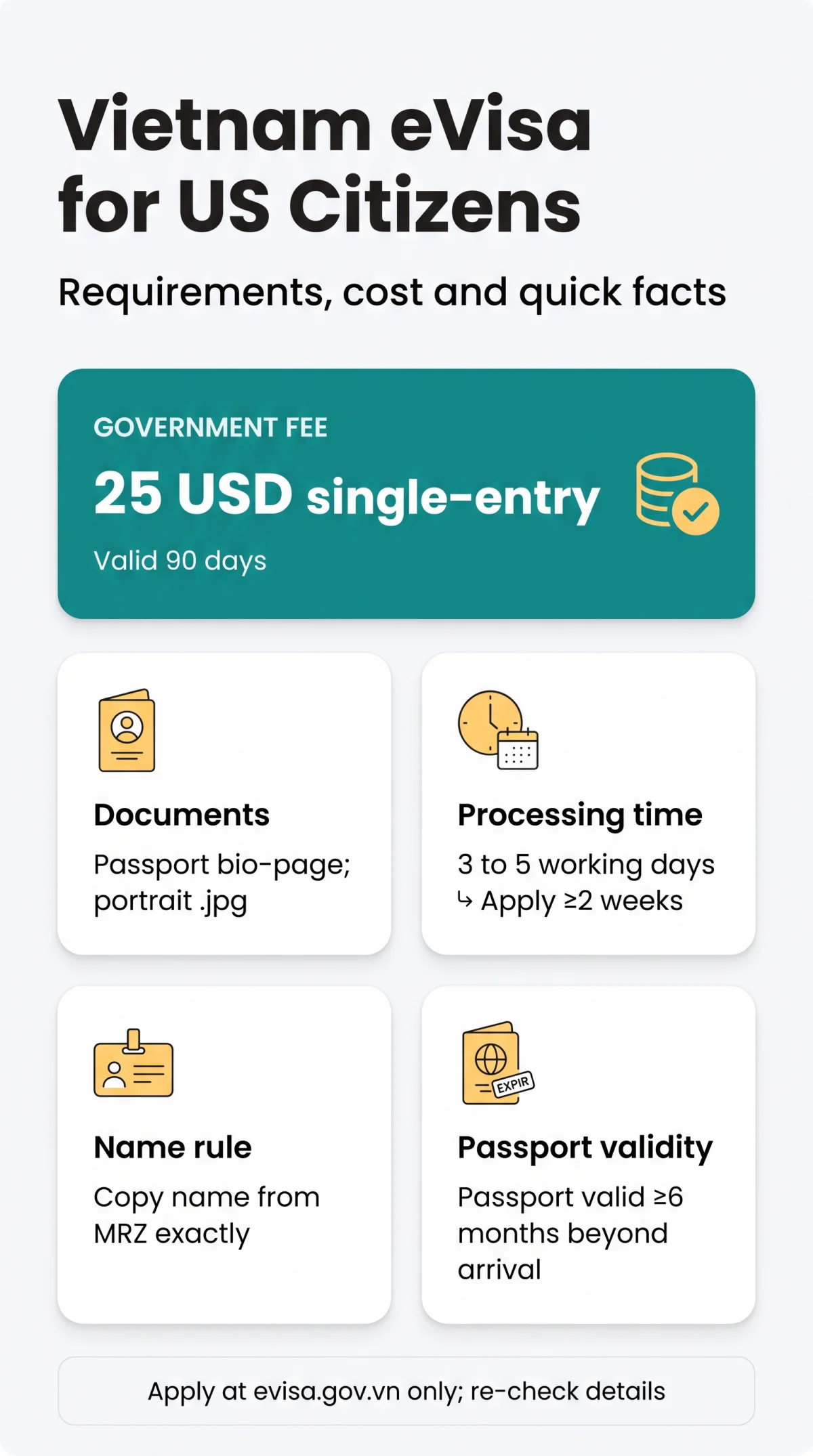
US citizens need a Vietnam eVisa for stays up to 90 days, with single-entry costing 25 USD and multiple-entry 50 USD. Processing takes 3 to 5 working days online, and your passport must be valid for at least six months beyond your arrival date.
This guide walks you through the Vietnam e visa for US citizens end to end: who needs it, what you upload, how to avoid the name and payment traps, and how Vietnam compares with Thailand and Bali. We’re an independent travel information site, not a government agency, and we don’t file applications or charge fees. Apply only through https://evisa.gov.vn/, and re-check details there before you travel.
Who Needs a Vietnam eVisa: US and Australian Passport Holders
Americans and Australians apply online before flying, because there’s no visa-free tourist entry for either nationality; once issued, you can stay up to 90 days.
- You’ll need a passport valid for at least six months from your date of entry, with two blank pages and no physical damage. Enter and exit on the same document.
- Australians holding an APEC Business Travel Card (ABTC) with the “VNM” code on the back can enter visa-free for business trips of up to 60 days.
- The eVisa covers tourism and short business visits.
- Each traveller, including children with their own passports, files a separate application.
The Phú Quốc 30-Day Visa Exemption
Phú Quốc is visa-free for up to 30 days, but only if you arrive directly by air or sea from abroad, or route via Hanoi or Ho Chi Minh City airport, where you clear immigration and continue to the domestic terminal. You must stay on the island, hold a return or onward ticket within 30 days, and carry a passport valid for six months. Leave the island for mainland Vietnam and you’ll need a valid visa.
How to Apply for a Vietnam eVisa: Costs, Timelines, and Form Data
The fee is 25 USD for single entry and 50 USD for multiple entry, non-refundable even if rejected. Standard processing takes 3 to 5 working days, excluding weekends and Vietnamese public holidays, so apply at least two weeks before departure.
| Visa type | Government fee | Processing time | When to apply |
|---|---|---|---|
| Single-entry (90 days) | 25 USD | 3 to 5 working days | At least two weeks before departure |
| Multiple-entry (90 days) | 50 USD | 3 to 5 working days | At least two weeks before departure |
File everything on https://evisa.gov.vn/ or its sister domain https://thithucdientu.gov.vn, in use since 11 November 2024. Commercial agencies charge a service fee on top of the same government fee, and some sites imitate the government portal, so type the address yourself rather than clicking a search ad.
Upload your documents
Passport bio-page scan and a portrait photo (.jpg files)
Enter your details
Contact details and your planned accommodation address
Select your ports
Choose your ports of entry and exit
Save the code and pay online
Status checks need that code, the email you applied with and your date of birth
Your photo needs a plain white background, a front-facing pose, no glasses or headwear, and must be no older than six months. The bio-page scan must show the full page, including the machine-readable ICAO lines at the bottom.
Mistakes in the name fields are a common reason for rejection. Copy your name from the MRZ strip on your passport’s bio page: your surname goes in the Surname field, and your first name and middle name go together in the Given Names field, exactly as in the MRZ. If your middle name appears in the MRZ but you leave it out of the form, airlines compare the eVisa against the MRZ and can deny you boarding.
Fixing Credit Card Payment Failures on the Application Portal
Payments from US and Australian cards often fail because the traveller’s bank declines the international transaction under its payment restrictions or fraud rules. The fee is charged in Vietnamese dong, so expect a currency conversion and possible foreign transaction fee.
Before you retry, authorize the charge in your banking app or tell your bank you’re paying an overseas merchant. If the card keeps failing, someone else can pay the fee on your behalf.
After Submission: Border Gates, Arrival Procedures, and Overstay Risks
Once you’ve paid, the form locks, so a typo in your name, passport number, passport expiry date or date of birth means starting a new application and paying again.

Your eVisa is valid at 83 international checkpoints: 17 airports (two of them, Long Thanh and Gia Binh, only once they start operating), 27 land crossings and 39 seaports. The issued PDF no longer prints a port name, but you are still tied to the entry and exit points you selected, so travel through the checkpoints you declared. Print the visa grant and carry it; border officers check it and stamp your entry, and verify your stamps before leaving the counter.
From 15 April 2026, if you’re landing at Tan Son Nhat airport in Ho Chi Minh City, you are encouraged to complete a digital arrival card online before arrival at prearrival.immigration.gov.vn.
After arrival, your hotel or host declares your stay with the local commune or ward police station on your first night. At customs, declare cash above 15,000,000 VND or 5,000 USD, or the equivalent in other currencies.
eVisas are not extended; normally you exit and apply again, though holders invited or sponsored by an agency, organisation or individual in Vietnam may be considered for a new visa. Overstaying means a fine you must pay before you can leave, and can lead to deportation and a future entry ban.
Vietnam vs Thailand vs Bali: Which Entry Process Suits Your Trip
The three systems work very differently: Vietnam gives you 90 days upfront, Thailand gives 60 days visa-free, and Bali gives 30 days, extendable once online for another 30.
| Destination | Entry document | Cost | Stay length | Extension option |
|---|---|---|---|---|
| Vietnam | eVisa (single or multiple entry) | 25 USD / 50 USD | 90 days | No; exit and reapply (a new visa may be possible with a local sponsor) |
| Thailand | Visa exemption (60 days) | Free | 60 days | Check official Thai immigration guidance |
| Bali (Indonesia) | e-VOA | 500,000 IDR (~35 USD) plus 150,000 IDR tourist levy | 30 days | Yes; one 30-day online extension |
Planning side trips to Bangkok or Ubud from Vietnam? Pay the extra 25 USD for the multiple-entry eVisa so each return doesn’t need a fresh application.
Vietnam’s tourist eVisa does not authorise any work in Vietnam, paid or voluntary; working requires a work permit first. Vietnam has no digital nomad visa, unlike Thailand’s DTV, and no dedicated permit for remote work.
Children with their own passports file their own applications (see above). If a child is not travelling with both parents, US border authorities recommend carrying a signed note from the other parent giving permission, and in custody cases an affidavit from that parent.
Frequently Asked Questions (FAQ)
Do US citizens need an eVisa for Vietnam?
Yes. Americans have no visa-free tourist entry to Vietnam, so you apply for the eVisa online before departure and pay 25 USD for single entry or 50 USD for multiple entry. Download the approved PDF from the portal and carry a printout, because airlines check it at departure and immigration checks it on arrival.
How much does a Vietnam eVisa cost for US passport holders?
The government fee is 25 USD for a single-entry eVisa and 50 USD for a multiple-entry eVisa, paid through the portal’s payment gateway and converted into Vietnamese dong. It is not refunded if the application is refused, and commercial agencies add their own service fee on top of it.
How long does Vietnam eVisa processing take for Americans?
Standard processing is 3 to 5 working days, counted from the moment the Immigration Department has both your application and your payment, and working days follow Vietnamese time, so weekends and Vietnamese public holidays do not count. Apply at least two weeks before departure so a slow review doesn’t clash with your flight.
Can US citizens get a visa on arrival at Vietnam airports?
Not without arranging documents first. Most Americans apply for the eVisa online before departure. A visa on arrival exists, but only for air arrivals at designated airports and only with a pre-approved visa letter obtained beforehand, plus a stamping fee of 25 USD for single entry or 50 USD for multiple entry paid in cash at the airport.
What is the government website to apply for a Vietnam eVisa?
Applications go to the national eVisa portal at evisa.gov.vn or its sister domain thithucdientu.gov.vn, both in use since 11 November 2024. Type the address into your browser yourself: commercial agencies run similar-looking sites and charge a service fee on top of the government fee.
What happens if my middle name is missing on my Vietnam eVisa?
Airlines may refuse boarding if the eVisa does not match the name printed in your passport, so enter first and middle names together in Given Names. Paid forms cannot be edited, so a mismatch means filing and paying again.
Can I extend my 90-day Vietnam eVisa while staying in the country?
No, the eVisa itself is not extended. Normally you leave Vietnam, apply for a new eVisa and re-enter; if an agency, organisation or individual in Vietnam invites or sponsors you, a new visa can be considered while you are in the country. Overstaying brings a fine that must be paid before you can leave the country, and can end in deportation and a future entry ban.
How does the Vietnam eVisa for US citizens compare to Bali’s visa on arrival?
Vietnam gives 90 days upfront for 25 to 50 USD with no in-country extension. Bali grants a 30-day e-VOA for 500,000 IDR plus a 150,000 IDR levy, extendable once online. Vietnam suits longer stays.
Sources and Further Reading
- evisa.gov.vn – the Vietnam national eVisa application portal with fees, photo rules, and the full checkpoint list.
- US Embassy in Vietnam – visa requirements and entry rules explained for American travellers.
- immigration.gov.vn – the national immigration portal covering entry procedures and announcements.
- GOV.UK entry requirements – UK travel advice on passports, customs limits, and arrival procedures.
Rules can change, so confirm details on evisa.gov.vn before your trip.