
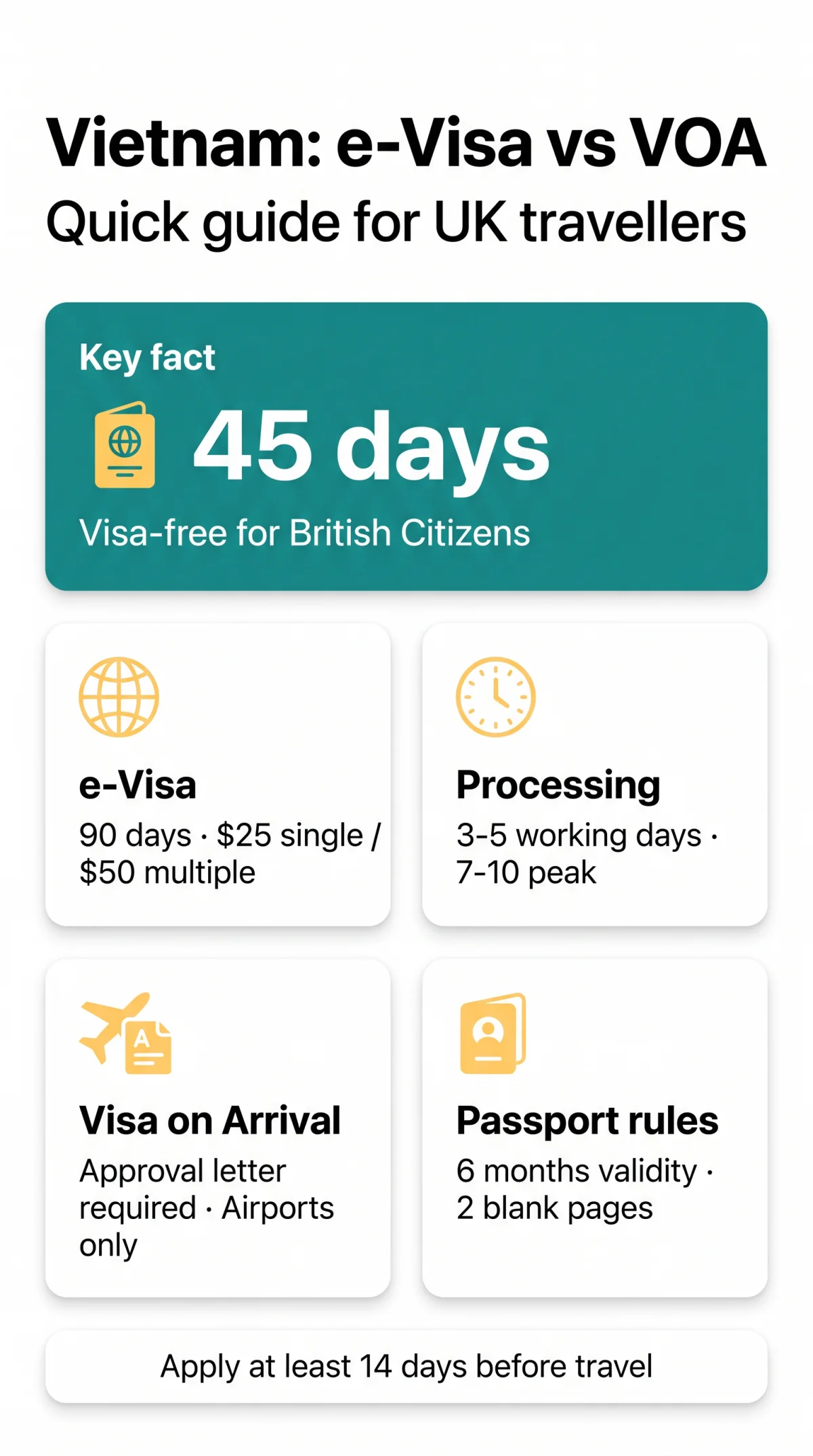
Deciding between the Vietnam e-visa vs visa on arrival (VOA)? Here’s the short answer: the 90-day eVisa is the main route if you need longer than the 45-day visa-free stay. It costs $25 single-entry or $50 multiple-entry, and you apply directly at evisa.gov.vn. It covers 81 air, land and sea checkpoints.
Visa on arrival now needs an approval letter from an accredited Vietnamese sponsor, and the Embassy in London issues consular visas for longer stays. This is an independent guide, not a government site, so confirm current rules on the official portal before you travel.
Do British Citizens Need a Visa for Vietnam?
If you hold a full British Citizen passport, you don’t need a visa for stays up to 45 days. Border officers stamp your passport on arrival, and there’s no fee. The exemption covers tourism and business trips.
You need to meet the conditions, though. Your passport must be valid for at least six months from your entry date, have two blank passport pages, and it must be undamaged – British nationals have been denied entry and exit because of passport damage.
Check the exit date stamped in your passport is 45 days from your arrival – immigration will not change it once you have left the border. If your stay might run past 45 days, arrange an eVisa or a consular visa before you fly.
Warning: the 45-day visa-free stay covers all classes of British nationality except British National (Overseas) passports; BN(O) holders must arrange an eVisa or a consular visa before departure.
E-Visa vs Visa on Arrival: How the Routes Differ
The 90-day eVisa is the primary online route for independent tourists, while commercial VOA is no longer an open alternative. Approval-letter visa on arrival is restricted to organised tours run through a licensed local tour operator, emergency or humanitarian entries, or invitations from Vietnamese authorities.
Here’s how all four routes compare:
| Route | Max stay | Cost | Processing | Entry ports | Best for |
|---|---|---|---|---|---|
| 45-day exemption | 45 days | Free stamp | None | International border gates | Short tourist trips, British Citizen passports |
| 90-day eVisa | 90 days | $25 single / $50 multiple | 3 – 5 working days | 81 air, land and sea gates | Independent travellers, overland routes |
| VOA with approval letter | 1 or 3 months | Agency fee + $25/$50 stamping fee | Depends on agency | Airports only | Licensed tours, emergencies, state invitations |
| Consular visa (London Embassy) | Set by visa category | Depends on visa category | Confirm with the consular section | As issued | Stays over 90 days, work, diplomatic trips |
The decision logic is simple: under 45 days, use the free stamp; up to 90 days, get the eVisa; over 90 days or a work or diplomatic purpose, go through the Embassy.
How to Apply for a Vietnam E-Visa from the UK
You apply online at evisa.gov.vn. The catch: every field locks after payment, so a single typo can cost you the fee.
Required Documents and Form Field Traps
Check your passport
At least 6 months’ validity from entry, valid 30 days beyond your requested eVisa validity, with 2 blank pages.
Scan and photograph
Scan your passport’s biographical page and take a portrait photo (full face, no glasses, no headwear).
Type your full name in capitals
Surname, middle name and given name – exactly as it appears on the ICAO line of your passport.
Add your stay and travel history
Your first declared address of stay in Vietnam and your travel history from the last year.
Pay and submit
Pay $25 single-entry or $50 multiple-entry. The fee is non-refundable, even if your application is rejected.
eVisas are issued to foreigners who are outside Vietnam; if you obtain one while in Vietnam, you must leave and re-enter to start it. If your details don’t match your passport letter-for-letter, the eVisa is not valid and you can be refused entry at the border; you would need a new application and a new fee.
Processing Times and Tracking Your Application
Standard processing takes about 3 to 5 working days, counted in Vietnam’s UTC+07:00 time zone. During peak season it can stretch to 7 – 10 working days, so apply at least two weeks before departure.
You check the result using the search function on evisa.gov.vn. When approval lands, print your approved eVisa and carry it for check-in and border control.
Visa on Arrival: Approval Letters and Airport Stamping
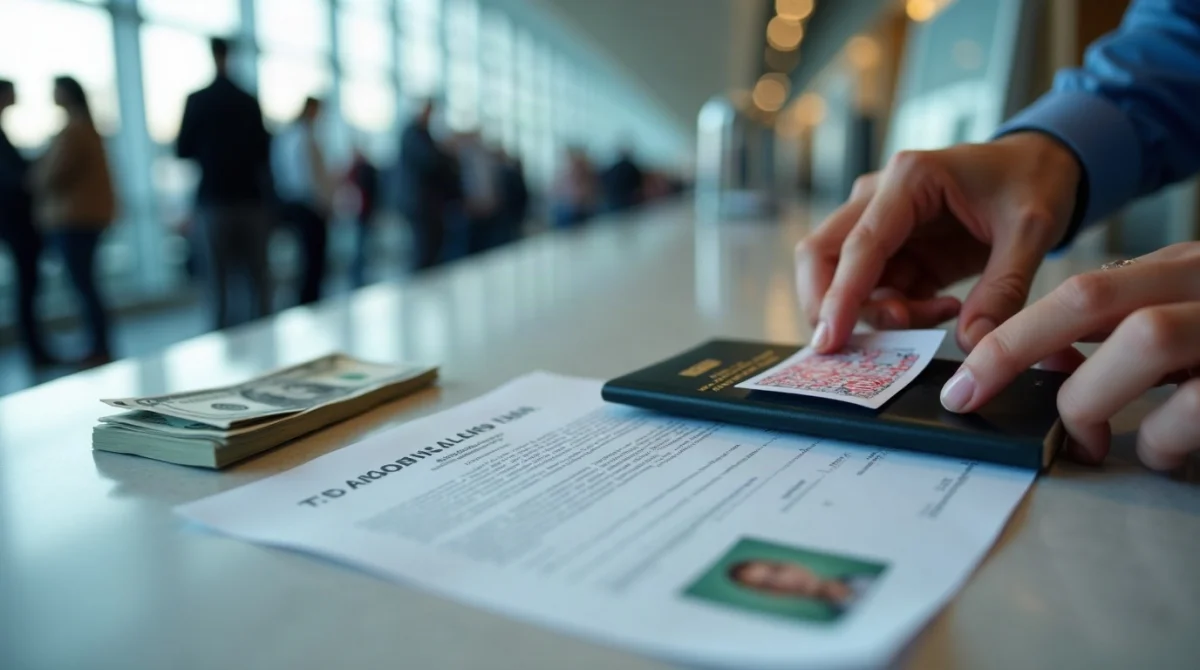
A visa on arrival works in two stages: you secure an approval letter before flying, then pay a stamping fee in cash at the airport. Neither stage is something you can do alone.
Obtaining a Pre-Approval Letter
The letter is issued by the Vietnamese Immigration Department at the request of a sponsor in Vietnam – typically a licensed travel agent or a business host. You give the sponsor your passport details and arrival plans, and they arrange the letter.
Airport Clearance at the Landing Visa Counter
Find the Landing Visa desk
Skip the normal passport queue – it operates at Hanoi, Ho Chi Minh City, Da Nang, Nha Trang, Hai Phong, Phu Quoc and Da Lat airports
Hand over your documents
Passport, printed approval letter, a passport photo and the stamping fee in cash
Wait for processing
About 20 to 40 minutes on average, depending on how many flights have landed at once
Join immigration lanes
The officer affixes the sticker visa in your passport, and you then join the immigration lanes
The cash trap: the stamping fee is $25 single-entry or $50 multiple-entry, paid in cash at the airport counter.
When You Need the Vietnamese Embassy in London
For stays beyond 90 days, work assignments, or diplomatic travel, the Kensington embassy is your route. It issues a physical visa sticker in your passport; confirm the current processing time with the consular section.
You’ll need this route for a stay longer than 90 days, or for a diplomatic or official mission, which falls outside the eVisa. Working in Vietnam also requires a work permit, so start early.
The embassy is the Embassy of the Socialist Republic of Vietnam, 12 – 14 Victoria Road, Kensington, London, W8 5RD, with the consular section at the same address. Check the accepted application method, payment method and current fees with the consular section before you send anything.
Entry Ports, Arrival Formalities and Common Mistakes
Your visa type decides where you can cross the border. An eVisa opens 81 international border gates: 15 airports, 27 land crossings such as Moc Bai and Lao Cai, and 39 seaports for cruise travellers. VOA works at international airports only.
A VOA is not valid at land crossings such as Moc Bai. If you’re touring Southeast Asia overland, you need an eVisa naming that land checkpoint, or a physical consular visa. Your eVisa restricts you to the entry and exit points you select when you apply, and all of them must be on the government’s approved list – you do not have to exit through the gate you entered.
Two formalities sit on top of your visa, not instead of it. Since 15 April 2026 travellers arriving at Tan Son Nhat are encouraged, but not required, to complete the digital arrival card online at prearrival.immigration.gov.vn before arrival; it is a pre-arrival form and does not replace a visa. Separately, you must declare cash at customs if you’re carrying over 15 million Vietnamese dong or 5,000 US dollars (or the same value in other currencies). You must declare temporary residence through the manager of your accommodation, who files it with the local police.
Common Mistakes to Avoid
- Applying within 3 days of your flight and trusting standard processing – peak season runs to 7 – 10 working days.
- Assuming VOA is open to independent tourists – it now needs an accredited sponsor.
- Typing your name differently from the ICAO line of your passport – errors cannot be corrected after payment.
- Arriving without cash for the stamping fee.
- Turning up at a land border with an airport-only VOA.
- Assuming a BN(O) passport gets the 45-day exemption – it doesn’t.
- Applying anywhere other than evisa.gov.vn or thithucdientu.gov.vn: commercial agencies add a service fee on top of the $25/$50 government fee, while sites imitating the state portal may charge unauthorised fees.
Frequently Asked Questions (FAQ)
What is the difference between a Vietnam e-visa and visa on arrival?
The eVisa is issued fully online before you travel and works at 81 checkpoints. VOA needs a pre-arranged approval letter from an accredited sponsor, works at airports only, and involves a cash stamping fee at the landing visa counter.
Is Vietnam visa on arrival still available for UK citizens?
Only in restricted cases: organised tours through a licensed local operator, emergency or humanitarian entries, or invitations from Vietnamese authorities.
How long does a Vietnam e-visa take to process?
Standard processing takes about 3 to 5 working days, but busy periods can stretch it to 7 – 10 working days, so apply at least two weeks before departure.
Can I enter Vietnam overland from Cambodia or Laos?
Yes, but only with the right document. VOA doesn’t work at land borders. You need an eVisa naming your land checkpoint – such as Moc Bai or Lao Bao – or a physical consular visa.
Do BN(O) passport holders qualify for the 45-day visa waiver?
No. The waiver covers all classes of British nationality apart from British National (Overseas), so BN(O) passport holders must arrange an eVisa or a consular visa from the Embassy in London before boarding.
What if there is a spelling mistake on my approved e-visa?
You can’t amend it. All fields lock after payment, so any error invalidates the document. You’ll have to submit a new application, pay the fee again, and wait for fresh approval.
How much does a consular visa cost at the Vietnamese Embassy in London?
Fees depend on the visa category, duration and processing speed. Contact the consular section at 12 – 14 Victoria Road, Kensington, for the current rate for your visa type.
Does the Digital Arrival Card replace a visa at Tan Son Nhat airport?
No. Since 15 April 2026 travellers arriving at Tan Son Nhat are encouraged to complete the digital arrival card online before arrival, but it is not currently mandatory and it is only a pre-arrival form. You still need a valid visa or the 45-day visa-free stay to enter Vietnam.
Sources and Further Reading
- evisa.gov.vn – the Vietnam National Electronic Visa system, where you apply and track your eVisa.
- gov.uk – Vietnam entry requirements – FCDO travel advice covering the 45-day exemption and passport rules.
- evisa.gov.vn FAQ – answers on fees, processing times and application rules.
Rules can change, so confirm details on the official portal before you travel.