

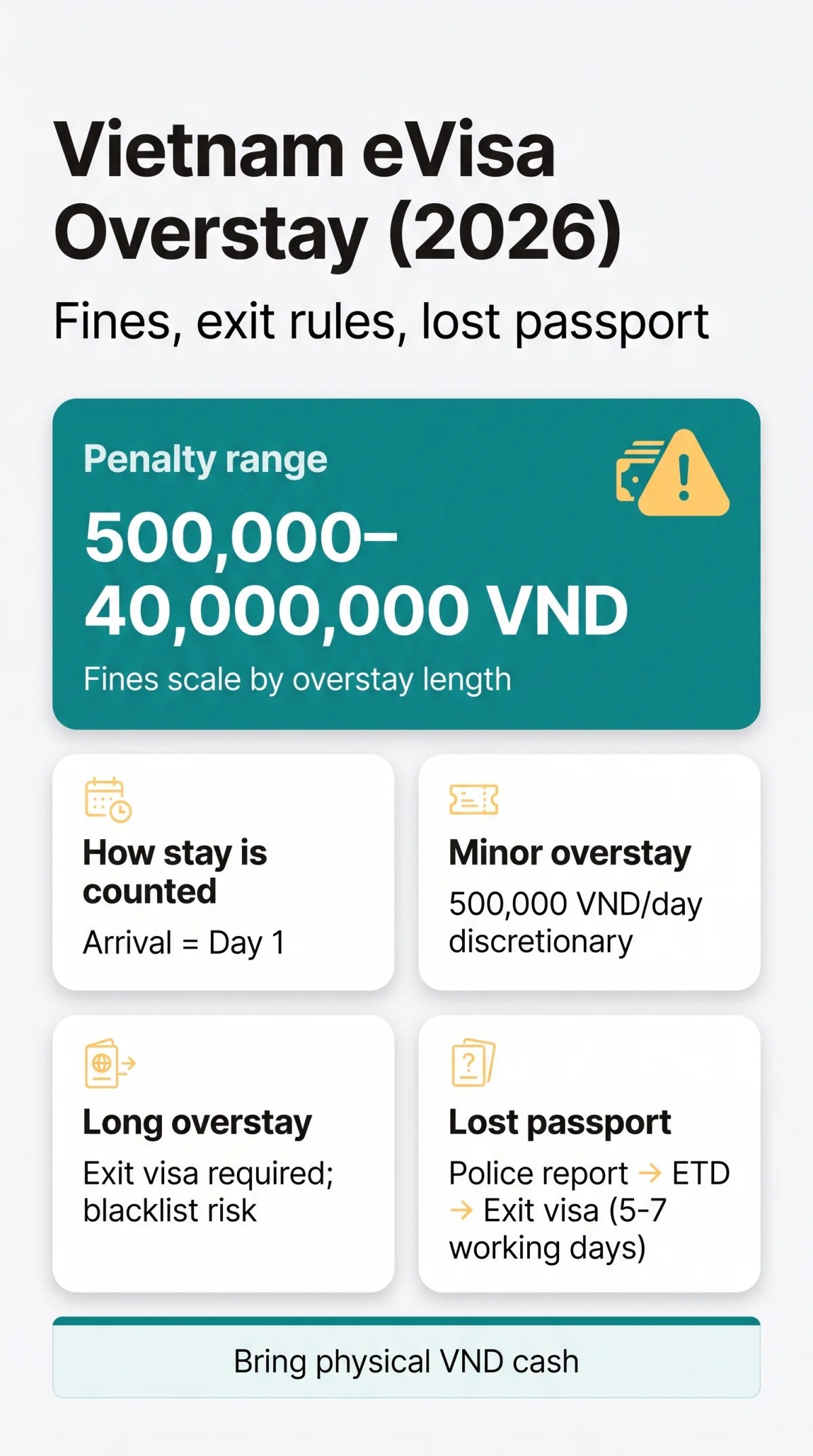
Overstaying a Vietnam eVisa in 2026 carries statutory fines from 500,000 VND up to 40,000,000 VND, plus possible re-entry bans. Delays of one to two days can sometimes be settled in cash with the immigration officer at the airport, but this is at the officer’s discretion. Longer overstays, or a lost passport holding your eVisa, require an exit visa from the Vietnam Immigration Department before you can fly home.
This guide is written for British tourists facing one of these problems or planning a contingency before departure. It’s an independent travel information guide, not a government website, and it doesn’t process applications or charge fees.
How Vietnam Counts Your Permitted Stay
Vietnam counts your stay by calendar day. Check the entry stamp before you leave the immigration desk, because officers occasionally enter a wrong date, and that date is what you will be judged against. Arrival day always counts as Day 1, whatever hour you land.
The Midnight Trap: a late-night arrival still uses up Day 1, so your last permitted day falls one day earlier than travellers often assume.
Two UK-specific traps sit here too. If the officer admits you under the visa exemption rather than on your eVisa, your permitted stay is the exemption period shown on the stamp, not the period on the eVisa, so check current exemption rules before you fly. And a single-entry eVisa is used up once you leave Vietnam, so a side trip to a neighbouring country means you need a new eVisa (or a valid exemption) to come back.
Overstay Fine Tiers in 2026
Fines scale with how long you’ve overstayed. The base ranges come from Decree 144/2021/NĐ-CP, and the upper tiers reflect the increased scale in force from 1 January 2026.
| Overstay duration | Fine range (VND) | Administrative actions |
|---|---|---|
| Up to 15 days | 500,000 – 2,000,000 | Pay fine; beyond two days settle it at an immigration office before flying |
| 16 to 29 days | 5,000,000 – 10,000,000 | Fine plus exit visa |
| 30 to 59 days | Up to 15,000,000 | Exit visa, blacklist risk (rises with length of overstay) |
| 60 to 89 days | Up to 20,000,000 | Exit visa, blacklist risk (rises with length of overstay) |
| 90 days to 6 months | Up to 25,000,000 | Deportation, re-entry ban |
| 6 months to 1 year | Up to 30,000,000 | Deportation, ban 3 – 5 years |
| 1 year or more, or ignoring an exit order | Up to 40,000,000 | Forced deportation, possible permanent ban |
If circumstances beyond your control caused the overstay, bring written evidence and a letter of explanation; a documented reason can help your case for an extension, but it does not guarantee a lower fine.
Minor Overstays: Paying at the Airport
If you’ve overstayed by one or two days, the border counter may let you settle on the spot at roughly 500,000 VND per day, paid to the immigration officer at the airport when you depart. This is discretionary, not an entitlement. From about three days, expect to be sent to an immigration office to pay the fine and, if required, obtain an exit visa, so settle it before your flight rather than at the departure desk.
Long Overstays: Bans and Deportation
Extended overstays bring an immigration blacklist with a re-entry ban of three to five years, or a permanent ban in the most serious cases. Forced deportation is also possible, usually together with a ban on future entry.
How and Where to Pay the Fine
Bring the fine in cash. The penalty is quoted in Vietnamese dong, so have Vietnamese dong with you rather than relying on a card at the counter. For a one or two-day overstay, budget at least 1,000,000 VND.
For overstays beyond two days, report in person to an immigration office. Foreigners’ exit visas are handled by the Immigration Department, so going there directly usually saves time:
Go to the Immigration Department
In Hanoi or Ho Chi Minh City, or to the immigration office of the province where you are staying
Hanoi
Report to 44-46 Tran Phu Street, Ba Dinh District
Ho Chi Minh City
Report to 333-335-337 Nguyen Trai Street, District 1
Bring your documents
Passport, cash, and a letter of explanation for the overstay
Expect the exit visa to take about five to seven working days, so don’t book a flight for the next morning. Extensions for tourist eVisas are limited and usually require a sponsoring organisation; otherwise you must leave Vietnam and apply for a new eVisa on the government eVisa portal evisa.xuatnhapcanh.gov.vn before returning.
Lost Passport with a Valid eVisa: Exit Steps
You can’t leave Vietnam on a replacement UK Emergency Travel Document until you’ve secured a police report and a physical exit visa. A printed eVisa PDF alongside a new ETD isn’t valid for exit, and border control will not clear you for departure without an Exit Visa (thị thực xuất cảnh) issued into the replacement document. Overstay days keep accumulating while you wait, so start immediately.
Step 1: Report the Loss to the Ward Police
Visit the Ward Police station (Công an Phường) with jurisdiction over where the loss occurred or where your hotel is registered. Ask for the Passport Lost Report (Đơn trình báo mất hộ chiếu) with the police stamp, as you will need it for both the embassy and the Immigration Department. Bring hotel staff to help with translation and confirm your temporary residence registration address.
Step 2: Get a UK Emergency Travel Document
Apply to the British Embassy in Hanoi or the Consulate General in Ho Chi Minh City, and check current addresses and appointment rules on GOV.UK. You’ll need the stamped police report and the documents the consulate asks for when you book the appointment. Processing times and fees for emergency travel documents are set by the consulate, so confirm them when you apply.
Step 3: Apply for the Exit Visa at Vietnam Immigration
Submit your application to the Immigration Department in Hanoi or Ho Chi Minh City; immigration offices also operate in cities such as Da Nang and Hai Phong. Bring the issued ETD, the stamped police report, a Diplomatic Note from the UK Embassy or Consulate, a printed copy of your original eVisa, your outbound flight ticket, a copy of your temporary residence declaration, and a letter explaining the loss and the overstay. Processing usually takes about five to seven working days, and the fee is set by the Immigration Department, so do not book a flight before the visa is in your hands.
Common Mistakes That Make Things Worse
- Assuming any short overstay can be paid at the airport. From about three days, expect to settle the fine at an immigration office before you fly, so check your stamp date against your ticket early.
- Turning up without cash. See the payment section above.
- Assuming any immigration office can issue your exit visa. Exit visas for foreigners are handled by the Immigration Department, so check before you queue.
- Trying to fly home on an ETD alone. The exit visa must be in the document first.
- Re-entering Vietnam on a single-entry eVisa after a side trip. The eVisa is spent; you need a new one before returning.
Frequently Asked Questions (FAQ)
How much is the fine for overstaying a Vietnam eVisa by 1 day?
About 500,000 VND for a single day, paid in cash to the immigration officer at the airport as you depart. Officers apply this only at their discretion and normally only if you are leaving straight away; from about three days you should expect to settle the fine at an immigration office first.
Can I pay my Vietnam overstay fine by card at the airport?
Plan on cash. Fines are quoted in Vietnamese dong and paid at the immigration counter, so carry physical VND rather than relying on a card.
What happens if I overstay my Vietnam eVisa by more than 30 days?
Fines reach 15,000,000 VND for 30 to 59 days and climb to 25,000,000 VND or more for overstays of 90 days and longer, and you must obtain an exit visa from the Immigration Department before you can leave. You’ll also likely be blacklisted with a re-entry ban of three to five years.
Will UK travel insurance cover my Vietnam overstay fine?
Whether a policy covers an immigration fine depends on its terms, so read the wording before relying on it. Keep written evidence of any circumstances beyond your control, such as a medical certificate, as it can support your case with the Immigration Department.
Can I leave Vietnam on a UK Emergency Travel Document without an exit visa?
No. Border control will not clear you for departure if you present an ETD without a physical Exit Visa (thị thực xuất cảnh) issued by the Vietnam Immigration Department. A printed eVisa PDF isn’t enough.
How do I get the police loss report for a lost passport in Vietnam?
Visit the Ward Police station (Công an Phường) covering your registered accommodation and ask for the Passport Lost Report (Đơn trình báo mất hộ chiếu) with the police stamp. Bring hotel staff to translate.
How many days before expiry should I leave Vietnam to avoid overstaying?
Make sure you are through the exit desk before your permitted stay ends. A flight just after midnight on the final day counts as an overstay, so leave a clear buffer for delays.
Is there a grace period for an overstayed Vietnam eVisa fine in 2026?
No. Vietnamese immigration law provides no formal grace period, so every day beyond your permitted stay is a violation. Lenient treatment of a one-day overstay is entirely at the officer’s discretion.