
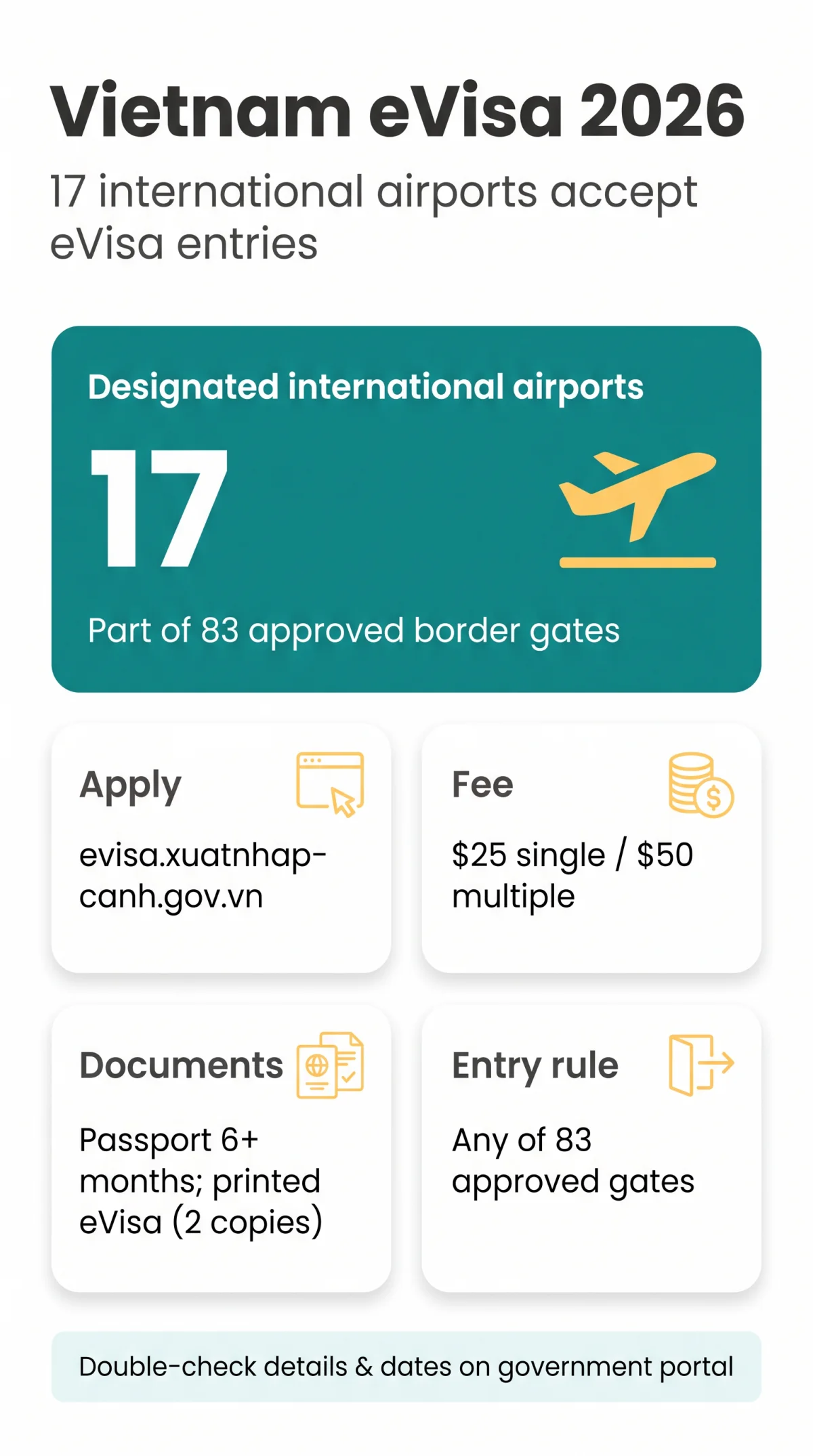
In 2026, Vietnam accepts eVisa entries at 17 designated international airports among 83 approved border gates under Resolution No. 389/NQ-CP, dated 2 December 2025. The full list of vietnam ports of entry accepting evisa 2026 is below, and you can land at any approved airport even if your application said otherwise. With a printed eVisa and a valid passport, you go straight to passport control.
This guide is written for UK travellers planning long-haul trips to Vietnam. We’re an independent travel guide, not a government body – you apply yourself at the government portal evisa.xuatnhapcanh.gov.vn, and before you fly, double-check your details and dates there.
Complete List of eVisa Airports in Vietnam
Under Resolution No. 389/NQ-CP (dated 2 December 2025), Vietnam expanded its eVisa network to 83 border gates, including 17 international airports. Lists mentioning 42 or 33 ports come from older regulations and are outdated. Thirteen of the 17 are existing, operating airports; four were added by Resolution 389/NQ-CP.
| Airport | IATA code | City / Region | Status |
|---|---|---|---|
| Noi Bai | HAN | Hanoi | Existing eVisa border gate |
| Tan Son Nhat | SGN | Ho Chi Minh City | Existing eVisa border gate |
| Da Nang | DAD | Da Nang | Existing eVisa border gate |
| Cam Ranh | CXR | Nha Trang | Existing eVisa border gate |
| Phu Quoc | PQC | Phu Quoc Island | Existing eVisa border gate |
| Cat Bi | HPH | Hai Phong | Existing eVisa border gate |
| Can Tho | VCA | Can Tho (Mekong Delta) | Existing eVisa border gate |
| Phu Bai | HUI | Hue | Existing eVisa border gate |
| Van Don | VDO | Quang Ninh | Existing eVisa border gate |
| Lien Khuong | DLI | Da Lat | Existing eVisa border gate |
| Tho Xuan | THD | Thanh Hoa | Existing eVisa border gate |
| Dong Hoi | VDH | Quang Binh | Existing eVisa border gate |
| Phu Cat | UIH | Quy Nhon | Existing eVisa border gate |
| Vinh | VII | Nghe An | Added by Resolution 389/NQ-CP |
| Chu Lai | VCL | Chu Lai (central Vietnam) | Added by Resolution 389/NQ-CP |
| Long Thanh | Dong Nai (near HCMC) | Eligible once it comes into operation | |
| Gia Binh | Bac Ninh | Eligible once it comes into operation |
For most UK travellers the practical choice comes down to HAN, SGN, DAD or CXR.
Can You Land at a Different Airport Than Stated on Your Application?
Yes, you can. The 2026 eVisa PDF no longer prints a port of entry field, so you may enter through any of the approved airports, or even an approved land border, without filing a new application. One limit applies: an eVisa is only valid at the 83 designated border gates, so your route must land at one of them.
What to Hand Over at the Counter
Keep two things ready: your passport, valid for at least six months beyond your entry date with two blank pages, and a printed hard copy of your eVisa PDF – two copies are recommended. At the border gate you only need your passport and the printed eVisa.
The eVisa fee – $25 single-entry, $50 multiple-entry – is paid online when you apply.
Bypass the Landing Visa Counter
The Landing Visa / Visa on Arrival desk is for travellers arriving with a visa-on-arrival approval letter; with an eVisa you go straight to passport control.
Disembark and follow signs to Immigration
Walk past the Landing Visa / VOA desk without stopping
Join the lanes marked “Foreign Passports”
Hand over your passport and printed eVisa for stamping
Collect your bags and clear customs
Can You Use the Autogates?
Plan for a staffed counter. The standard eVisa procedure is to join the lanes marked “Foreign Passports” and present your passport and printed eVisa to an officer, so allow time for the staffed lanes rather than counting on an automated gate.
Arrival Guides for the Major Hubs
Noi Bai International Airport (HAN), Hanoi
The airport sits about 18 km from the city centre. Pick the general Foreign Passports lane with your eVisa in hand; after stamping, you continue to baggage reclaim and then customs.
Tan Son Nhat International Airport (SGN), Ho Chi Minh City
This is one of the airports with the largest operating capacity in Vietnam, so plan your patience. The officer verifies your eVisa QR code, stamps your passport, and sends you to baggage reclaim and customs.
Da Nang International Airport (DAD)
The same document check applies: printed eVisa plus passport.
Cam Ranh International Airport (CXR), Nha Trang
Cam Ranh is a designated eVisa border gate for Nha Trang; the document check is identical to the larger hubs – printed eVisa plus passport.
Regional Airports, Transit and Mistakes to Avoid
The smaller regional airports accept standard eVisas too, with a few quirks worth knowing before you book.
Phu Quoc, Cat Bi and Other Regional Entry Points
Phu Quoc International Airport (PQC) has a special rule: you can stay on the island for up to 30 days without a visa, provided you remain there for the whole of your stay. The moment you plan to continue to mainland Vietnam, you must hold a valid eVisa before landing.
Cat Bi International Airport (HPH) sits just 5 km from Hai Phong city centre and serves as a gateway to Ha Long Bay. Can Tho (VCA) and Phu Bai / Hue (HUI) are low-volume regional entry points – queues are short, but international routes are limited.
Connecting Flights: The First Port of Entry Rule
If your itinerary is London → Ho Chi Minh City → Da Nang, you clear immigration and customs at SGN, your first port of landing. Check with your airline how your checked bags are handled on the domestic leg, and plan for the full sequence.
Clear immigration at the first international airport
Collect your checked luggage from the international carousel
Exit through customs with your bags
Transfer to the domestic terminal and re-check your bags
Common Mistakes and Border Rejections
| Mistake | What happens at the border | How to fix it |
|---|---|---|
| Entry stamp shows a shorter stay than your eVisa | Your permitted stay is shorter than the validity shown on your eVisa (up to 90 days) | Check the “admitted until” date before leaving the counter; ask for a correction on the spot |
| Wrong passport number, name, date of birth, nationality, passport expiry or visa dates on the eVisa | Cannot be corrected after issuance – the data must match your passport exactly | Submit a new application – these fields can’t be edited after issuance |
| Different arrival airport or changed hotel address | Nothing – these don’t affect entry validity | No action needed |
| Applying around Tet (Lunar New Year) | Processing pauses; your visa may not arrive in time | Apply two to four weeks before your planned arrival date |
How and Where to Apply
You can apply yourself at the government portal evisa.xuatnhapcanh.gov.vn and pay only the government fee. Agencies charge a service fee on top of it; watch out for sites that imitate the official portal. The fee is $25 single-entry or $50 multiple-entry, non-refundable, paid by card online.
Standard processing takes 3 working days, excluding weekends and Vietnamese public holidays, though rare Ministry of Public Security reviews can extend this to 15 working days. You’ll need a passport scan (ICAO lines visible, JPG under 2MB), a digital portrait photo on a white background (4×6 cm, under 2MB), your card, your first accommodation details, and your entry history for the past year, including any earlier entries on a different passport.
Frequently Asked Questions (FAQ)
Which airports in Vietnam accept the eVisa in 2026?
Seventeen international airports are designated under Resolution 389/NQ-CP – 13 existing, operating airports plus four added by the resolution. The main hubs are Hanoi (HAN), Ho Chi Minh City (SGN), Da Nang (DAD), Cam Ranh (CXR), Phu Quoc (PQC), Cat Bi (HPH), Can Tho (VCA) and Phu Bai (HUI), plus regional airports like Van Don and Da Lat.
Can I enter Vietnam at a different airport than the one listed on my eVisa?
Yes. The 2026 eVisa PDF doesn’t print a port of entry field, so you’re free to land at any of the approved airports or land borders. The only restriction: the checkpoint must be on the approved list of 83 border gates.
Do I need to pay a stamping fee in cash upon landing with an eVisa?
No. The eVisa fee – $25 for single entry or $50 for multiple entry – is paid by card when you submit the application on the government portal, and it is non-refundable. You arrive with your passport and printed eVisa and present them at passport control.
Where do I go after landing: the Landing Visa desk or Passport Control?
Head for passport control and join the lanes marked “Foreign Passports”. The Landing Visa / Visa on Arrival desk is there for travellers arriving with a visa-on-arrival approval letter, so with an eVisa in hand you do not need to stop at it.
Can British tourists use automated e-gates on arrival in Vietnam?
The eVisa arrival procedure runs through the staffed lanes marked “Foreign Passports”, where an officer checks your passport and printed eVisa. Plan for a staffed counter rather than an automated gate when you estimate your arrival time.
How does domestic transit work if my flight connects in Hanoi or Ho Chi Minh City?
You clear immigration and customs at your first landing airport. After stamping, collect your checked bags, walk through customs, then transfer to the domestic terminal to re-check them.
What should UK passport holders check on their entry stamp?
Check the “admitted until” date on your entry stamp before leaving the counter and compare it with the validity shown on your eVisa; if it differs, ask for a correction on the spot.
Do I need an eVisa if I fly directly to Phu Quoc International Airport?
You can spend up to 30 days on Phu Quoc without a visa as long as you remain on the island for your entire stay. If you plan to travel on to mainland Vietnam, you need a valid eVisa before you land.
Sources and Further Reading
- List of eVisa ports (PDF, 2019) – an archival government list of 33 border gates, superseded by Resolution 389/NQ-CP.
- Viet Nam expands list of ports for e-visa – the government announcement covering Resolution No. 389/NQ-CP and the 83 approved border gates.
Rules can change, so check the government portal before you travel.